Alison Weir - Captive Queen
Здесь есть возможность читать онлайн «Alison Weir - Captive Queen» весь текст электронной книги совершенно бесплатно (целиком полную версию без сокращений). В некоторых случаях можно слушать аудио, скачать через торрент в формате fb2 и присутствует краткое содержание. Год выпуска: 2010, ISBN: 2010, Издательство: BALLANTINE, Жанр: Историческая проза, на английском языке. Описание произведения, (предисловие) а так же отзывы посетителей доступны на портале библиотеки ЛибКат.
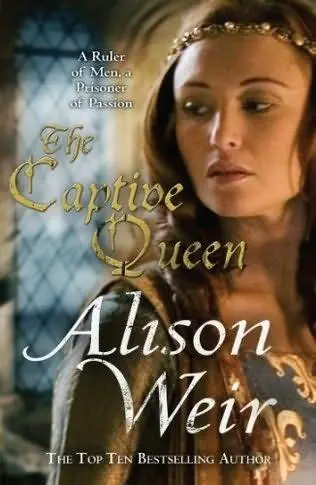
- Название:Captive Queen
- Автор:
- Издательство:BALLANTINE
- Жанр:
- Год:2010
- ISBN:978-0-345-52195-8
- Рейтинг книги:3 / 5. Голосов: 1
-
Избранное:Добавить в избранное
- Отзывы:
-
Ваша оценка:
Captive Queen: краткое содержание, описание и аннотация
Предлагаем к чтению аннотацию, описание, краткое содержание или предисловие (зависит от того, что написал сам автор книги «Captive Queen»). Если вы не нашли необходимую информацию о книге — напишите в комментариях, мы постараемся отыскать её.
Renowned for her highly acclaimed and bestselling British histories, Alison Weir has in recent years made a major impact on the fiction scene with her novels about Queen Elizabeth and Lady Jane Grey. In this latest offering, she imagines the world of Eleanor of Aquitaine, the beautiful twelfth-century woman who was Queen of France until she abandoned her royal husband for the younger man who would become King of England. In a relationship based on lust and a mutual desire for great power, Henry II and Eleanor took over the English throne in 1154, thus beginning one of the most influential reigns and tumultuous royal marriages in all of history. In this novel, Weir uses her extensive knowledge to paint a most vivid portrait of this fascinating woman.
Captive Queen — читать онлайн бесплатно полную книгу (весь текст) целиком
Ниже представлен текст книги, разбитый по страницам. Система сохранения места последней прочитанной страницы, позволяет с удобством читать онлайн бесплатно книгу «Captive Queen», без необходимости каждый раз заново искать на чём Вы остановились. Поставьте закладку, и сможете в любой момент перейти на страницу, на которой закончили чтение.
Интервал:
Закладка:
Henry was frowning, but he was immovable.
“You may go where you will,” he said. “I will make the arrangements.”
34
Woodstock and Oxford, 1166
It was cold in the wilds of Oxfordshire, and there was a promise of snow in the leaden air. The sky was lowering, the skeletal trees bending before the icy wind. Eleanor sat huddled in her litter, her swollen body swathed in furs, aware that she should find some place of shelter soon, for it could not be long now before this babe was ready to greet the world.
Poor child, she thought: it had been conceived in sorrow and would be born in bitterness, for Henry had let her go without a protest, and she’d had no word from him since. He was angry at her defiance, of that there could be no doubt, but she still maintained adamantly that she had a just grievance: the thought of Young Henry having Richard’s inheritance was an open wound that would not heal.
She was weary of the ceaseless jostling with Henry for autonomy in her own lands, enraged with him for slighting her adored boy, and tortured by the crumbling of their marriage. It was a relief to be away from him, and yet … and yet, for all that, she missed him, wanted him, needed him … The pain was relentless. She tortured herself with speculation about the possibility that she had been supplanted by another woman. There was no proof, nothing at all, but what else could have caused such a change in his manner toward her? Had he simply ceased to care for her?
She rested her head back on the pillows. It was no good tormenting herself with these disturbing thoughts—it was not beneficial for her, in her condition. She must think of her coming child.
They had been making for Oxford, hoping to get there by dusk, before the snow fell, but their battle with the elements delayed them, and the Queen now had no choice but to order that they divert to Woodstock for the night. The royal hunting lodge was a favorite residence of Eleanor’s; she had a suite of rooms there, and was hoping the steward would have kept them in a habitable condition. She did not think she could face freezing chambers, an unaired bed, or damp sheets; what she needed right now was a roaring fire, warming broth, a feather bed, and the ministrations of her women. She was weary to her bones.
At last the litter was trundled across the drawbridge, the men-at-arms clip-clopping on either side. As the little procession drew to a standstill, Eleanor parted the leather curtains of her litter, allowed her attendants to assist her to her feet—and then gaped in astonishment. For she saw that Woodstock now boasted a new, fair tower of the finest yellow stone. It was perhaps only to be expected, for Henry had been indefatigable in improving or rebuilding the royal residences, and he had spent much time doing so not long ago. What was surprising was what lay before it, nestling within the curtain walls. It was some kind of enclosed garden—indeed, the most curious of pleasaunces—and it certainly had not been here when she last visited. She walked heavily toward it, almost in a daze. Henry had been here for much of last winter and spring, she remembered. Had he gone to the trouble of ordering it planted for her, for some future visit? And that tower? Was that for her too?
She soon saw that the pleasaunce was in fact a labyrinth, laid out in a circular design with young yews and briars; a paved path disappearing into its depths could be glimpsed at the entrance. The maze was not large, but it looked enticing, even magical—and not a little sinister—in the light of the torches carried by her people against the deepening dusk. Had Henry gone to the trouble of having this intricate thing laid out just for her? How strange! He had had no idea that she would come here in the foreseeable future.
There was a grassy path skirting the labyrinth; one branch of it led to the tower, the other to the older hall with the King’s and Queen’s solars above, but Eleanor walked past that one. She had noticed a light in the tower, at one of the upper windows; it was flickering behind grisaille glass, such as that usually found only in great churches. Could some personage of importance be lodging here? Or, more likely, was some servant about his or her duties? That would account for the light.
Suddenly, a door opened and the steward materialized breathlessly out of the gathering darkness. His face was red, his manner flustered.
“My lady, welcome, welcome!” he cried, bowing hastily. “We had no idea you were coming. I will make all ready. I pray you, come in and get warm.” He indicated that Eleanor should go before him into the large room at the base of the solar block, but she swept on.
“In a moment, I thank you. But first, I have a mind to see that impressive new tower,” she told him.
His face blanched. “Madame, I should not advise it. It is, er, unfinished, and may not be safe.”
“Someone is up there!” Eleanor pointed, and strode in ungainly fashion toward the studded wooden door at the base of the tower.
“My lady!” the steward protested, but she ignored him.
“Open the door!” she commanded. Unhappily, he did as he was bidden, and the Queen brushed past him and began climbing the spiral stairs. She was out of breath by the time she reached the first-floor chamber and had to stop for a few moments, her hand resting on her swollen belly. Clearly, there was no one on this story, and the steward had spoken the truth: the tower was as yet unfinished. Half-completed murals adorned the lime-washed walls; the wooden floor was stacked with ladders, crocks of paint, brushes, and stained rags.
When she had rested a bit, she took the stairs to the next level, a vaulted storeroom containing several iron-bound chests, some stools, and very little else. No one here either. Determined to satisfy her curiosity, she dragged herself up to the topmost story, panting determinedly, and found herself outside a narrow wooden door. Light streamed from beneath it.
Eleanor took a deep breath and depressed the latch. The door swung open to reveal a pretty domestic scene. The room was warm, heated by the coals in a glowing brazier. An exquisitely beautiful young girl was sitting before a basin of chased silver, humming as she washed herself with a fine holland cloth by the dancing light of many wax candles. She wore only a white chemise, draped around her waist, exposing her upper body. In the instant before the startled nymph gasped and covered herself, Eleanor’s shrewd eyes took in the small, pink-tipped breasts, the long, straw-colored tresses, the firm, slender arms, and the damp, rose-petal skin.
“Who are you?” she asked, aghast, already dreading the answer.
“I am Rosamund de Clifford, madame,” the girl said, her expression guarded. She had no idea who this intruder was; the woman was bundled up in a thick cloak, and the white wimple beneath it, although fine, was of a type worn by many middle-and upper-class matrons.
“And what is your business here?” Eleanor could not help her hectoring tone. She had to know who—and what—this young female was.
“I live here by order of my Lord the King,” Rosamund answered, a touch defensively. “May I ask who it is who wishes to know?”
Eleanor could not speak. Her heart was racing in horror. Was this child—for she could be no more than that—the reason for Henry’s strange, distant behavior? Had he installed her here as his mistress? Or—her mind raced on—was this Rosamund some bastard child of his?
“I am Queen Eleanor,” she said, her voice sounding far more confident than she felt, and was gratified to see the girl gather her shift about her and drop hurriedly into an obeisance.
“My lady, forgive me,” she bleated.
Keeping her on her knees, Eleanor placed one finger under Rosaimund’s chin and tilted it upward, daring her to meet her eye, but the young chit would not look directly at her.
Читать дальшеИнтервал:
Закладка:
Похожие книги на «Captive Queen»
Представляем Вашему вниманию похожие книги на «Captive Queen» списком для выбора. Мы отобрали схожую по названию и смыслу литературу в надежде предоставить читателям больше вариантов отыскать новые, интересные, ещё непрочитанные произведения.








Обсуждение, отзывы о книге «Captive Queen» и просто собственные мнения читателей. Оставьте ваши комментарии, напишите, что Вы думаете о произведении, его смысле или главных героях. Укажите что конкретно понравилось, а что нет, и почему Вы так считаете.