Alison Weir - Captive Queen
Здесь есть возможность читать онлайн «Alison Weir - Captive Queen» весь текст электронной книги совершенно бесплатно (целиком полную версию без сокращений). В некоторых случаях можно слушать аудио, скачать через торрент в формате fb2 и присутствует краткое содержание. Год выпуска: 2010, ISBN: 2010, Издательство: BALLANTINE, Жанр: Историческая проза, на английском языке. Описание произведения, (предисловие) а так же отзывы посетителей доступны на портале библиотеки ЛибКат.
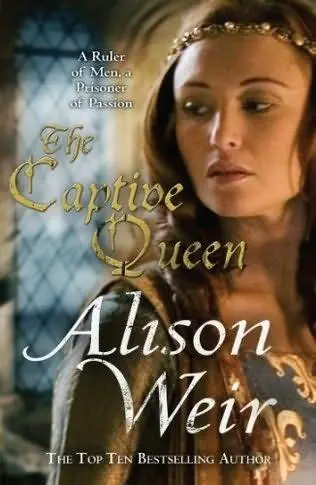
- Название:Captive Queen
- Автор:
- Издательство:BALLANTINE
- Жанр:
- Год:2010
- ISBN:978-0-345-52195-8
- Рейтинг книги:3 / 5. Голосов: 1
-
Избранное:Добавить в избранное
- Отзывы:
-
Ваша оценка:
Captive Queen: краткое содержание, описание и аннотация
Предлагаем к чтению аннотацию, описание, краткое содержание или предисловие (зависит от того, что написал сам автор книги «Captive Queen»). Если вы не нашли необходимую информацию о книге — напишите в комментариях, мы постараемся отыскать её.
Renowned for her highly acclaimed and bestselling British histories, Alison Weir has in recent years made a major impact on the fiction scene with her novels about Queen Elizabeth and Lady Jane Grey. In this latest offering, she imagines the world of Eleanor of Aquitaine, the beautiful twelfth-century woman who was Queen of France until she abandoned her royal husband for the younger man who would become King of England. In a relationship based on lust and a mutual desire for great power, Henry II and Eleanor took over the English throne in 1154, thus beginning one of the most influential reigns and tumultuous royal marriages in all of history. In this novel, Weir uses her extensive knowledge to paint a most vivid portrait of this fascinating woman.
Captive Queen — читать онлайн бесплатно полную книгу (весь текст) целиком
Ниже представлен текст книги, разбитый по страницам. Система сохранения места последней прочитанной страницы, позволяет с удобством читать онлайн бесплатно книгу «Captive Queen», без необходимости каждый раз заново искать на чём Вы остановились. Поставьте закладку, и сможете в любой момент перейти на страницу, на которой закончили чтение.
Интервал:
Закладка:
32
Chinon, 1166
The court was staying at the Fort St. George, Henry’s magnificent castle of Chinon, which straddled a high spur above the River Vienne, when both the King and Queen sickened. Eleanor knew very well what was causing the familiar nausea: she was pregnant for the eleventh time, made fruitful with the seed planted that tragic night at Angers, the night when she realized that she had lost Henry in all the ways that were most important to her. Since then, matters had not improved between them, and now it seemed that there was an unbreachable distance. They still observed the courtesies, and they talked like civilized beings; he had frequented her bed on several nights, but it was like coupling with a stranger. She knew he sensed her withdrawal from him, a retreat less tactical than instinctive, born of the need to protect herself. She told herself that love was not essential in a royal marriage: she was Henry’s wife and queen; she was Eleanor, Duchess of Aquitaine, Queen of England, Duchess of Normandy, Countess of Anjou and Maine. She was undefeatable, a match for any light-of-love to whom her lord might take a passing fancy. She dared not let the facade drop; she must think of herself as invincible.
Henry appeared not to be troubled by her studied amenity; she believed he welcomed it, for it absolved him of any need to put things right. There was no point in him trying to do that if his heart wasn’t in it. She did not want him to play a role for her: she needed his honesty, but she was damned if she would probe for it, for she feared to provoke any painful revelations. But now, here she was, pregnant with his child once more, another reason why the pretense that all was well must be maintained. And she must tell him her news.
She came upon him in their solar as he sat stitching a tear in his hunting cloak, and sat beside him on the wooden settle, struggling to suppress the rising bile in her throat. The thought of the coming months depressed her: she was weary of childbearing, had suffered it too often. She was forty-four, and she’d had enough. This, she vowed, would be the final time.
“I am to have another child, Henry,” she announced quietly. He paused in his mending.
“You are not pleased,” he said.
“If I spoke the truth, no. However, it is God’s will, and I must make the best of it. But I pray you, let this be our last child.” She looked at him as she spoke, but he would not meet her eyes. “You understand my meaning,” she persisted, her heart breaking. She had the horrible, sinking feeling that she was closing a door forever—and perhaps closing it prematurely.
Henry did not answer. The needle flew in and out.
“Henry?”
“It’s your decision,” he said.
“Do you care?” she ventured, thinking that she might as well be dead, and knowing she was about to shatter the fragile equilibrium between them.
Now he did raise his head and look at her. His eyes were guarded, his expression unreadable. There was a slight flush on his bristled cheeks; was it anger? That would be something … Surely he would not agree, uncomplaining, to what she asked. As her husband, he could insist on claiming his rights—and who knew, a miracle could happen and they might recapture the joy they had shared. She would endure ten more pregnancies for that, if he would just intimate, by one word, that he still wanted her.
“It’s your decision,” he said again, turning back to his handiwork. “You’re the one who has to bear the children. Whether I care or not is beside the point.”
“Are you accusing me of deliberately ignoring your needs?” Eleanor cried, forgetting her resolve to maintain a gentle and dignified detachment.
“I’m saying I don’t need this at this time!” Henry snarled. “I’ve got Thomas threatening to excommunicate me and proclaiming to the whole of Christendom that my Constitutions of Clarendon are unlawful. There’s trouble in Brittany, where my vassal, Count Conan, is unable to keep order, and your Aquitainian lords are up to their usual tricks. I’m not feeling well, Eleanor, in fact I’m feeling bloody awful, and you choose this moment to tell me you don’t want to sleep with me anymore!”
Relief flooded through her. He was ill. That explained much. Maybe things were not so bad after all. Then the implications of his being ill hit her like a blow.
“You are ill?” she echoed. “Why didn’t you tell me, Henry? What is wrong?”
“I feel sick to my bones,” Henry said, glad to be able to offer Eleanor an explanation—albeit a temporary one—for his coolness toward her; he could never have admitted that he no longer loved her as he had, that there was a new love in his life now. Overburdened by cares as he was, the sweet image of Rosamund remained with him constantly, his longing for her a continual ache in his loins. If that was a sickness, then yes, he was ill. But there was more to it than that.
Thomas was threatening him with anathema. Flippant as Henry could be in regard to religion, he still feared eternal damnation, and of being cast out from the communion of the Church. Where would that leave him as a ruler who held dominion over all the territories from Scotland to Aquitaine? When a man was excommunicated, all Christians were bound to shun him; he could not receive the Blessed Sacrament, or any of the consolations of his faith. He would be as a leper.
He knew, though, that it was forbidden to excommunicate a man who was sick. The Church, in her wisdom and mercy, held that the sick were weak in judgment and incapable of rational thought. It would make good sense, therefore—for so many reasons—to take to his bed and feign illness.
So he took to his bed, and had it given out that he was laid low by a mysterious malady. He even fooled his doctors, groaning and rolling his eyes in mock pain as they approached. A mystery illness indeed, they agreed, conferring privately among themselves. Had they not seen the King in such evident discomfort they would have said there was nothing wrong with him.
Eleanor was at her wits’ end. Henry had not thought fit to take her into his confidence, so she was terrified of him dying, and distraught at the doctors’ failure to cure him. When she came to sit beside him, he affected to be all but comatose, suffering her ministrations in silence and wishing she would go away. Nothing further had been said by either of them on the subject of their quarrel: the issue remained unresolved, although, a thousand times each day, Eleanor crucified herself for what she had said. She made bargains with God; she demanded that He heal Henry; and when He had done that, she beseeched Him to make things right between them. Daily, on her knees, she nagged, pleaded with, and bullied Him as if He were one of her subjects.
Henry had lain abed for two months, and Eleanor was beginning to lose all hope of his recovery, and to worry if Young Henry was ready for the heavy task of ruling the empire, when news came from Vézelay.
“Becket has excommunicated all those who formulated the Constitutions of Clarendon,” announced the Empress, who, frail as she was, had traveled from Rouen to be with her ailing son. Wearily, she climbed the stairs to the Queen’s bower to convey the latest tidings to her exhausted daughter-in-law.
Eleanor swayed. It had come, this news they had all dreaded, the fear of which—she had begun to suspect—was one of the causes of Henry’s malady.
“Sit down, Eleanor!” the Empress commanded. “You must think of the child you carry, and take comfort from the fact that Henry is not included with the rest, on account of his illness. Even Becket did not dare to go so far.”
“Thanks be to God,” Eleanor breathed fervently, collapsing onto a stool with relief. “We must tell Henry at once.”
Читать дальшеИнтервал:
Закладка:
Похожие книги на «Captive Queen»
Представляем Вашему вниманию похожие книги на «Captive Queen» списком для выбора. Мы отобрали схожую по названию и смыслу литературу в надежде предоставить читателям больше вариантов отыскать новые, интересные, ещё непрочитанные произведения.










Обсуждение, отзывы о книге «Captive Queen» и просто собственные мнения читателей. Оставьте ваши комментарии, напишите, что Вы думаете о произведении, его смысле или главных героях. Укажите что конкретно понравилось, а что нет, и почему Вы так считаете.