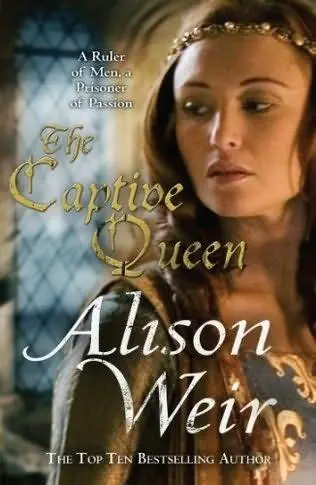
Alison Weir - Captive Queen
Здесь есть возможность читать онлайн «Alison Weir - Captive Queen» весь текст электронной книги совершенно бесплатно (целиком полную версию без сокращений). В некоторых случаях можно слушать аудио, скачать через торрент в формате fb2 и присутствует краткое содержание. Год выпуска: 2010, ISBN: 2010, Издательство: BALLANTINE, Жанр: Историческая проза, на английском языке. Описание произведения, (предисловие) а так же отзывы посетителей доступны на портале библиотеки ЛибКат.
- Название:Captive Queen
- Автор:
- Издательство:BALLANTINE
- Жанр:
- Год:2010
- ISBN:978-0-345-52195-8
- Рейтинг книги:3 / 5. Голосов: 1
-
Избранное:Добавить в избранное
- Отзывы:
-
Ваша оценка:
Captive Queen: краткое содержание, описание и аннотация
Предлагаем к чтению аннотацию, описание, краткое содержание или предисловие (зависит от того, что написал сам автор книги «Captive Queen»). Если вы не нашли необходимую информацию о книге — напишите в комментариях, мы постараемся отыскать её.
Renowned for her highly acclaimed and bestselling British histories, Alison Weir has in recent years made a major impact on the fiction scene with her novels about Queen Elizabeth and Lady Jane Grey. In this latest offering, she imagines the world of Eleanor of Aquitaine, the beautiful twelfth-century woman who was Queen of France until she abandoned her royal husband for the younger man who would become King of England. In a relationship based on lust and a mutual desire for great power, Henry II and Eleanor took over the English throne in 1154, thus beginning one of the most influential reigns and tumultuous royal marriages in all of history. In this novel, Weir uses her extensive knowledge to paint a most vivid portrait of this fascinating woman.
Captive Queen — читать онлайн бесплатно полную книгу (весь текст) целиком
Ниже представлен текст книги, разбитый по страницам. Система сохранения места последней прочитанной страницы, позволяет с удобством читать онлайн бесплатно книгу «Captive Queen», без необходимости каждый раз заново искать на чём Вы остановились. Поставьте закладку, и сможете в любой момент перейти на страницу, на которой закончили чтение.
Интервал:
Закладка:
She was not pleased with Henry. She felt he had behaved with less than his usual wisdom in recent months. It had all begun when news of the death of Archbishop Theobald reached them in Rouen, brought by Gilbert Foliot, the Bishop of Hereford. Henry had been shocked and grieved.
“Theobald was my true friend,” he said. “I owe my kingdom to his support.”
“God rest him, the good man,” Eleanor murmured, crossing herself. “He has earned his place in Heaven.”
The Empress got to her feet stiffly—she suffered miseries from painful joints these days—and rested a hand on her son’s shoulder.
“He must be replaced,” she counseled. “England cannot long be without an Archbishop of Canterbury.”
“I agree, sire,” Bishop Foliot chimed in. He was a portly, bushy-browed ecclesiastic, a traditionalist much respected for his integrity and learning. Eleanor had always admired his directness and fearless honesty. You always knew where you were with him.
“Yes, but who could fill Theobald’s shoes?” Henry asked, obviously reluctant to have to consider replacing his old friend.
The answer was obvious, Eleanor felt: it could be none other than Foliot himself. He would be an outstanding choice, having all the requisite qualities and experience.
Matilda evidently felt the same, for she too was looking hopefully at Foliot.
“You have not far to seek, my son,” she said.
“Indeed, I have not,” Henry answered her, his eyes lighting up, but not on the expectant bishop. “Thomas Becket shall be my archbishop.”
“Thomas Becket?” echoed three dissonant voices in unison. Oh, no, Eleanor thought; Becket would be a disaster. He was far too preoccupied with earthly glories, and insufferable enough as it was.
“Have you gone mad, Henry?” the Empress cried, abandoning her customary self-control and deference. “He is too worldly a man for high ecclesiastical office.”
“That is exactly what I was going to say, sire,” chimed in Foliot. “And he is not even ordained a priest.”
“Then show me a better candidate,” Henry challenged.
“I said before, you have not far to look,” the Empress bristled.
“I want an archbishop who is on my side, and prepared to work with me, not against me,” Henry declared.
“My Lord King, all your bishops are ‘on your side,’ as you put it,” Foliot said smoothly, unruffled by the implied slur. “And, unless I am very much mistaken, none has ever worked against you. We are loyal to a man, depend upon it.”
“True, very true—to a point!” Henry rounded on him. “But, if put to the test, your first loyalty would be to the Church. Am I correct?”
“It would be to God,” Foliot stated firmly.
“Well, I can’t argue with that,” Henry sniffed, with a rueful smile. “As long as God is on my side, at least. Anyway, the matter must wait. Louis is threatening war, although I doubt he will exert himself greatly. Even so, I must strengthen my defenses on the Norman border, in case he tries to take back the Vexin. And then I have to go south to Aquitaine, for there is trouble in Gascony—again.”
“To Aquitaine?” Eleanor echoed joyfully. “I will go with you, my lord! I can stay in Bordeaux.” It would be wonderful to see her domains again, to feel once more the heat of the southern sun, hear the lays of the troubadours and the summer buzzing of the crickets, taste succulent duck and rich truffles, and see the majestic hills and sparkling rivers of her homeland.
“No,” Henry said.
It had been that adamant refusal, and what followed, far more than the matter of Canterbury, that drove a wedge between them. She had insisted, cajoled, and begged, but Henry proved immovable, arguing that her condition prevented her from traveling far. This was nonsense, she countered, arguing that during her earlier pregnancies, she had journeyed hundreds of miles around England during his absences, right up to her ninth month. She was as strong as an ox, she told him, and had never felt better. But still he had refused. And soon it was to become clear why.
She had stayed in Rouen with the Empress, fretting at her enforced idleness and wishing beyond hope that she was in Poitiers and Gascony with Henry. He sent messengers fairly regularly, though, with news and solicitous inquiries as to her health, and the first tidings of his venture were good. He had besieged and taken the strong castle of Castillon-sur-Agen within just one week, and the rebel lords were so overawed—utterly terrified, in fact—by this feat that all resistance quickly melted away.
It was the next reports from Henry that made Eleanor see red. She had left her uncle, Raoul de Faye, in charge of her domains, but Henry made it quite clear to Raoul, when he saw him in Poitiers, that he had a poor opinion of Raoul’s ability to function effectively as the duchess’s deputy, and overruled him on several important matters. Raoul, in turn, had written to Eleanor to voice his protest and warn her that her subjects were up in arms about it, complaining that the duke was infringing on their liberties. And they had even more cause to gripe when Henry began installing his own Norman administrators in positions of influence.
As soon as she heard of this, Eleanor had written to him in furious haste, demanding to know what he thought he was doing. He replied briskly that it was desirable that Aquitaine, like Normandy and England, should have strong, centralized government, and that he meant to enforce it upon her unruly, whoreson barons if it was the last thing he did! Which it might be, she thought savagely.
At the same time, another letter arrived from Raoul. “The people have withdrawn from their allegiance to the King of the English,” he wrote, deliberately omitting to refer to Henry as Duke of Aquitaine, his proper title in the duchy. “They complain that he has pruned their liberties. They have even approached the legates of the Pope, showing them a chart of lineage and asking them to dissolve your marriage to the King on the grounds of consanguinity.”
When she read this, Eleanor’s blood ran cold. Beside herself with frustration, she took the letter and sought out the Empress, thrusting it in front of her.
“See what your son has done!” she cried.
Matilda said not a word, but read the parchment. “I should not worry yourself, Eleanor,” she said coolly. “The legates will not dare to offend the King; they are only in Aquitaine because they seek his support for their master, Pope Alexander.”
“I am aware of that,” Eleanor retorted. “What angers me is that Henry has once more alienated my subjects—and gone against my wishes.”
“Strong measures are never popular,” Matilda observed, “but sometimes they are necessary. Your Aquitainian lords are a menace, you must admit.”
“I will write to Henry,” Eleanor fumed. “I will protest at his interference in my domains. How dare he!”
“Because he has every right,” Matilda pointed out. “He is your lord, and he is their duke.”
“He should have consulted me!” Eleanor raged.
“He does not need to,” Matilda told her. Eleanor sensed she was enjoying seeing her daughter-in-law discountenanced. She snatched back her letter, swept out of the room, and dashed off a response to Henry, castigating him for his folly and for arousing the ire of her subjects.
His reply made her want to howl with rage. He had ignored all her complaints! There was not a word in justification or apology. He wrote only that the legates, who were falling over themselves to humor him, told him that the Pope had agreed to canonize King Edward the Confessor. He himself, he continued, was still in Poitiers, where he had inspected the building work at the cathedral and found it satisfactory; she might like to know that he had ordered the building of a new church, new city walls, new bridges, a marketplace, and shops, and that he was having the great hall of her palace refurbished with bigger windows.
Читать дальшеИнтервал:
Закладка:
Похожие книги на «Captive Queen»
Представляем Вашему вниманию похожие книги на «Captive Queen» списком для выбора. Мы отобрали схожую по названию и смыслу литературу в надежде предоставить читателям больше вариантов отыскать новые, интересные, ещё непрочитанные произведения.











Обсуждение, отзывы о книге «Captive Queen» и просто собственные мнения читателей. Оставьте ваши комментарии, напишите, что Вы думаете о произведении, его смысле или главных героях. Укажите что конкретно понравилось, а что нет, и почему Вы так считаете.