Alison Weir - Captive Queen
Здесь есть возможность читать онлайн «Alison Weir - Captive Queen» весь текст электронной книги совершенно бесплатно (целиком полную версию без сокращений). В некоторых случаях можно слушать аудио, скачать через торрент в формате fb2 и присутствует краткое содержание. Год выпуска: 2010, ISBN: 2010, Издательство: BALLANTINE, Жанр: Историческая проза, на английском языке. Описание произведения, (предисловие) а так же отзывы посетителей доступны на портале библиотеки ЛибКат.
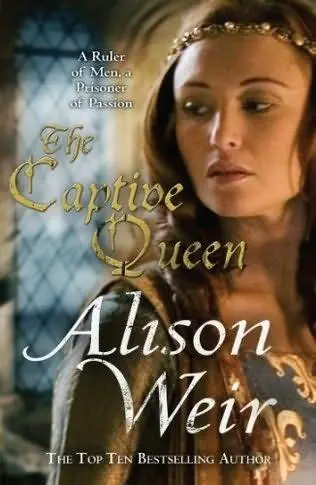
- Название:Captive Queen
- Автор:
- Издательство:BALLANTINE
- Жанр:
- Год:2010
- ISBN:978-0-345-52195-8
- Рейтинг книги:3 / 5. Голосов: 1
-
Избранное:Добавить в избранное
- Отзывы:
-
Ваша оценка:
Captive Queen: краткое содержание, описание и аннотация
Предлагаем к чтению аннотацию, описание, краткое содержание или предисловие (зависит от того, что написал сам автор книги «Captive Queen»). Если вы не нашли необходимую информацию о книге — напишите в комментариях, мы постараемся отыскать её.
Renowned for her highly acclaimed and bestselling British histories, Alison Weir has in recent years made a major impact on the fiction scene with her novels about Queen Elizabeth and Lady Jane Grey. In this latest offering, she imagines the world of Eleanor of Aquitaine, the beautiful twelfth-century woman who was Queen of France until she abandoned her royal husband for the younger man who would become King of England. In a relationship based on lust and a mutual desire for great power, Henry II and Eleanor took over the English throne in 1154, thus beginning one of the most influential reigns and tumultuous royal marriages in all of history. In this novel, Weir uses her extensive knowledge to paint a most vivid portrait of this fascinating woman.
Captive Queen — читать онлайн бесплатно полную книгу (весь текст) целиком
Ниже представлен текст книги, разбитый по страницам. Система сохранения места последней прочитанной страницы, позволяет с удобством читать онлайн бесплатно книгу «Captive Queen», без необходимости каждый раз заново искать на чём Вы остановились. Поставьте закладку, и сможете в любой момент перейти на страницу, на которой закончили чтение.
Интервал:
Закладка:
It pleased her to know that, thanks to her, her magnificent Henry was now Duke of Aquitaine and—at just nineteen—the mightiest prince in Europe. Together, she knew, they would make a stir in the world, greater than any royal couple before them. And as they emerged from the cathedral to acknowledge the rapturous acclaim of her people, she was again convinced of the rightness of it all—that she had made her bargain with destiny.
That night, Henry took her with even greater ardor than before, stripping away inhibitions and boundaries, and launching them on a long and sensual journey of ever-greater discovery.
“Never hold back!” he demanded. “I want everything you can give me.”
“I am my lord’s to command now,” Eleanor answered willingly, and in that moment meant it.
“Ours is a marriage of lions,” he breathed in her ear. “Did it occur to you? You have a lion as the symbol of Poitou, and my symbol is also a lion, inherited from my grandfather, King Henry of England. They called him ‘the Lion of Justice,’ but he’s supposed to have thought up the idea after receiving the gift of a lion for his menagerie in the Tower of London.”
“I like that,” Eleanor murmured, snuggling closer to him in the warmth of the feather mattress. “A marriage of lions. It has a chivalric ring to it.”
“It is apt in more ways than one, I think,” her husband observed as his arms tightened about her. “Eh, my Eleanor? We are neither of us meek and mild, but strong, audacious characters, brave as lions ourselves.”
“With you beside me, I will never know fear,” she told him, pressing her smooth cheek to his bearded one, reveling in the masculine scent of him.
“We will do well together, my fair lioness!” Henry laughed, and drew her close to him once more.
7
Abbey of Fontevrault, 1152
It was with a glad heart that Eleanor paid a visit to Fontevrault the month after her wedding.
“This abbey is a place especially dear to me,” she told Henry. “It was founded at my grandmother’s behest, and is dedicated to Our Lady.”
Henry nodded approvingly. He had heard of the fame of this double house of monks and nuns under the rule of an abbess, which had become a finishing school and retreat for royal and aristocratic ladies, and a haven of piety and contemplative prayer. It was a most unusual establishment in that its founder, a renowned Breton scholar called Robert d’Arbrissel, had wished to enhance the status of women, and even dared to assert that they were superior to men in many ways. Leaving that strange notion aside, Henry could understand why Eleanor thought highly of Fontevrault. He had a very good opinion of it himself. It was one of the greatest bastions of piety and faith in all Christendom.
The abbey lay by a fountain, in lush woodland on the banks of the River Vienne in north Poitou, near the border with Anjou. As Eleanor entered its lofty white church, which was distinguished by a quality of light and space seen nowhere else on Earth, and which had been beautified with simple, soaring columns and elegant triforium arcades, she felt uplifted and suffused with thankfulness. The abbess, Isabella of Anjou, who was Henry’s aunt, kissed her warmly in welcome, conducted her through the tranquil cloisters and ushered her into her spacious house, which was attached to the adjoining convent of Le Grand Moutier, where the nuns lived. Almond milk, pears, and sweetmeats were brought, and the two women, who immediately felt a mutual respect and affection, sat down to enjoy some congenial conversation.
“To what do we owe the pleasure of this visit, my lady?” Abbess Isabella asked. She was a plump, motherly woman in her mid-forties with the florid Angevin coloring, and had ruled her community for four years.
“It is a great joy to me to come to Fontevrault at this time, Mother,” Eleanor said. “I have much for which to be grateful to God. My heart is so full, and I wish to offer thanks for the great happiness He has bestowed on me in my marriage, and for making me the instrument through which unity and peace might be achieved in Christendom.”
“We must all give thanks to God for that,” the abbess declared. Intelligent and perceptive woman that she was, she was well aware of the hoped-for outcome of the duchess’s union with Henry FitzEmpress. “You will join us for dinner in our refectory afterward?” the abbess invited.
“Most certainly, I thank you.” Eleanor smiled. “But there is another purpose to my visit, Mother. After my marriage to my Lord Henry, I felt that divine inspiration was leading me to visit this sacred congregation. It feels as if I have been guided by God to Fontevrault, and while here, I intend to approve and confirm all the charters and gifts that my forefathers have given to this house. If you will have this drawn up on a parchment, Mother, I will affix my seal. It is a new one.” Proudly, she drew it from the embroidered purse hanging at her girdle and showed it to the abbess. It portrayed Eleanor as duchess of both Aquitaine and Normandy. “See, I am holding a bird perched upon a cross; it is a sacred symbol of sovereignty.”
“If I may say so, madame, wedlock suits you: you are looking radiant,” the abbess observed. “I am delighted that you have found such joy in your union with my nephew. I hear that he has ambitions to be King of England.”
“Which I have no doubt he will fulfill,” Eleanor said.
“I was in England thirty years ago, before I entered religion,” Abbess Isabella recalled. “I was married to William, the son of King Henry, who was himself son to William the Conqueror, and grandfather to your husband. They called King Henry the ‘Lion of Justice.’ He was a lion indeed! Strong and respected as a ruler, but a terrifying man, cruel and ruthless. I can never forget what he did to his grandchildren.”
“What did he do?” Eleanor asked, thrusting away the unwelcome thought that the same violent blood ran in her own Henry.
“One of his daughters defied him, with her husband, and he had the eyes of their two little girls put out as punishment.”
Eleanor shivered. “How vile. That’s too awful to contemplate. What was his son like?”
“William? They called him ‘the Atheling,’ after the old Saxon princes before the conquest. He was another like his father, proud, fierce, and hardhearted. Mercifully, I was not married to him for very long.”
“Was he the prince who drowned when the White Ship sank?”
“The very same.”
“I have heard my lord speak of his death. He said King Henry never smiled again.”
“For the King, it was a tragedy. He had no other son to succeed him. Not a legitimate one, at any rate. His bastards, of course, were legion.” The abbess’s lips twitched. “But God in His wisdom took unto himself my young lord, and King Henry forced his barons to swear allegiance to his daughter Matilda as his heir.”
“The Empress, my mother-in-law,” Eleanor supplied. “Did you ever meet her?”
“No, she was then married to the Holy Roman Emperor and living in Germany. He died later on, and she married my brother Geoffrey, but she never came to visit me. By all accounts she is a strong woman. She has certainly fought hard for the kingdom that was lawfully hers.”
“And lost,” Eleanor put in. “But my lord will reclaim it in her name. She has ceded her rights to him. The portents are good.”
“King Stephen still lives, though,” Isabella stated.
“He is hated and despised, my lord says. Those barons who would not accept a woman as their ruler are far more amenable to Henry, especially now that he has proved himself a ruler to be reckoned with. Tell me, Mother, what is England like?”
“They call it ‘the ringing isle’ because there are so many churches. It is green and lovely, and a lot like France in some parts, but the weather is unpredictable. The people are insular, but hospitable. And no, before you ask, they do not have tails, as is popularly bruited here!”
Читать дальшеИнтервал:
Закладка:
Похожие книги на «Captive Queen»
Представляем Вашему вниманию похожие книги на «Captive Queen» списком для выбора. Мы отобрали схожую по названию и смыслу литературу в надежде предоставить читателям больше вариантов отыскать новые, интересные, ещё непрочитанные произведения.





Обсуждение, отзывы о книге «Captive Queen» и просто собственные мнения читателей. Оставьте ваши комментарии, напишите, что Вы думаете о произведении, его смысле или главных героях. Укажите что конкретно понравилось, а что нет, и почему Вы так считаете.