Bernard Cornwell - Excalibur
Здесь есть возможность читать онлайн «Bernard Cornwell - Excalibur» весь текст электронной книги совершенно бесплатно (целиком полную версию без сокращений). В некоторых случаях можно слушать аудио, скачать через торрент в формате fb2 и присутствует краткое содержание. Год выпуска: 1999, Издательство: MacMillan Publishers, Жанр: Историческая проза, на английском языке. Описание произведения, (предисловие) а так же отзывы посетителей доступны на портале библиотеки ЛибКат.
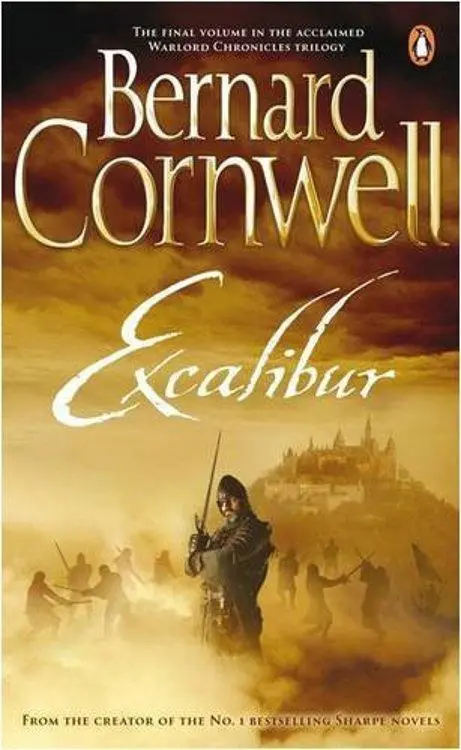
- Название:Excalibur
- Автор:
- Издательство:MacMillan Publishers
- Жанр:
- Год:1999
- ISBN:нет данных
- Рейтинг книги:4 / 5. Голосов: 2
-
Избранное:Добавить в избранное
- Отзывы:
-
Ваша оценка:
Excalibur: краткое содержание, описание и аннотация
Предлагаем к чтению аннотацию, описание, краткое содержание или предисловие (зависит от того, что написал сам автор книги «Excalibur»). Если вы не нашли необходимую информацию о книге — напишите в комментариях, мы постараемся отыскать её.
to Marion Zimmer Bradley's
, the legend of King Arthur has haunted and inspired generations of writers to reinvent the ancient story. In
and
, Bernard Cornwell demonstrated his astonishing ability to make the oft-told legend of King Arthur fresh and new for our time. Now, in this riveting final volume of the
, Cornwell tells the story of Arthur's desperate attempt to triumph over a ruined marriage and the Saxons' determination to destroy him.
Set against the backdrop of the Dark Ages, this brilliant saga continues as seen through the eyes of Derfel, an orphan brought up by Merlin and one of Arthur's warriors. In this book, the aging Arthur has been betrayed by, among others, his beloved Guinevere; but although he is alone and deeply saddened, he still embraces his dreams of a world in which civilization triumphs over brute force. Arthur and his warriors must face the dreaded Saxons — now allied with Arthur's betrayer Lancelot — for the throne of Britain.
This is the tale not only of a broken love remade but also of enemies more subtle than any Saxon spearman — of forces both earthly and unearthly that threaten everything Arthur stands for. When Merlin and Nimue embark on a dangerous quest to summon the Gods back to Britain, they unleash forces that will lead to a last desperate battle on the sands of Camlann, where it seems that Arthur must fail unless Merlin's final enchantment can avert the horror.
Peopled by princesses and bards, warriors and magicians, Excalibur is a story of love, war, loyalty, and betrayal, the unforgettable conclusion to a brilliant retelling of one of the most powerful legends of all time.
Excalibur — читать онлайн бесплатно полную книгу (весь текст) целиком
Ниже представлен текст книги, разбитый по страницам. Система сохранения места последней прочитанной страницы, позволяет с удобством читать онлайн бесплатно книгу «Excalibur», без необходимости каждый раз заново искать на чём Вы остановились. Поставьте закладку, и сможете в любой момент перейти на страницу, на которой закончили чтение.
Интервал:
Закладка:
‘We have to, Lord,’ I said, though it would be hard. We had lost scores of men and our wall would be thin. Our spears and swords were blunted now and there were not enough sharpening stones to make them keen again, while the enemy was being reinforced with fresh men whose weapons were untouched. Arthur slid from Llamrei, threw her reins to Hygwydd, then walked with me to the scattered tide line of the dead. He knew some of the men by name, and he frowned when he saw the dead youngsters who had scarcely had time to live before they met their enemy. He stooped and touched a finger to Bors’s forehead, then walked on to pause beside a Saxon who lay with an arrow embedded in his open mouth. For a moment I thought he was about to speak, then he just smiled. He knew Guinevere was with my men, indeed he must have seen her on her horse and seen her banner that now flew alongside my starry flag. He looked at the arrow again and I saw a flicker of happiness on his face. He touched my arm and led me back towards our men who were sitting or else leaning on their spears. A man in the gathering Saxon ranks had recognized Arthur and now strode into the wide space between the armies and shouted a challenge at him. It was Liofa, the swordsman I had faced at Thunreslea, and he called Arthur a coward and a woman. I did not translate and Arthur did not ask me to. Liofa stalked closer. He carried no shield and wore no armour, not even a helmet, and carried only his sword and that he now sheathed as if to show that he had no fear of us. I could see the scar on his cheek and I was tempted to turn and give him a bigger scar, a scar that would put him in a grave, but Arthur checked me. ‘Let him be,’ he said.
Liofa went on taunting us. He minced like a woman, suggesting that was what we were, and he stood with his back to us to invite a man to come and attack him. Still no one moved. He turned to face us again, shook his head with pity for our cowardice, then strode on down the tide line of the dead. The Saxons cheered him while my men watched in silence. I passed word down our line that he was Cerdic’s champion, and dangerous, and that he should be left alone. It galled our men to see a Saxon so rampant, but it was better that Liofa should live now than be given a chance to humiliate one of our tired spearmen. Arthur tried to give our men heart by remounting Llamrei and, ignoring Liofa’s taunts, galloping along the line of corpses. He scattered the naked Saxon wizards, then drew Excalibur and spurred yet closer to the Saxon line, flaunting his white crest and bloodied cloak. His red-crossed shield glittered and my men cheered to see him. The Saxons shrank away from him, while Liofa, left impotent in Arthur’s wake, called him woman-hearted. Arthur wheeled the horse and kicked her back to me. His gesture had implied that Liofa was not a worthy opponent, and it must have stung the Saxon champion’s pride because he came still nearer to our line in search of an opponent.
Liofa stopped by a pile of corpses. He stepped into the gore, then seized a fallen shield that he dragged free. He held it up so that we could all see the eagle of Powys and, when he was sure we had seen the symbol, he threw the shield down then opened his trews and pissed on the insignia of Powys. He moved his aim so that his urine fell on the shield’s dead owner, and that insult proved too great. Cuneglas roared his anger and ran out of the line.
‘No!’ I shouted and started towards Cuneglas. It was better, I thought, that I should fight Liofa, for at least I knew his tricks and his speed, but I was too late. Cuneglas had his sword drawn and he ignored me. He believed himself invulnerable that day. He was the king of battle, a man who had needed to show himself a hero, and he had achieved that and now he believed that everything was possible. He would strike down this impudent Saxon in front of his men, and for years the bards would sing of King Cuneglas the Mighty, King Cuneglas the Saxon-killer, King Cuneglas the Warrior. I could not save him for he would lose face if he turned away or if another man took his place and so I watched, horrified, as he strode confidently towards the slim Saxon who wore no armour. Cuneglas was in his father’s old wargear, iron trimmed with gold and with a helmet crested with an eagle’s wing. He was smiling. He was soaring at that moment, filled with the day’s heroics, and he believed himself touched by the Gods. He did not hesitate, but cut at Liofa and we could all have sworn that the cut must strike home, but Liofa glided from under the slash, stepped aside, laughed, then stepped aside again as Cuneglas’s sword cut air a second time.
Both our men and the Saxons were roaring encouragement. Arthur and I alone were silent. I was watching Ceinwyn’s brother die, and there was not a thing I could do to stop it. Or nothing I could do with honour, for if I were to rescue Cuneglas then I would disgrace him. Arthur looked down at me from his saddle with a worried face.
I could not relieve Arthur’s worry. ‘I fought him,’ I said bitterly, ‘and he’s a killer.’
‘You live.’
‘I’m a warrior, Lord,’ I said. Cuneglas had never been a warrior, which was why he wanted to prove himself now, but Liofa was making a fool of him. Cuneglas would attack, trying to smash Liofa down with his sword, and every time the Saxon just ducked or slid aside, and never once did he counter-attack; and slowly our men fell silent, for they saw that the King was tiring and that Liofa was playing with him.
Then a group of men from Powys rushed forward to save their King and Liofa took three fast backward steps and mutely gestured at them with his sword. Cuneglas turned to see his men. ‘Go back!’
he shouted at them. ‘Go back!’ he repeated, more angrily. He must have known he was doomed, but he would not lose face. Honour is everything.
The men from Powys stopped. Cuneglas turned back to Liofa, and this time he did not rush forward, but went more cautiously. For the first time his sword actually touched Liofa’s blade, and I saw Liofa slip on the grass and Cuneglas shouted his victory and raised his sword to kill his tormentor, but Liofa was spinning away, the slip deliberate, and the whirl of his swing carried his sword low above the grass so that it sliced into Cuneglas’s right leg. For a moment Cuneglas stood upright, his sword faltering, and then, as Liofa straightened, he sank. The Saxon waited as the King collapsed, then he kicked Cuneglas’s shield aside and stabbed down once with his sword point.
The Saxons cheered themselves hoarse, for Liofa’s triumph was an omen for their victory. Liofa himself had time only to seize Cuneglas’s sword, then he ran lithely away from the men who chased him for vengeance. He easily outstripped them, then turned and taunted them. He had no need to fight them, for he had won his challenge. He had killed an enemy King and I did not doubt that the Saxon bards would sing of Liofa the Terrible, the slayer of kings. He had given the Saxons their first victory of the day. Arthur dismounted and he and I insisted on carrying Cuneglas’s body back to his men. We both wept. In all the long years we had possessed no stauncher ally than Cuneglas ap Gorfyddyd, King of Powys. He had never argued with Arthur and never once failed him, while to me he had been like a brother. He was a good man, a giver of gold, a lover of justice, and now he was dead. The warriors of Powys took their dead King from us and carried him behind the shield wall. ‘The name of his killer,’ I said to them, ‘is Liofa, and I will give a hundred gold coins to the man who brings me his head.’
Then a shout turned me. The Saxons, assured of victory, had started their advance. My men stood. They wiped sweat from their eyes. I pulled on my battered and bloody helmet, closed its cheekpieces, and snatched up a fallen spear.
Читать дальшеИнтервал:
Закладка:
Похожие книги на «Excalibur»
Представляем Вашему вниманию похожие книги на «Excalibur» списком для выбора. Мы отобрали схожую по названию и смыслу литературу в надежде предоставить читателям больше вариантов отыскать новые, интересные, ещё непрочитанные произведения.


Обсуждение, отзывы о книге «Excalibur» и просто собственные мнения читателей. Оставьте ваши комментарии, напишите, что Вы думаете о произведении, его смысле или главных героях. Укажите что конкретно понравилось, а что нет, и почему Вы так считаете.