Bernard Cornwell - Excalibur
Здесь есть возможность читать онлайн «Bernard Cornwell - Excalibur» весь текст электронной книги совершенно бесплатно (целиком полную версию без сокращений). В некоторых случаях можно слушать аудио, скачать через торрент в формате fb2 и присутствует краткое содержание. Год выпуска: 1999, Издательство: MacMillan Publishers, Жанр: Историческая проза, на английском языке. Описание произведения, (предисловие) а так же отзывы посетителей доступны на портале библиотеки ЛибКат.
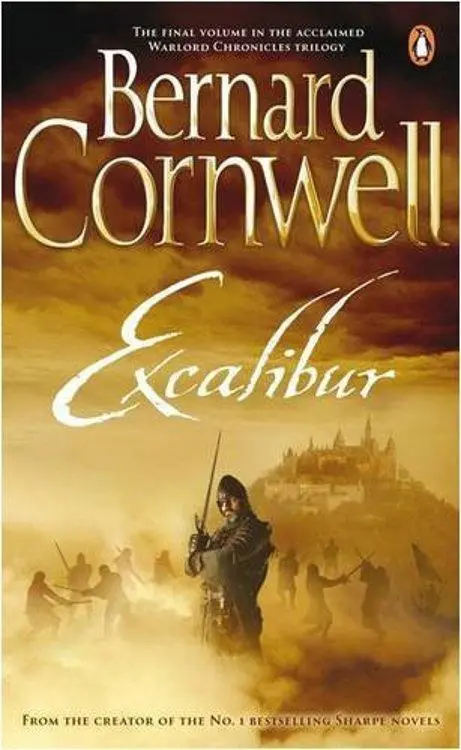
- Название:Excalibur
- Автор:
- Издательство:MacMillan Publishers
- Жанр:
- Год:1999
- ISBN:нет данных
- Рейтинг книги:4 / 5. Голосов: 2
-
Избранное:Добавить в избранное
- Отзывы:
-
Ваша оценка:
Excalibur: краткое содержание, описание и аннотация
Предлагаем к чтению аннотацию, описание, краткое содержание или предисловие (зависит от того, что написал сам автор книги «Excalibur»). Если вы не нашли необходимую информацию о книге — напишите в комментариях, мы постараемся отыскать её.
to Marion Zimmer Bradley's
, the legend of King Arthur has haunted and inspired generations of writers to reinvent the ancient story. In
and
, Bernard Cornwell demonstrated his astonishing ability to make the oft-told legend of King Arthur fresh and new for our time. Now, in this riveting final volume of the
, Cornwell tells the story of Arthur's desperate attempt to triumph over a ruined marriage and the Saxons' determination to destroy him.
Set against the backdrop of the Dark Ages, this brilliant saga continues as seen through the eyes of Derfel, an orphan brought up by Merlin and one of Arthur's warriors. In this book, the aging Arthur has been betrayed by, among others, his beloved Guinevere; but although he is alone and deeply saddened, he still embraces his dreams of a world in which civilization triumphs over brute force. Arthur and his warriors must face the dreaded Saxons — now allied with Arthur's betrayer Lancelot — for the throne of Britain.
This is the tale not only of a broken love remade but also of enemies more subtle than any Saxon spearman — of forces both earthly and unearthly that threaten everything Arthur stands for. When Merlin and Nimue embark on a dangerous quest to summon the Gods back to Britain, they unleash forces that will lead to a last desperate battle on the sands of Camlann, where it seems that Arthur must fail unless Merlin's final enchantment can avert the horror.
Peopled by princesses and bards, warriors and magicians, Excalibur is a story of love, war, loyalty, and betrayal, the unforgettable conclusion to a brilliant retelling of one of the most powerful legends of all time.
Excalibur — читать онлайн бесплатно полную книгу (весь текст) целиком
Ниже представлен текст книги, разбитый по страницам. Система сохранения места последней прочитанной страницы, позволяет с удобством читать онлайн бесплатно книгу «Excalibur», без необходимости каждый раз заново искать на чём Вы остановились. Поставьте закладку, и сможете в любой момент перейти на страницу, на которой закончили чтение.
Интервал:
Закладка:
They still could have beaten us, for their numbers were so great, but it is hard to fight in a broken shield wall going uphill and our sudden attack had broken their spirits. Too many of the Saxons were also drunk. A drunken man fights well in victory, but in defeat he panics quickly, and though Cerdic tried to hold them to the battle, his spearmen panicked and ran. Some of my youngsters were tempted to follow further down the hill, and a handful yielded to the temptation and went too far and so paid for their temerity, but I shouted at the others to stay where they were. Most of the enemy escaped, but we had won, and to prove it we stood in the blood of Saxons and our hillside was thick with their dead, their wounded and their weapons. The overturned wagon burned on the slope, a trapped Saxon screaming beneath its weight, while the other still rumbled on until it thumped into the hedge at the foot of the hill. Some of our women came down to plunder the dead and kill the wounded. Neither Aelle nor Cerdic were among those Saxons left on the hill, but there was one great chief who was hung with gold and wore a sword with a gold-decorated hilt in a scabbard of soft black leather criss-crossed with silver; I took the belt and sword from the dead man and carried them up to Guinevere. I knelt to her, something I had never done. ‘It was your victory, Lady,’ I said, ‘all yours.’ I offered her the sword. She strapped it on, then lifted me up. ‘Thank you, Derfel,’ she said.
‘It’s a good sword,’ I said.
‘I’m not thanking you for the sword,’ Guinevere said, ‘but for trusting me. I always knew I could fight.’
‘Better than me, Lady,’ I said ruefully. Why had I not thought to use the wagons?
‘Better than them!’ Guinevere said, indicating the beaten Saxons. She smiled. ‘And tomorrow we shall do it all over again.’
The Saxons did not return that evening. It was a lovely twilight, soft and glowing. My sentries paced the wall as the Saxon fires brightened in the spreading shadows below. We ate, and after the meal I talked with Issa’s wife, Scarach, and she recruited other women and between them they found some needles, knives and thread. I had given them some cloaks that I had taken from the Saxon dead and the women worked through the dusk, then on into the night by the light of our fires. So that next morning, when Guinevere awoke, there were three banners on Mynydd Baddon’s southern rampart. There was Arthur’s bear and Ceinwyn’s star, but in the middle, in the place of honour as befitted a victorious warlord, there was a flag showing Guinevere’s badge of a moon-crowned stag. The dawn wind lifted it, she saw the badge and I saw her smile.
While beneath us the Saxons gathered their spears again.
The drums began at dawn and within an hour five wizards had appeared on Mynydd Baddon’s lower slopes. Today, it seemed, Cerdic and Aelle were determined to exact revenge for their humiliation. Ravens tore at more than fifty Saxon corpses that still lay on the slope close to the charred remnants of the wagon, and some of my men wanted to drag those dead to the parapet and there make a horrid array of bodies to greet the new Saxon assault, but I forbade it. Soon, I reckoned, our own corpses would be at the Saxons’ disposal and if we defiled their dead then we would be denied in turn. It soon became clear that this time the Saxons would not risk one assault that could be turned to chaos by a tumbling wagon. Instead they were preparing a score of columns that would climb the hill from the south, the east and the west. Each group of attackers would only number seventy or eighty men, but together the small attacks must overwhelm us. We could perhaps fight off three or four of the columns, but the others would easily get past the ramparts and so there was little to do except pray, sing, eat and, for those who needed to, drink. We promised each other a good death, meaning that we would fight to the finish and sing as long as we could, but I think we all knew the end would not be a song of defiance, but a welter of humiliation, pain and terror. It would be even worse for the women. ‘Should I surrender?’
I asked Ceinwyn.
She looked startled. ‘It isn’t for me to say.’
‘I have done nothing without your advice,’ I told her.
‘In war,’ she said, ‘I have no advice to give you, except maybe to ask what will happen to the women if you don’t surrender.’
‘They’ll be raped, enslaved, or else given as wives to men who need wives.’
‘And if you do surrender?’
‘Much the same,’ I admitted. Only the rape would be less urgent.
She smiled. ‘Then you don’t need my advice after all. Go and fight, Derfel, and if I don’t see you till the Otherworld, then know that you cross the bridge of swords with my love.’
I embraced her, then kissed my daughters, and went back to the jutting prow of the southern rampart to watch the Saxons start up the hill. This attack was not taking nearly so long as the first, for that had needed a mass of men to be organized and encouraged, while today the enemy needed no motivation. They came for revenge and they came in such small parties that even if we had rolled a wagon down the hill they could easily have evaded it. They did not hurry, but they had no need for haste. I had divided my men into ten bands, each responsible for two of the Saxon columns, but I doubted that even the best of my spearmen would stand for more than three or four minutes. Most likely, I thought, my men would run back to protect their women as soon as the enemy threatened to outflank them and the fight would then collapse into a miserable one-sided slaughter around our makeshift hut and its surrounding campfires. So be it, I thought, and I walked among my men and thanked them for their services and encouraged them to kill as many Saxons as they could. I reminded them that the enemies they slew in battle would be their servants in the Otherworld, ‘so kill them,’ I said, ‘and let their survivors recall this fight with horror.’ Some of them began to sing the Death Song of Werlinna, a slow and melancholy tune that was chanted about the funeral fires of warriors. I sang with them, watching the Saxons climb nearer, and because I was singing, and because my helmet clasped me tight about the ears, I did not hear Niall of the Blackshields hail me from the hill’s farther rim. It was not till I heard the women cheering that I turned. I still saw nothing unusual, but then, above the sound of the Saxon drums, I heard the shrill, high note of a horn.
I had heard that horn-call before. I had first heard it when I was a new young spearman and Arthur had ridden to save my life, and now he came again.
He had come on horseback with his men, and Niall had shouted at me when those heavily armoured horsemen had swept through the Saxons on the hill beyond the saddle and galloped on down the slope. The women on Mynydd Baddon were running to the ramparts to watch him, for Arthur did not ride up to the summit, but led his men around the upper slope of the hill. He was in his polished scale armour and wore his gold-encrusted helmet and carried his shield of hammered silver. His great war banner was unfurled, its black bear streaming stark on a linen field that was as white as the goose feathers in Arthur’s helm. His white cloak billowed from his shoulders and a pennant of white ribbon was tied about the base of his spear’s long blade. Every Saxon on Mynydd Baddon’s lower slopes knew who he was and knew what those heavy horses could do to their small columns. Arthur had only brought forty men, for most of his big warhorses had been stolen by Lancelot in the previous year, but forty heavily armoured men on forty horses could tear infantry into horror.
Arthur reined in beneath the southern angle of the ramparts. The wind was small, so that Guinevere’s banner was not visible except as an unrecognizable flag hanging from its makeshift staff. He looked for me, and finally recognized my helmet and armour. ‘I have two hundred spearmen a mile or so behind!’ he shouted up at me.
Читать дальшеИнтервал:
Закладка:
Похожие книги на «Excalibur»
Представляем Вашему вниманию похожие книги на «Excalibur» списком для выбора. Мы отобрали схожую по названию и смыслу литературу в надежде предоставить читателям больше вариантов отыскать новые, интересные, ещё непрочитанные произведения.






Обсуждение, отзывы о книге «Excalibur» и просто собственные мнения читателей. Оставьте ваши комментарии, напишите, что Вы думаете о произведении, его смысле или главных героях. Укажите что конкретно понравилось, а что нет, и почему Вы так считаете.