Bernard Cornwell - Excalibur
Здесь есть возможность читать онлайн «Bernard Cornwell - Excalibur» весь текст электронной книги совершенно бесплатно (целиком полную версию без сокращений). В некоторых случаях можно слушать аудио, скачать через торрент в формате fb2 и присутствует краткое содержание. Год выпуска: 1999, Издательство: MacMillan Publishers, Жанр: Историческая проза, на английском языке. Описание произведения, (предисловие) а так же отзывы посетителей доступны на портале библиотеки ЛибКат.
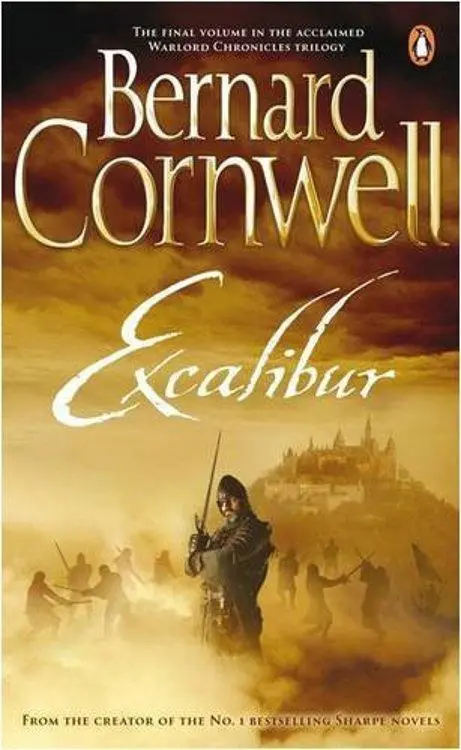
- Название:Excalibur
- Автор:
- Издательство:MacMillan Publishers
- Жанр:
- Год:1999
- ISBN:нет данных
- Рейтинг книги:4 / 5. Голосов: 2
-
Избранное:Добавить в избранное
- Отзывы:
-
Ваша оценка:
Excalibur: краткое содержание, описание и аннотация
Предлагаем к чтению аннотацию, описание, краткое содержание или предисловие (зависит от того, что написал сам автор книги «Excalibur»). Если вы не нашли необходимую информацию о книге — напишите в комментариях, мы постараемся отыскать её.
to Marion Zimmer Bradley's
, the legend of King Arthur has haunted and inspired generations of writers to reinvent the ancient story. In
and
, Bernard Cornwell demonstrated his astonishing ability to make the oft-told legend of King Arthur fresh and new for our time. Now, in this riveting final volume of the
, Cornwell tells the story of Arthur's desperate attempt to triumph over a ruined marriage and the Saxons' determination to destroy him.
Set against the backdrop of the Dark Ages, this brilliant saga continues as seen through the eyes of Derfel, an orphan brought up by Merlin and one of Arthur's warriors. In this book, the aging Arthur has been betrayed by, among others, his beloved Guinevere; but although he is alone and deeply saddened, he still embraces his dreams of a world in which civilization triumphs over brute force. Arthur and his warriors must face the dreaded Saxons — now allied with Arthur's betrayer Lancelot — for the throne of Britain.
This is the tale not only of a broken love remade but also of enemies more subtle than any Saxon spearman — of forces both earthly and unearthly that threaten everything Arthur stands for. When Merlin and Nimue embark on a dangerous quest to summon the Gods back to Britain, they unleash forces that will lead to a last desperate battle on the sands of Camlann, where it seems that Arthur must fail unless Merlin's final enchantment can avert the horror.
Peopled by princesses and bards, warriors and magicians, Excalibur is a story of love, war, loyalty, and betrayal, the unforgettable conclusion to a brilliant retelling of one of the most powerful legends of all time.
Excalibur — читать онлайн бесплатно полную книгу (весь текст) целиком
Ниже представлен текст книги, разбитый по страницам. Система сохранения места последней прочитанной страницы, позволяет с удобством читать онлайн бесплатно книгу «Excalibur», без необходимости каждый раз заново искать на чём Вы остановились. Поставьте закладку, и сможете в любой момент перейти на страницу, на которой закончили чтение.
Интервал:
Закладка:
I fell into a fever after my hand was struck oif, and when I woke I discovered Ceinwyn sitting beside my bed. At first I did not recognize her, for her hair was short and had gone as white as ash. But it was my Ceinwyn, she was alive and her health was coming back, and when she saw the light in my eyes she leaned forward and laid her cheek on mine. I put my left arm around her and discovered I had no hand to stroke her back, only a stump bound in bloody cloth. I could feel the hand, I could even feel it itching, but there was no hand there. It had been burned. A week later I was baptized in the River Usk. Bishop Emrys performed the ceremony, and once he had dipped me in the cold water, Ceinwyn followed me down the muddy bank and insisted on being baptized as well. ‘I will go where my man goes,’ she told Bishop Emrys, and so he folded her hands on her breasts and tipped her back into the river. A choir of women sang as we were baptized and that night, dressed in white, we received the Christian bread and wine for the first time. After the mass Morgan produced a parchment on which she had written my promise to obey her husband in the Christian faith and she demanded that I sign my name.
‘I’ve already given you my word,’ I objected.
‘You will sign, Derfel,’ Morgan insisted, ‘and you will swear the oath on a crucifix as well.’
I sighed and signed. Christians, it seemed, did not trust the older form of oath-making, but demanded parchment and ink. And so I acknowledged Sansum as my Lord and, after I had written my name, Ceinwyn insisted on adding her own. Thus began the second half of my life, the half in which I have kept my oath to Sansum, though not as well as Morgan hoped. If Sansum knew I was writing this tale he would construe it as a breaking of the promise and punish me accordingly, but I no longer care. I have committed many sins, but breaking oaths was not one of them.
After my baptism I half expected a summons from Sansum, who was still with King Meurig in Gwent, but the mouse lord simply kept my written promise and demanded nothing, not even money. Not then. The stump of my wrist healed slowly, and I did not help the healing by insisting on practising with a shield. In battle a man puts his left arm through the two shield loops and grips the wooden handle beyond, but I no longer had fingers to grip the shield and so I had the loops remade as buckled straps that could be tightened about my forearm. It was not as secure as the proper way, but it was better than having no shield, and once I had become used to the tight straps I practised with sword and shield against Galahad, Culhwch or Arthur. I found the shield clumsy, but I could still fight, even though every practice bout left the stump bleeding so that Ceinwyn would scold me as she put on a new dressing. The full moon came and I took no sword or sacrifice to Nant Dduu. I waited for Nimue’s vengeance, but none came. The feast of Beltain was a week after the full moon and Ceinwyn and I, obedient to Morgan’s orders, did not extinguish our fires or stay awake to see the new fires lit, but Culhwch came to us next morning with a brand of the new fire that he tossed into our hearth. ‘You want me to go to Gwent, Derfel?’ he asked.
‘Gwent?’ I asked. ‘Why?’
‘To murder that little toad, Sansum, of course.’
‘He’s not troubling me.’
‘Yet,’ Culhwch grumbled, ‘but he will. Can’t imagine you as a Christian. Does it feel different?’
‘No.’
Poor Culhwch. He rejoiced to see Ceinwyn well, but hated the bargain I had made with Morgan to make her well. He, like many others, wondered why I did not simply break my promise to Sansum, but I feared Ceinwyn’s sickness would return if I did and so I stayed true. In time that obedience became a habit, and once Ceinwyn was dead I found I had no will to break the promise, even though her death had loosed the promise’s grip on me.
But this lay far in the unknown future on that day when the new fires warmed cold hearths. It was a beautiful day of sunshine and blossom. I remember we bought some goslings in the marketplace that morning, thinking our grandchildren would like to see them grow in the small pond that lay behind our quarters, and afterwards I went with Galahad to the amphitheatre where I practised again with my clumsy shield. We were the only spearmen there, for most of the others were still recovering from a night of drinking. ‘Goslings aren’t a good idea,’ Galahad said, rattling my shield with a solid blow of his spear butt.
‘Why not?’
‘They grow up to be bad-tempered.’
‘Nonsense,’ I said. ‘They grow up to become supper.’
Gwydre interrupted us with a summons from his father, and we strolled back into the town to discover Arthur had gone to Bishop Emrys’s palace. The Bishop was seated, while Arthur, in shirt and trews, was leaning on a big table that was covered with wood shavings on which the Bishop had written lists of spearmen, weapons and boats. Arthur looked up at us and for a heartbeat he said nothing, but I remember his grey-bearded face was very grim. Then he uttered one word. ‘War.’
Galahad crossed himself, while I, still accustomed to my old ways, touched Hywelbane’s hilt. ‘War?’ I asked.
‘Mordred is marching on us,’ Arthur said. ‘He’s marching right now! Meurig gave him permission to cross Gwent.’
‘With three hundred and fifty spearmen, we hear,’ Emrys added.
To this day I believe it was Sansum’s persuasion that convinced Meurig to betray Arthur. I have no proof of that, and Sansum has ever denied it, but the scheme reeked of the mouse lord’s cunning. It is true that Sansum had once warned us of the possibility of just such an attack, but the mouse lord was forever cautious in his betrayals and if Arthur had won the battle that Sansum confidently expected to be fought in Isca then he would have wanted a reward from Arthur. He certainly wanted no reward from Mordred, for Sansum’s scheme, if it was indeed his, was intended to benefit Meurig. Let Mordred and Arthur fight to the death, then Meurig could take over Dumnonia and the mouse lord would rule in Meurig’s name.
And Meurig did want Dumnonia. He wanted its rich farmlands and its wealthy towns, and so he encouraged the war, though he strenuously denied any such encouragement. If Mordred wanted to visit his uncle, he said, who was he to stop it? And if Mordred wanted an escort of three hundred and fifty spearmen, who was Meurig to deny a King his entourage? And so he gave Mordred the permission he wanted, and by the time we first heard of the attack the leading horsemen of Mordred’s army were already past Glevum and hurrying west towards us.
Thus by treachery, and through the ambition of a weak King, Arthur’s last war began. We were ready for that war. We had expected the attack to come weeks before, and though Mordred’s timing surprised us our plans were all made. We would sail south across the Severn Sea and march to Durnovaria where we expected Sagramor’s men to join us. Then, with our forces united, we would follow Arthur’s bear north to confront Mordred as he returned from Siluria. We expected a battle, we expected to win, and afterwards we would acclaim Gwydre as King of Dumnonia on Caer Cadarn. It was the old story; one more battle, then everything would change.
Messengers were sent to the coast demanding that every Silurian fishing-boat be brought to Isca, and while those boats rowed up river on the flood tide, we readied for our hasty departure. Swords and spears were sharpened, armour was polished and food was put into baskets or sacks. We packed the treasures from the three palaces and the coins from the treasury, and warned Isca’s inhabitants to be ready to flee westwards before Mordred’s men arrived.
Next morning we had twenty-seven fishing-boats moored in the river beneath Isca’s Roman bridge. A hundred and sixty-three spearmen were ready to embark, and most of those spearmen had families, but there was room in the boats for them all. We were forced to leave our horses behind, for Arthur had discovered that horses make bad sailors. While I had been travelling to meet Nimue he had tried loading horses onto one of the fishing-boats, but the animals panicked in even the gentlest waves, and one had even kicked its way through the boat’s hull and so on the day before we sailed we drove the animals to pastures on a distant farm and promised ourselves we would return for them once Gwydre was made King. Morgan alone refused to sail with us, but instead went to join her husband in Gwent. We began loading the boats at dawn. First we placed the gold in the bottom of the boats, and on top of the gold we piled our armour and our food, and then, under a grey sky and in a brisk wind, we began to embark. Most of the boats took ten or eleven people, and once the boats were filled they pulled into the middle of the river and anchored there so that the whole fleet could leave together. The enemy arrived just as the last boat was being loaded. That was the largest boat and it belonged to Balig, my sister’s husband. In it were Arthur, Guinevere, Gwydre, Morwenna and her children, Galahad, Taliesin, Ceinwyn and me, together with Culhwch, his one remaining wife and two of his sons. Arthur’s banner flew from the boat’s high prow and Gwydre’s standard flapped at the stern. We were in high spirits, for we were sailing to give Gwydre his kingdom, but just as Balig was shouting at Hygwydd, Arthur’s servant, to hurry aboard, the enemy came.
Читать дальшеИнтервал:
Закладка:
Похожие книги на «Excalibur»
Представляем Вашему вниманию похожие книги на «Excalibur» списком для выбора. Мы отобрали схожую по названию и смыслу литературу в надежде предоставить читателям больше вариантов отыскать новые, интересные, ещё непрочитанные произведения.








Обсуждение, отзывы о книге «Excalibur» и просто собственные мнения читателей. Оставьте ваши комментарии, напишите, что Вы думаете о произведении, его смысле или главных героях. Укажите что конкретно понравилось, а что нет, и почему Вы так считаете.