Thomas Keneally - A River Town
Здесь есть возможность читать онлайн «Thomas Keneally - A River Town» весь текст электронной книги совершенно бесплатно (целиком полную версию без сокращений). В некоторых случаях можно слушать аудио, скачать через торрент в формате fb2 и присутствует краткое содержание. Город: New York, Год выпуска: 2011, ISBN: 2011, Издательство: Nan A. Talese, Жанр: Историческая проза, на английском языке. Описание произведения, (предисловие) а так же отзывы посетителей доступны на портале библиотеки ЛибКат.
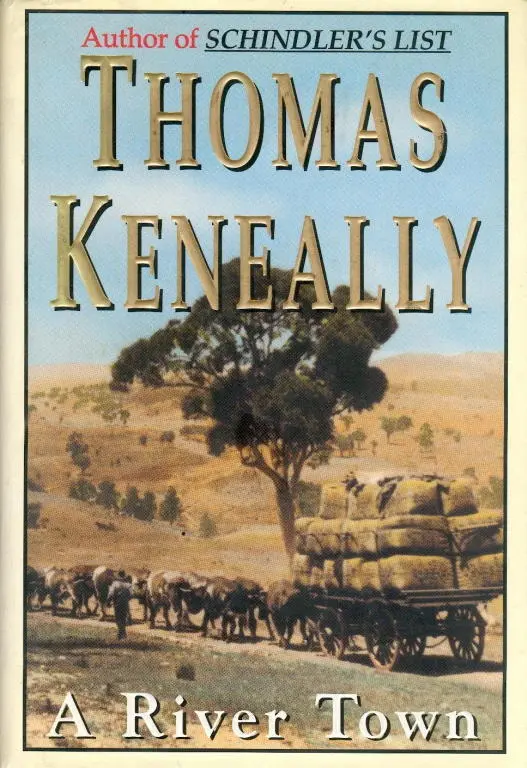
- Название:A River Town
- Автор:
- Издательство:Nan A. Talese
- Жанр:
- Год:2011
- Город:New York
- ISBN:978-0-307-80063-3
- Рейтинг книги:4 / 5. Голосов: 1
-
Избранное:Добавить в избранное
- Отзывы:
-
Ваша оценка:
A River Town: краткое содержание, описание и аннотация
Предлагаем к чтению аннотацию, описание, краткое содержание или предисловие (зависит от того, что написал сам автор книги «A River Town»). Если вы не нашли необходимую информацию о книге — напишите в комментариях, мы постараемся отыскать её.
.
A River Town — читать онлайн бесплатно полную книгу (весь текст) целиком
Ниже представлен текст книги, разбитый по страницам. Система сохранения места последней прочитанной страницы, позволяет с удобством читать онлайн бесплатно книгу «A River Town», без необходимости каждый раз заново искать на чём Вы остановились. Поставьте закладку, и сможете в любой момент перейти на страницу, на которой закончили чтение.
Интервал:
Закладка:
There were now cries of “Fenian!” and “Papist bastard!” But despite the accusations of being fatally Irish, Borger was native-born of the Macleay and had the accent to go with it.
“This war is being fought for gold, and for Jewish gold interests! Read the Bulletin and have the scales fall from your eyes. I tell you!”
Borger pursed his lips and sat down in a welter of hisses.
Old Billy Thurmond, owner of a model farm at Pola Creek, and a scientific sort of farmer, was on his feet with an Antrim voice which Tim thought of as being capable of ripping through ice and disintegrating glaciers.
“There you have, Mr. Chairman, the basis, the living reason for a black list for pro-Boer sympathisers. Borger’s not the sole one. There are others too in this hall.”
A native Australian voice took it up, the vowels slung like wet washing on a droopy, lazy line. “Botha the Boer’s down there on the river, Billy, in the bilges on Burrawong , waiting for word from Borger. He’s shitting himself they’re going to send the boys from Hickey’s Creek.”
Laughter. Joyful laughter. And safe to join in. Great mockers, the Australians. One of their graces. Billy Thurmond held out the fingers of both his hands before him crookedly. “Don’t you worry about that,” he yelled, nodding. What he knew, he knew. He cast his eyes around the hall and they lay a second at a time on all those likely to agree with Borger. The old man’s gaze hung, of course, on Tim amongst others.
“Go to buggery,” Tim muttered under his breath.
Tim saw Ernie Malcolm rise immaculate from the Treasurer’s chair, a man with a clean domestic and civil plate.
“Mr. Chairman,” Ernie said. His medallions glittered on his watch fob, each one of them a token of community service. You had to admire the bugger, and Tim did. Would there be a timetable of fětes for Kitty to attend and Tim to stand aside from without fellows like him?
His voice was strong but with an adenoidal timbre. From it, you could bet he was a snorer. There he would lie beside darkly well-ordered Mrs. Malcolm snorting like a mastiff with a bone.
“We are an equestrian nation,” said Ernie. “From childhood we think nothing of travelling huge distances on horseback.”
Kempsey to Comara and back, like Constable Hanney.
“There would be no better form for our boys to make their entry onto the world’s scene than as mounted cavalry. I would like to move a motion that a light cavalry regiment be raised from the Macleay. Its fibre would far outshine that of recruits drawn from the slums of Birmingham or Manchester.”
Ernie’s wide-set eyes shone. He was pre-awarding the medals and preparing his speech for the Argus , the Chronicle , the Sydney Morning Herald .
“I move too, that the Macleay’s willingness to recruit such a body of men be communicated, if necessary by a delegation of citizens, to Sir William Lyne, Premier of New South Wales.”
“Seconded!” shouted Billy Thurmond. There was a lot of applause and a few whistles which could have stood for votes either way. But the clapping was a sign that you never went wrong congratulating Australians on their horsemanship.
In the mêlée of general approval for Ernie’s gallantry, the tall Scot Dr. Erson had risen to his feet.
“I would like to inform the company that my brother-in-law, who is a surgeon to a company of Natal mounted gentlemen…”
This unfinished sentence itself brought a round of cheers for the popular physician’s brother, who was no doubt a charming, sportive bloke like Erson himself.
“He informs me, gentlemen, that irregular formations do well against the Boer. Men who can dismount to take shelter, then mount again quickly and be in pursuit. Marksmanship a premium, horsemanship essential. How do you describe these sorts of men? You describe them as mounted bushmen. With the greatest respect to our treasurer, Mr. Malcolm, I urge that the motion be amended and that the Premier be informed of our willingness to enlist a battalion of mounted bushmen.”
“Exactly, exactly!” men were crying.
“Well why not send bloody both?” remarked a tie-less satirical young farmer at Tim’s side. “And a bloody navy as well.”
Tim noticed with a pulse of excitement that the Offhand was amongst those who had risen now and had their arm up. There seemed to be a reluctance in dapper M. M. Chance as, knowing the press could not safely be ignored, he gestured towards the journalist. Sad to see the Offhand’s flushed face and purple gills. Tuberculosis, liquor or both. Would have made a British statesman if not for the drink.
“Sir,” said the Offhand in his cockneyish accent, redeemed a little by oratory lessons in an Anglican school of divinity. “Sir, I take both Mr. Ernie Malcolm’s point about young Australians spending their childhood on horseback, and likewise Dr. Erson’s observation that an irregular horse unit would best suit the moral temperament of the young men of Northern New South Wales. We would first, of course, need to find foreign horses for them, since there aren’t enough up-to-scratch military horses in the Macleay.”
There was a stutter of laughter. The Offhand raised his eyes to the ceiling and smiled with charming, lax lips. “I ask, what is the most common relationship between man and horse in this valley? What is the most universal competence and trade which the men of the Macleay demonstrate?”
There were cries of, “Boozing!” or, “Gin jockeying.”
Oh the black camps. The mineral spirits drunk there! Who rode out there stealthily on horseback to beget on the black gins the half-white little bastards of Greenhill or Burnt Bridge? The gin jockeys.
The Offhand picked up again in the lee of everyone’s hilarity.
“The men of this valley are above all hauliers and carters. The men of this valley, above all, know how to grease an axle, and how to get a wagon out of a bog. The men of this valley are not easily defeated by dust or mud, like—to quote Mr. Malcolm—the children of the slums of Manchester and Birmingham. I believe that we can raise from the Macleay a transportation unit unparalleled in the Empire. And since the armies of Generals Buller and Roberts and French are faced above all with this problem—the problem of supply, and problems of hygienic facilities—let the Macleay come to the party with the finest company of wagoneers imaginable under any dispensation!”
The Offhand held his arms out as if to invite applause, yet there was utter silence in the hall.
“Come, sirs,” he cried. “Men languish for want of bandage and biscuit and bullet! I refer you to the figures for deaths from camp fever. A single set of de-lousing equipment carried to the front by wagon would itself save hundreds of lives. In that sense, one Macleay Valley haulier would be worth a battalion. Given our already-expressed debt to, our dependence upon Britain Our Mother, would we not wish to make the most effective contribution? Or would we prefer merely to make the one which suits our municipal vanity?”
M. M. Chance said evenly, “Sir, Offhand, we are all used to your notorious sense of caprice.”
Offhand however was being careful to show no sign of any caprice at all. “Mr. Chance, if you consider the skills which are invested daily in bringing down to Kempsey the large timber from Kookaburra, and likewise all the daily cleverness which goes into the delivery of cream to the dairy co-operatives, then I’m sure that like me you would be struck by a seamless admiration for the craft of haulage as exercised in the Macleay.”
“I think we may be looking for a more directly martial expression,” Mr. Chance admitted.
Tim’s long, thin moustache, falling in fronds over his lips due to recent growth, was a good veil to smile behind. And so he did smile. Bravo to blazes, Offhand!
Читать дальшеИнтервал:
Закладка:
Похожие книги на «A River Town»
Представляем Вашему вниманию похожие книги на «A River Town» списком для выбора. Мы отобрали схожую по названию и смыслу литературу в надежде предоставить читателям больше вариантов отыскать новые, интересные, ещё непрочитанные произведения.








Обсуждение, отзывы о книге «A River Town» и просто собственные мнения читателей. Оставьте ваши комментарии, напишите, что Вы думаете о произведении, его смысле или главных героях. Укажите что конкретно понравилось, а что нет, и почему Вы так считаете.