Thomas Keneally - A River Town
Здесь есть возможность читать онлайн «Thomas Keneally - A River Town» весь текст электронной книги совершенно бесплатно (целиком полную версию без сокращений). В некоторых случаях можно слушать аудио, скачать через торрент в формате fb2 и присутствует краткое содержание. Город: New York, Год выпуска: 2011, ISBN: 2011, Издательство: Nan A. Talese, Жанр: Историческая проза, на английском языке. Описание произведения, (предисловие) а так же отзывы посетителей доступны на портале библиотеки ЛибКат.
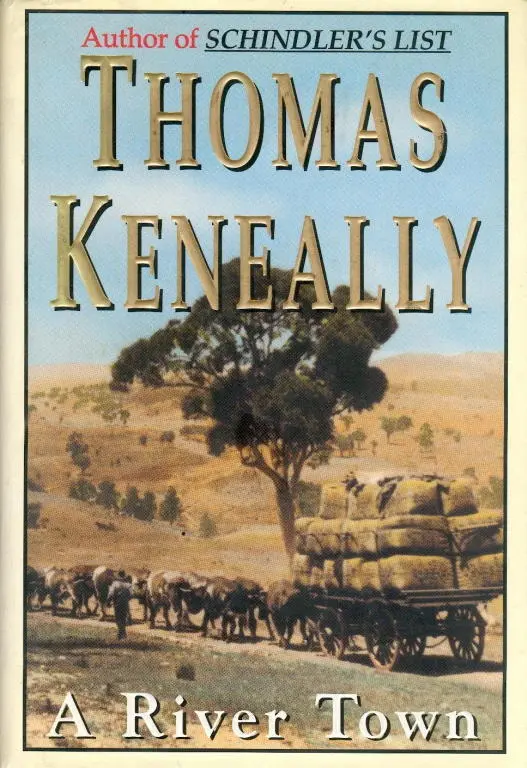
- Название:A River Town
- Автор:
- Издательство:Nan A. Talese
- Жанр:
- Год:2011
- Город:New York
- ISBN:978-0-307-80063-3
- Рейтинг книги:4 / 5. Голосов: 1
-
Избранное:Добавить в избранное
- Отзывы:
-
Ваша оценка:
A River Town: краткое содержание, описание и аннотация
Предлагаем к чтению аннотацию, описание, краткое содержание или предисловие (зависит от того, что написал сам автор книги «A River Town»). Если вы не нашли необходимую информацию о книге — напишите в комментариях, мы постараемся отыскать её.
.
A River Town — читать онлайн бесплатно полную книгу (весь текст) целиком
Ниже представлен текст книги, разбитый по страницам. Система сохранения места последней прочитанной страницы, позволяет с удобством читать онлайн бесплатно книгу «A River Town», без необходимости каждый раз заново искать на чём Вы остановились. Поставьте закладку, и сможете в любой момент перейти на страницу, на которой закончили чтение.
Интервал:
Закладка:
Still regarding herself but at least dropping the cloth back from her head, Kitty said, “Mr. Habash, you know. The hawker. I invited him in to show me material.”
“Show you? Smother you in the stuff!”
“Don’t you understand? After the child, I’ll be needing new clothes. You know that. I’ve let the old out as far as they’ll go.” She patted her abdomen. “Don’t you see I have to prepare for the little scoundrel. You were keen enough on the making of him.”
Had the hawker bedecked her? Or had his visit made her flighty enough to do it herself? Tim was frightened by the strangeness Bandy Habash had brought into Kitty’s behaviour, and angry he was not still there to be expelled from the premises.
“What if a customer came in and heard all that hooting out here in yellow cloth?”
“I’d say that I owe him the supply of kerosene and butter and soap. But nothing says I can’t sing as much as I bloody like!”
She ran her stubby little fingers over the cloth. He wouldn’t mind betting she had also bought a fresh bottle of some mad Punjabi elixir as well. He’d found the bottles in the past. Now he walked up, held her by the shoulder and unwrapped her. Beneath the golden extravagance, she wore a dress of white muslin. He let the swathes fall on the floor. “How many yards is this?” he asked.
“I needed four,” she told him, unabashed, firm. “I can use it for Anne’s dresses too.”
“There are other bloody hawkers, you know.”
“And I have regard for what they cost. Do you want me to run up a bill? I can certainly manage that but normally leave it to you.”
Again, a blow delivered. Kitty was landing all of them. He had no chance of successful rage, since the bloody little Punjabi was gone.
“You should understand,” he told her, “I’ve already warned Mr. Habash off.”
“And I’m supposed to know. Read it in the Argus I suppose.”
The bell in the shop began to ring. Someone had come in wanting something. Kitty processed out, her small hands joined in front of the bulge beneath her breasts.
Tim was restless with this slow, uneasy rage. To help contain and diffuse it he sat down at the table and read the Chronicle . Habash made all a man’s Britishness rise in him. You were going pretty well to do that in an Irishman. Bandy made you think of regiments, flashes of scarlet, take that you Dervish dogs! Such feelings came in handy for spiking up his enthusiasm for tonight’s meeting.
Good Templars’ Hall, Smith Street, Kempsey: centre of civic enthusiasms. Of sandstone quarried by the prisoners at Trial Bay, it rose two storeys and had a Greek architrave in which the symbol of masonry, the compass, had its place.
Approaching it by the gas lanterns lit by Tapley, who had once done the Empire’s time, you couldn’t see stars, and you felt you were a squat, solid citizen in a low-ceilinged world. You forgot your half-shameful, half-just rancour against the hawker and fixed on other questions. Whether to wear a tie and dress as a player in that world, or an open collar as a spectator, a contemplative observer of tonight’s argument? He’d decided on a tie, but worn casually, the top button undone. And please don’t ask me for a donation to the Patriotic Fund! I gave all I had to Imelda. The Irish Empire. The British Empire needs to get in line.
“Sure you want to go?” Kitty asked. “Look a bit weird you being there.”
“I’m going to hear the Offhand,” he said, telling part of the truth.
“Don’t you dare enlist,” she warned him as a joke. As if the Macleay’s contingent would be enlisted by the end of the meeting and marched straight past the enthusiastic citizens of the Shire to embark on the Burrawong for Cape Town or Durban!
An immense crowd inside, barely a seat left. The Offhand was already there, flushed with his evening’s drink, and holding very visibly a notebook and shorthand pencil, recording names. The names of people whose ties were done up, the names of the well-suited. Constable Hanney patrolling a side aisle, sober and unburdened tonight, without Missy, without a bewildered spouse. And on the platform, dapper M. M. Chance, and old Mr. Baylor, father of a tormented chemist in West who—the year before—had killed himself by accident, through drinking laudanum. Now Mr. Baylor was all suited up to show the Boers he meant business. To give them indirectly the hell which would be delivered in person through the hands of sleeper-cutters and dairy farmers’ sons. Why not go himself and bully them into becoming opium-eaters like his poor son?
Chance had a pleasant, smooth face, and the capacity to dress up his ideas in very appeasing language. He was a widower with two daughters everyone called brilliant. One sang duets with Dr. Erson, the second was a famous painter of the East Kempsey swamp and of the river. Chance was supporting her now as she painted in Paris, which as a city was, according to the Argus , very pro-Boer.
Everywhere, members of the Farmer’s Union wearing blue ribbons to show their high calling as owners of cattle and growers of corn. Feeders of swine as well. Willing now to discuss the form in which boys were to be sent to the cannon, to the bullet, or—even more likely—to the fevers of the encampment. One little louse, after all, more potent than a sniper. One tiny and impartial louse.
Ernie Malcolm came in from the edge of the stage. Treasurer.
At five past eight Baylor got up and called for silence and read some unintelligible minutes, which someone on the floor moved the acceptance of. Ernie Malcolm presented a financial statement and tendered various minor bills for settlement. Then Chance rose and initiated the debate on the major item of that evening’s agenda. Speaking first, moustache jutting and gleaming with wax, a hand hooked on a watch chain, easy command of the gift of oratory.
“The underpinning proposition of our existence is that we live in a robust dominion of British citizens, in a smiling land whose safety is dependent on the British fleet and on British military force. Thus, if the centre of the Empire is under threat, we are by that fact ourselves under threat. Britain stands between our smiling society and the prospect of our becoming a mongrelised province of Asia. For that reason it behoves us to help Britain in every season of her distress.”
A tall dairy farmer named Borger stood up and asked whether it were possible for Australia to depend on itself for safety?
Though there were catcalls, Mr. Chance himself seemed neither affronted nor threatened by Borger’s interjection.
“Sir, I believe the answer is obvious. We are six fledgling colonies, just now contemplating a unity of self-defence. We are dependent upon the protection of the parent. But like a maturing child, we are able to come to the mother’s defence.”
Borger would not sit down, even though people groaned. Tim thought him in a way an admirable but dangerous fellow. Like Uncle Johnny, his own political uncle from Glenlara, a Shea family secret. Uncle Johnny was Fenian “Centre”—they said at his trial in Tim’s infancy—for the whole of Cork. Denied absolution by most priests. Broke his aging mother, whom Tim remembered from funerals and weddings in the old days. Uncle Johnny harried in the newspapers. Stuck by his ideas, like Borger, and was shipped on the last convict ship to Western Australia. Ultimately pardoned, the last Tim had heard of him. Johnny named in his honour and having the same dangerous edge. Uncle Johnny now old and living in California somewhere, according to old Jerry Shea. A soul like Borger’s. A soul Tim didn’t want to have.
“Great Britain took it into its head to commit aggression against the Boers of the Transvaal, purely for the sake of British gold mining interests there. And look at it—an army so pathetic, generals so pathetic, they can’t get within coo-ee of their goal.”
Читать дальшеИнтервал:
Закладка:
Похожие книги на «A River Town»
Представляем Вашему вниманию похожие книги на «A River Town» списком для выбора. Мы отобрали схожую по названию и смыслу литературу в надежде предоставить читателям больше вариантов отыскать новые, интересные, ещё непрочитанные произведения.










Обсуждение, отзывы о книге «A River Town» и просто собственные мнения читателей. Оставьте ваши комментарии, напишите, что Вы думаете о произведении, его смысле или главных героях. Укажите что конкретно понравилось, а что нет, и почему Вы так считаете.