Jay Parini - The Last Station
Здесь есть возможность читать онлайн «Jay Parini - The Last Station» весь текст электронной книги совершенно бесплатно (целиком полную версию без сокращений). В некоторых случаях можно слушать аудио, скачать через торрент в формате fb2 и присутствует краткое содержание. Город: London, Год выпуска: 2007, ISBN: 2007, Издательство: Canongate Books, Жанр: Историческая проза, на английском языке. Описание произведения, (предисловие) а так же отзывы посетителей доступны на портале библиотеки ЛибКат.
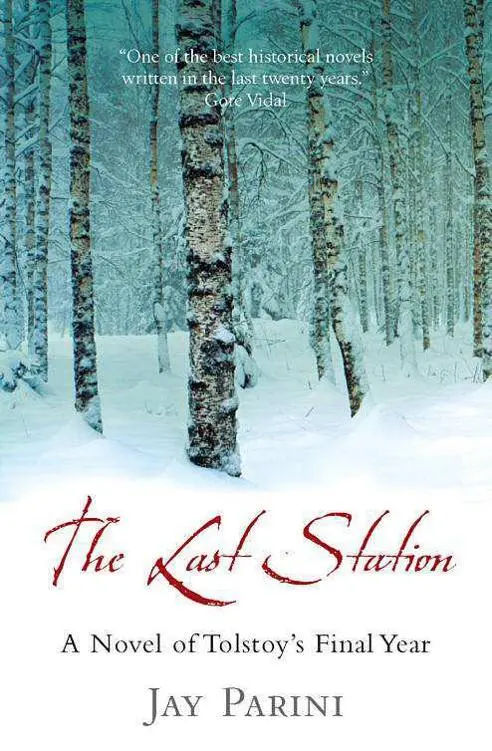
- Название:The Last Station
- Автор:
- Издательство:Canongate Books
- Жанр:
- Год:2007
- Город:London
- ISBN:978-1-84767-394-7
- Рейтинг книги:4 / 5. Голосов: 1
-
Избранное:Добавить в избранное
- Отзывы:
-
Ваша оценка:
The Last Station: краткое содержание, описание и аннотация
Предлагаем к чтению аннотацию, описание, краткое содержание или предисловие (зависит от того, что написал сам автор книги «The Last Station»). Если вы не нашли необходимую информацию о книге — напишите в комментариях, мы постараемся отыскать её.
Jay Parini moves deftly between a colorful cast of characters to create a stunning portrait of one of the world’s most treasured authors. Dancing between fact and fiction,
is a brilliant and moving literary performance.
The Last Station — читать онлайн бесплатно полную книгу (весь текст) целиком
Ниже представлен текст книги, разбитый по страницам. Система сохранения места последней прочитанной страницы, позволяет с удобством читать онлайн бесплатно книгу «The Last Station», без необходимости каждый раз заново искать на чём Вы остановились. Поставьте закладку, и сможете в любой момент перейти на страницу, на которой закончили чтение.
Интервал:
Закладка:
‘Cannibalism is evil,’ said Dushan Makovitsky.
Papa grinned. ‘My friend Trubetskoy says that cannibalism is a kind of civilization, too. Cannibals, you know, maintain that they eat only savages. Most of us, I think, would be included in their definition.’
There was a look of mixed confusion and mortification on all faces, though Bulgakov laughed out loud. Too loud, in fact. Chertkov’s minions do not dare laugh in his presence.
‘Leo Nikolayevich has quite a sense of humor,’ Chertkov noted with a grimace.
We had intended to stay only a week or so, but Papa showed not even the slightest interest in curbing his visit. He was enjoying himself too much. He began to write stories every morning, completing two in three days. If he were free from the tensions of Yasnaya Polyana, he might well begin writing novels again.
He also finished a preface to his Thoughts on Life , a collection of his work assembled by Chertkov, who never tires of that sort of thing. Reading over the preface, Vladimir Grigorevich said, ‘I like it very much, Leo Nikolayevich. But you should change one phrase. You write about the need for us to cultivate a “love of God and other beings.” What you mean, surely, is “a consciousness of God.”’
I did not like Chertkov’s presumption. He thinks he understands Papa’s work better than Papa. This is one of the things about him that annoys Mama beyond description.
I went riding with Papa and Chertkov one day, and we stopped to visit an asylum. Papa is fascinated by the insane. He says they are closer to God than we are.
Papa noted, ‘The doctors clearly regard the insane quite objectively, as medical cases, not as human beings for whom they must show pity. They are the material with which they work. I suppose it must be so, otherwise they would become demoralized.’
Everyone listened to Papa’s observations, nodding eagerly when he was done. I was a little embarrassed by their false attitude.
Papa asked the patients about their religious sentiments. He asked one gaunt, elderly man with no teeth and wild, yellow hair if he believed in God.
‘I am an atom of God,’ the man replied.
My father shook his head in assent, then asked the same question of a fat, oily-skinned woman, who said, ‘I do not believe in God. I believe in science. God and science cannot exist together.’
Papa was taken by the clarity of her remark and asked Chertkov to write it down so that he could record it later in his diary.
That afternoon, before dinner, a delegation of children from the local orphanage came to Chertkov’s house with flowers for Papa. He greeted them with affection, kissing the little girls and rubbing his knuckles over the boys’ shaven heads. Chertkov appeared from the next room carrying a boxful of photographs of Papa on horseback. He passed them out to the children, who received them in silent gratitude.
‘Is this you?’ one of the smaller girls asked my father.
‘I’m afraid I cannot deny it,’ he said. He bent to kiss her on the forehead, but she withdrew. ‘An old man is a very ugly thing,’ he said.
The next day we received the news that Chertkov would be allowed to return to Telyatinki on a temporary basis. Papa quivered with joy. He wrung his hands, both blood-bright, and shifted from foot to foot like a schoolboy. I liked seeing him so happy.
Chertkov speculated, quite rightly, that this temporary permission will probably be extended indefinitely if he does not publish ‘inflammatory’ pieces. Such strictures are distasteful to him, he said, but he understands the practical need to be close to Yasnaya Polyana and will ‘behave’ himself.
‘That’s like asking an ass not to brae,’ Papa said.
Chertkov assumed his usual arctic stare. He can hardly bear it when Papa teases him.
At last the weather grew heavy, with storm clouds swirling in the sky. It was raining hard, a diagonal June rain that turned the garden behind Meshcherskoye into black mud. That night, after dinner, a telegram arrived from Varvara. It startled the entire company: ‘Sofya Andreyevna’s nerves dreadful. Insomnia, weeping. Pulse is 100. Please telegraph.’
I felt sorry for Varvara. Mama was putting unnatural pressure on her, trying to pull her into the expanding web of madness that she spins for herself.
Two hours later, as we drank glasses of tea by a fire, a second telegram arrived, from Mama herself: ‘I beg of you, hurry back. Tomorrow.’
I took Papa off by himself into his room. ‘You must not give in to her,’ I told him.
‘She is unwell.’
‘She’s faking it. She always does this. It’s a trick to get you to go home before you’re ready.’
‘I’ve been here quite a long time.’
‘A few days! Anyway, Erdenko is coming tonight.’ Erdenko is the most celebrated violinist in Russia, and Papa cannot resist a good musical performance, even though he disapproves of taking too much pleasure in music.
He wrote a telegram: ‘More convenient return tomorrow. Unless indispensable.’
‘I’ll send it immediately,’ I said.
Everyone was pleased with Papa for not giving in. Alas, only a few hours later, a brief reply from Mama was delivered. ‘Indispensable,’ she wired.
‘You mustn’t cave in,’ I said to Papa. ‘There will be no end to her demands if she sees that she can force you to come and go at whim.’
Papa insisted that she is unwell, not physically but mentally. ‘She cannot help herself,’ he said. ‘It is my duty. I am glad of a chance to do my duty.’ More to himself than to me, he added, ‘God help me.’
I went to my room and, for the first time in some years, prayed. I prayed for Papa, whose burden grows heavier each day. I sensed that, soon, he would crack under the weight. A man of his age can carry only so much without breaking.
22
J. P.
SONYA: A SESTINA
On my knees, still praying, by the blackened pond.
I watch the moon’s bare sickle and the stars
that fleck and burn my skin, asking the God
of thunder to avenge me now, to cleanse or kill
the enemy without, within, to make love
blaze like this wild grassfire, searing wind.
I feel it rising in the wood, hot wind
across the world. It stipples the black pond
and wakens what I used to know of love,
that whirling zodiac of flinty stars
that filled my nights. It’s easier to kill
now, kill what hurts. To spit at God.
What have I come to, railing at my God?
Deliver me, O Lord. Let fiery wind
rise through my hair. Why should I kill
what I love best? I’ll float above the pond
tonight like moonglow, flaking stars.
I’ll fill the water, overwhelmed by love.
It’s what I live for: love, bright love
that starts, as always, in the eye of God,
then spills through dark, ignites the stars,
the fields and forests with its blazing wind
and marks the surface of my little pond,
a skin of fire. I’d never want to kill
what I love best. I may scream kill
and kill as Cain did in my heart. But love
prevents me, buoys me up. It’s like a pond
that holds and fills me with the light of God,
a love of man. I listen to the wind
that scatters, blows, and sparks a billion stars.
I’m on my knees still, scattered like the stars.
If I am nothing, what is there to kill?
I’m piecemeal, pierced, and parcel of the wind,
with nothing left to love or not to love.
I’m one bright atom in the mind of God,
almost extinguished here beside the pond.
I’m full of stars and, maybe, full of love.
I’ll kill whatever in me turns from God,
avoids hot wind, the heart’s black pond.
Интервал:
Закладка:
Похожие книги на «The Last Station»
Представляем Вашему вниманию похожие книги на «The Last Station» списком для выбора. Мы отобрали схожую по названию и смыслу литературу в надежде предоставить читателям больше вариантов отыскать новые, интересные, ещё непрочитанные произведения.





Обсуждение, отзывы о книге «The Last Station» и просто собственные мнения читателей. Оставьте ваши комментарии, напишите, что Вы думаете о произведении, его смысле или главных героях. Укажите что конкретно понравилось, а что нет, и почему Вы так считаете.