Stewart Binns - Conquest
Здесь есть возможность читать онлайн «Stewart Binns - Conquest» весь текст электронной книги совершенно бесплатно (целиком полную версию без сокращений). В некоторых случаях можно слушать аудио, скачать через торрент в формате fb2 и присутствует краткое содержание. Город: London, Год выпуска: 2011, ISBN: 2011, Издательство: Penguin Books, Жанр: Историческая проза, на английском языке. Описание произведения, (предисловие) а так же отзывы посетителей доступны на портале библиотеки ЛибКат.
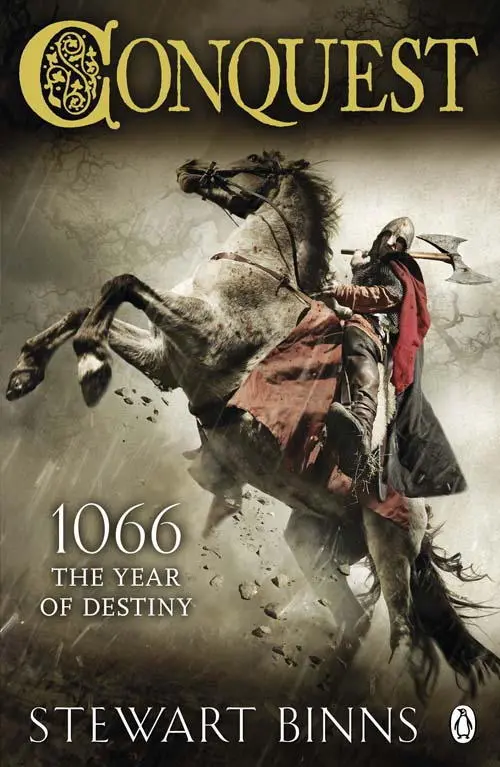
- Название:Conquest
- Автор:
- Издательство:Penguin Books
- Жанр:
- Год:2011
- Город:London
- ISBN:978-0-141-96059-3
- Рейтинг книги:5 / 5. Голосов: 1
-
Избранное:Добавить в избранное
- Отзывы:
-
Ваша оценка:
Conquest: краткое содержание, описание и аннотация
Предлагаем к чтению аннотацию, описание, краткое содержание или предисловие (зависит от того, что написал сам автор книги «Conquest»). Если вы не нашли необходимую информацию о книге — напишите в комментариях, мы постараемся отыскать её.
The battle is hard fought and bloody, the lives of thousands have been spent, including that of King Harold. But England will not be conquered easily, the Anglo-Saxons will not submit meekly to Norman rule.
Although his heroic deeds will nearly be lost to legend, one man unites the resistance. His name is Hereward of Bourne, the champion of the English. His honour, bravery and skill at arms will change the future of England. His is the legacy of the noble outlaw.
This is his story.
Conquest — читать онлайн бесплатно полную книгу (весь текст) целиком
Ниже представлен текст книги, разбитый по страницам. Система сохранения места последней прочитанной страницы, позволяет с удобством читать онлайн бесплатно книгу «Conquest», без необходимости каждый раз заново искать на чём Вы остановились. Поставьте закладку, и сможете в любой момент перейти на страницу, на которой закончили чтение.
Интервал:
Закладка:
Hereward and Alphonso had sufficient status and finery to gain an audience with the Bishop of Urgel. A man of great charm, he invited them to stay with him for a couple of days to rest themselves and their horses. With Alphonso acting as translator, they told of their journeys and campaigns. The Bishop talked of Spain, the Moors and, most importantly, Rodrigo Diaz of Bivar.
His was an interesting tale, not without parallels to Hereward’s story. Ferdinand I, King of Castile, León and Galicia had died at Christmas 1065, almost exactly the same time as Edward had passed away in England. Unlike Edward, who had died without heirs, Ferdinand had three sons. Almost certainly well intentioned, if a little naïve, he had divided his kingdom into three parts: to his eldest son, Sancho, he gave Castile; to his favourite son, Alphonso, he gave León; and to his youngest son, Garcia, he gave Galicia.
Rodrigo Diaz of Bivar was ‘Armiger’, or Champion, to Sancho, the strongest of the three brothers. As part of his father’s legacy to him, Sancho had inherited tributes to Castile from the Taifa fiefdom of Zaragoza. Sensing weakness after the death of Ferdinand, Zaragoza refused to pay, so Rodrigo was despatched to persuade them that their actions were less than prudent.
In a display of remarkable bravery, Rodrigo left his large force at the gates of the city, demanded entry and rode in alone. Then, in the central square of the city with all its knights, men-at-arms and citizens watching, he offered to release Zaragoza from its obligation to Castile if any man could unseat him from his horse. However, such was his reputation that no one dared accept his challenge and he left for Castile laden with all the city’s tributes packed into chests.
In the summer of 1067, Sancho of Castile had also exerted his influence over his neighbours to the east – Aragon and Navarre. In what became known as the ‘War of the Three Sanchos’, Sancho of Castile campaigned against his cousins, Sancho IV of Navarre and Sancho Ramirez of Aragon, and succeeded in expanding his territories. Rodrigo was the outstanding leader of Castile’s forces and, in a series of brilliant manoeuvres, he forced the Sanchos of Navarre and Aragon to recognize Sancho of Castile as their lord. This triumph, in addition to the mystique that already surrounded him following his many victories in jousts and hand-to-hand combats, made Rodrigo’s reputation as a legendary warrior complete. His prowess had earned him a title by which he was known throughout Spain, ‘El Cid’. It was an Arabic epithet, meaning ‘The Master’.
In November 1067, Ferdinand’s widow, the Dowager Queen Sancha, died. While she was alive, her three sons had maintained a grudging acceptance of their father’s tripartite endowment, but as soon as she died, hostility between the brothers began to grow. This culminated in a huge battle at Llantada, on the border between Castile and León, in July 1068, when Rodrigo once more led King Sancho II’s forces to victory. An uneasy truce had since held between the three of them, in which both Garcia of Galicia and Alphonso of León recognized that, with Rodrigo at his side, Sancho was the first among the triumvirate of equals.
Hereward and Alphonso’s kindly host told them that Rodrigo was to be found spending the winter in the north of León, at the court of his friend Count Diego of Oviedo. It would be another long trek for the two friends, taking them even further from England.
But based on Pedro’s stirring account of Rodrigo’s prowess, both agreed it was a venture worth undertaking.
20. The Cid
By the time Hereward and Alphonso left Urgel, they were both impatient to meet Rodrigo Diaz. They talked about him constantly as they journeyed across ancient lands and saw places Hereward had heard of from Alphonso’s stories: San Juan de la Pena with its imposing monastery, Pamplona, home to the fiercely proud Basque peoples, and Burgos and León, capital cities of the noble lands of Castile and León. Hereward liked what he saw, but the land was demanding of its inhabitants – bitingly cold in winter and searingly hot in summer. Its peoples needed to be rugged and independent. He decided there were many similarities between Spain and his own land. Just as its many kingdoms had buried their differences to fight the Moors, perhaps the Celts, Danes and Saxons would unite to defeat William.
The Bishop of Urgel’s stories about The Cid had been a rude reminder of the passage of time: Hereward was now approaching his thirty-fourth birthday, whereas Bishop Pedro estimated that The Cid was only about twenty-five. Perhaps the younger man could offer Hereward some insight that would be the vital key to oust William from his palace at Westminster.
Oviedo was an impressive fortified town with an imposing cathedral. Count Diego, a rotund, jovial man with long grey whiskers, had been a staunch ally and good friend to Sancho’s father, Ferdinand, and had fought many battles with him. As a pragmatic ruler and a firm believer in order and discipline, he approved of Sancho enforcing his authority over his two brothers, believing it preferable that the Christians of the north be united against the threat from the Muslims of the south. He was also blunt about the Moors. Although he thought them keenly intelligent and in possession of a wealth of knowledge from antiquity, they were not Christians. Moreover, even though he had fought both with them and against them and knew they were brave and honourable, they nevertheless worshipped a different God. For him it was straightforward: they had brought their heresy to Spain many years ago and it was time for them to go back to where they belonged.
Hereward and Alphonso arrived in the Great Hall of Count Diego in some style. They had cleaned their tunics, weapons and armour and Hereward’s unmistakable hallmark, the Great Axe of Göteborg, shone like a newly forged weapon.
With Alphonso acting as translator, the Count’s Chamberlain introduced the guests. ‘Lord Diego, I present Hereward of Bourne, formerly in the service of Harold I, King of England. With him is his sergeant-at-arms, Alphonso of Granada.’
‘Welcome to Oviedo, Hereward of Bourne.’ Count Diego was polite but perplexed.
This Englishman had made a grand entrance and had the bearing and weapons of a lord, but without the title. Fearing that he had been deceived into welcoming a mercenary, he cast a look of annoyance at his Chamberlain, but the man to the Count’s right, who Hereward immediately sensed must be The Cid, intervened.
‘I have heard of this man, my Lord Diego. Fear not, you are right to offer him a welcome worthy of a nobleman, for that, beyond any doubt, is what he is.’ The Cid looked directly at Hereward. ‘Forgive me for talking across you, Hereward of Bourne, but your admirable modesty has put my good friend Count Diego at a disadvantage. May I introduce myself? I am Rodrigo Diaz of Bivar, Armiger to Sancho of Castile.’
‘Alphonso and I are honoured to be given an audience by the Count of Oviedo and to meet Rodrigo of Bivar.’
Rodrigo addressed Diego, who was now looking much more relaxed. ‘I hear that Hereward of Bourne has been offered many titles and refused them all. There are myriad legends that pass from traveller to traveller about his exploits.’ He turned to Hereward. ‘Tell me, noble Englishman, are they all true?’
‘My Lord Rodrigo, I’m certain they’ve become embellished in the telling –’
The Count interrupted. ‘You two have something in common. Rodrigo accepts no title either, so you can call one another by whatever names you choose. But may I remind you that, until I deem it otherwise, I am your Lord, Count Diego.’
Everyone laughed.
Hereward looked at Rodrigo and saw much in him that he recognized. The Castilian was not as tall, and had olive skin and hair the colour of chestnuts, but he was powerfully built and his hands were gnarled and calloused from many blows and long hours of weapons training. He wore a long ruby-coloured smock, fastened with a broad leather belt, and across his shoulders was draped a magnificent bearskin cloak fastened by a finely tooled bronze clasp. His leggings were winter riding breeches, and he had boots of the finest leather. Rodrigo’s armour, which adorned a mannequin behind the high table, was comprised of a small circular shield like those of the Saracens, a straight thrusting sword, a style preferred by northern Europeans, and a small axe with a crescent-shaped blade. He also had a long lance for use in jousts and cavalry charges, and a smaller javelin, a weapon to be hurled at the enemy in an infantry encounter. His weapons were in beautiful condition, but it was obvious they had been used frequently; his mail coat, though finely worked, bore the cuts and gouges of many blows.
Читать дальшеИнтервал:
Закладка:
Похожие книги на «Conquest»
Представляем Вашему вниманию похожие книги на «Conquest» списком для выбора. Мы отобрали схожую по названию и смыслу литературу в надежде предоставить читателям больше вариантов отыскать новые, интересные, ещё непрочитанные произведения.










Обсуждение, отзывы о книге «Conquest» и просто собственные мнения читателей. Оставьте ваши комментарии, напишите, что Вы думаете о произведении, его смысле или главных героях. Укажите что конкретно понравилось, а что нет, и почему Вы так считаете.