Stewart Binns - Conquest
Здесь есть возможность читать онлайн «Stewart Binns - Conquest» весь текст электронной книги совершенно бесплатно (целиком полную версию без сокращений). В некоторых случаях можно слушать аудио, скачать через торрент в формате fb2 и присутствует краткое содержание. Город: London, Год выпуска: 2011, ISBN: 2011, Издательство: Penguin Books, Жанр: Историческая проза, на английском языке. Описание произведения, (предисловие) а так же отзывы посетителей доступны на портале библиотеки ЛибКат.
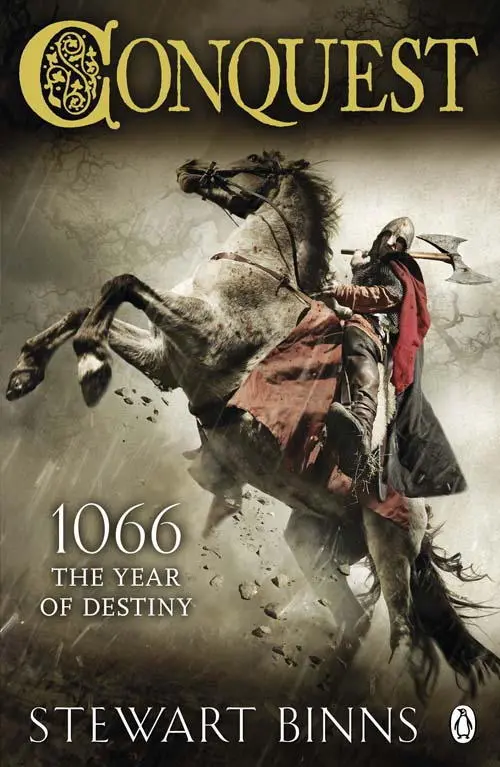
- Название:Conquest
- Автор:
- Издательство:Penguin Books
- Жанр:
- Год:2011
- Город:London
- ISBN:978-0-141-96059-3
- Рейтинг книги:5 / 5. Голосов: 1
-
Избранное:Добавить в избранное
- Отзывы:
-
Ваша оценка:
Conquest: краткое содержание, описание и аннотация
Предлагаем к чтению аннотацию, описание, краткое содержание или предисловие (зависит от того, что написал сам автор книги «Conquest»). Если вы не нашли необходимую информацию о книге — напишите в комментариях, мы постараемся отыскать её.
The battle is hard fought and bloody, the lives of thousands have been spent, including that of King Harold. But England will not be conquered easily, the Anglo-Saxons will not submit meekly to Norman rule.
Although his heroic deeds will nearly be lost to legend, one man unites the resistance. His name is Hereward of Bourne, the champion of the English. His honour, bravery and skill at arms will change the future of England. His is the legacy of the noble outlaw.
This is his story.
Conquest — читать онлайн бесплатно полную книгу (весь текст) целиком
Ниже представлен текст книги, разбитый по страницам. Система сохранения места последней прочитанной страницы, позволяет с удобством читать онлайн бесплатно книгу «Conquest», без необходимости каждый раз заново искать на чём Вы остановились. Поставьте закладку, и сможете в любой момент перейти на страницу, на которой закончили чтение.
Интервал:
Закладка:
They searched and searched; days passed, then weeks. No sign of her was to be found. She had disappeared from their lives.
Hereward’s despair at the loss of his beloved Torfida only worsened as time passed. His girls were bewildered and hurt and desperately needed their father’s love. He tortured himself with constant questions. Had Torfida returned to the life her father had lived – as a hermit of the forest – consumed by anger for what had happened? If so, why could they not find her? Had her journey been an aimless meander, without a destination? Even so, she must have left a trace somewhere, or been seen by someone. Was she still in search of herself and her destiny? But why had she abandoned everything she cared for and left everyone she loved, especially her children? Had she taken her own life? Surely, it was not possible that Torfida could have committed such a desperate act. After months of anguish, Hereward’s grief turned to resentment that she had left him without a word of explanation.
Torfida had come into his life cloaked in mystery, the result of a prophecy; she left it in an unfathomable riddle.
It was only when the long days of summer began to shorten in the late autumn of 1067 that Hereward’s loyal companions began to tire of his increasingly futile searches for Torfida.
A summit was called by Einar at which they challenged Hereward and, although he protested, stood their ground. Their strongest argument was the future of the children. Given that Earls Edwin and Morcar had submitted to William, Hereward was once again an outlaw and the Duke would hunt him down without mercy. They insisted that Hereward follow the advice he had so earnestly given to Torfida in the event of his death on Senlac Ridge: ‘Go south, to Aquitaine, to Castile or León.’
It was a part of the world Alphonso knew well, and he gave a vivid description of the lands he loved: they were prosperous, rich of harvest, warm, both in climate and in the demeanour of their peoples, and a long way from England’s trauma. Hereward offered only token resistance to the plan. In his heart, he knew Torfida had gone. He had always been able to sense her presence, even when they were apart; now there was only a void.
England was also in despair. William’s grip on the country was tightening and his henchmen were building their mottes and baileys all over the land. Whenever a hint of resistance appeared, it was extinguished with a ferocity that struck fear into the hearts of Englishmen of all ranks.
After the decision to leave England had been taken, the family chose Aquitaine as their destination. There had been recent squabbles between the princes in Spain’s Castile and León, so the peaceful domain of the Count of Toulouse was their considered choice. Einar took charge of the journey and Ingigerd and Maria became surrogate mothers to Gunnhild and Estrith.
Passage south was secured on a trading vessel, plying its wares between Exeter and St Brieuc in Brittany. After several more days on a Basque merchantman, the warmth of the south began enveloping them as they arrived in Bordeaux at the mouth of the Garonne, the great trading river of Aquitaine. From there, they travelled east by river barge along the ancient arteries of the Garonne and the Lot, famous for the exchange of wine, walnuts, truffles and prunes. Their route took them deep into a hinterland of forest and limestone plateaux, until they reached the city of Cahors.
Roger Guiscard had often talked about Cahors when Hereward served with him in Sicily. He had lands there and said that it was an ideal place to start a new life. An old Roman settlement on the river Lot, it was home to merchants, bankers and artisans and a city far richer than most in Europe. It sat unobtrusively amid vast areas of farmland, vineyards and forest, far removed from the anxieties of the rest of Europe.
Torfida would have approved: there were fine churches and towering bridges, wealthy residences and flourishing markets, and the climate was warm and dry. The family spent the winter in the city, in a large house rented from a banker from Lombardy, allowing them time to plan their future and decide whether Aquitaine was to their liking. By the time they agreed that it was a place where they could settle, it was early spring 1068.
England and all its turmoil and sadness were suddenly a long way away.
19. A Message from the Grave
By any standards, Hereward and his family were rich. King Harold had made generous provision for them – a legacy which might well have included an earldom, had the outcome of 14 October 1066 been different. Hereward insisted that his windfall be shared equally between the entire family, and they decided to buy a large estate several miles east of Cahors at the promontory of St Circ Lapopie. The remote settlement had many acres of vines, which produced the renowned ‘black’ wine of Cahors, known throughout Europe since Roman times. It had endless orchards of plums, grown for prunes, a local speciality, plantations of walnut trees, which produced much sought after nuts and oil, and truffles in abundance in its vast forests of scrub oaks. It was an idyllic setting.
News of the presence of Hereward soon reached the court of the Count of Toulouse, who was Lord of Quercy, the domain in which Cahors was located. The Count sent his Chancellor to welcome the English settlers and inform them of their feudal responsibilities, which included the payment of annual tithes. The Chancellor also brought an open invitation to attend the Count’s court in Toulouse. Hereward’s reply was gracious but, content just to pay their dues and avoid the trappings and intrigues of court, he never took up the invitation.
Hereward’s melancholy did not improve, despite the charms of their new home, but Martin and Einar took to farming and their lordly duties with great enthusiasm. Their families were healthy and growing to maturity, well away from the dangers they had previously faced in their lives. The serenity of St Circ Lapopie was beginning to have an effect and life for the migrants soon settled into a harmonious rhythm of contentment.
Only Alphonso, ever the loner, seemed restless. He and Hereward spent more and more time talking, usually about their campaigns and battles, and often went on extended hunting trips deep into the vast wilderness of the Causse de Limogne that surrounded their lands.
William had returned to England from Normandy in the summer of 1067, refreshed and ready for the enormous task of subduing the hinterland of his newly conquered realm. Although William was the anointed King and more and more Norman opportunists were arriving every day, there were still only 25,000 foreigners trying to rule an Anglo-Saxon population of close to a million. Even accounting for the slaughter on Senlac Ridge, every burgh and village was home to a body of men with extensive military training – and they did not take kindly to being oppressed by foreign rulers. Harold’s sons, led by his firstborn, Godwin Haroldson, had begun to raid the West Country from their base in Ireland. However, what the English lacked was organization and leadership, and they needed both quickly.
Conversely, the Normans had strong leadership and organizational skills in abundance. William had begun to campaign further and further from London, building imposing fortifications at every strategic vantage point, and he now restructured the taxation system so that wealth flowed into Norman coffers in vast quantities. His catechism of rule had only two lines of doctrine: total obedience and the severest punishments for any misdemeanour. The greater part of the English population was terrified, and William did not forego any opportunity to intensify their fear.
He campaigned throughout the autumn and winter and was still on the march in the summer of 1068. Thousands were slaughtered – women and children included – whole towns and villages were made examples of, and the scale of the atrocities cowed the people and shocked the rest of Europe.
Читать дальшеИнтервал:
Закладка:
Похожие книги на «Conquest»
Представляем Вашему вниманию похожие книги на «Conquest» списком для выбора. Мы отобрали схожую по названию и смыслу литературу в надежде предоставить читателям больше вариантов отыскать новые, интересные, ещё непрочитанные произведения.










Обсуждение, отзывы о книге «Conquest» и просто собственные мнения читателей. Оставьте ваши комментарии, напишите, что Вы думаете о произведении, его смысле или главных героях. Укажите что конкретно понравилось, а что нет, и почему Вы так считаете.