Stewart Binns - Crusade
Здесь есть возможность читать онлайн «Stewart Binns - Crusade» весь текст электронной книги совершенно бесплатно (целиком полную версию без сокращений). В некоторых случаях можно слушать аудио, скачать через торрент в формате fb2 и присутствует краткое содержание. Город: London, Год выпуска: 2012, ISBN: 2012, Издательство: Penguin Books, Жанр: Историческая проза, на английском языке. Описание произведения, (предисловие) а так же отзывы посетителей доступны на портале библиотеки ЛибКат.
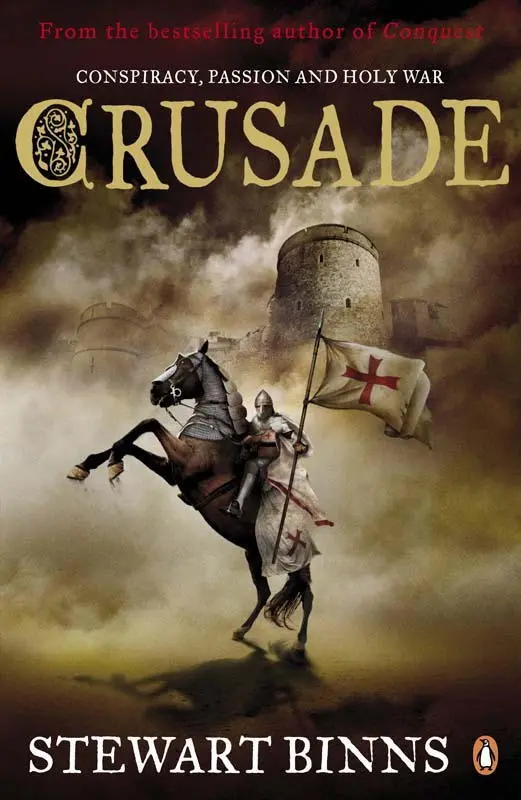
- Название:Crusade
- Автор:
- Издательство:Penguin Books
- Жанр:
- Год:2012
- Город:London
- ISBN:978-0-241-95758-5
- Рейтинг книги:3 / 5. Голосов: 1
-
Избранное:Добавить в избранное
- Отзывы:
-
Ваша оценка:
Crusade: краткое содержание, описание и аннотация
Предлагаем к чтению аннотацию, описание, краткое содержание или предисловие (зависит от того, что написал сам автор книги «Crusade»). Если вы не нашли необходимую информацию о книге — напишите в комментариях, мы постараемся отыскать её.
In the face of chaos and death, Edgar and his allies form a secret brotherhood, pledging to fight for justice and freedom wherever they are denied. But soon they are called to fight for an even greater cause: the plight of the Holy Land. Embarking on the epic First Crusade to recapture Jerusalem, together they will participate in some of the cruellest battles the world has ever known, the savage Siege of Antioch and the brutal Fall of Jerusalem, and together they will fight to the death.
Crusade — читать онлайн бесплатно полную книгу (весь текст) целиком
Ниже представлен текст книги, разбитый по страницам. Система сохранения места последней прочитанной страницы, позволяет с удобством читать онлайн бесплатно книгу «Crusade», без необходимости каждый раз заново искать на чём Вы остановились. Поставьте закладку, и сможете в любой момент перейти на страницу, на которой закончили чтение.
Интервал:
Закладка:
Another word for money in Dutch and German (‘gelt’ in Yiddish), in medieval England it meant tax, or tribute or a ransom – as in Danegeld.
A small tailed flag or banner, flown from the top of a lance or pole to indicate lordly status, common throughout Europe. It would carry the colours, crest or heraldry of its owner.
The secret weapon of the Byzantine emperors. A sort of ancient napalm, it was invented by a Syrian engineer, a refugee from Baalbek, in the Egyptian city of Heliopolis in 673 AD. The mix of ingredients, a closely guarded secret, was reputedly handed down from emperor to emperor. It has remained a secret to this day, but is thought to be a combination of pitch, sulphur, tree resin, quicklime and bitumen. The key ingredient may well have been magnesium, which would explain why the ‘fire’ would burn under water.
A hammer-beam roof allows a span greater than the length of any individual piece of timber. In place of a normal tie beam spanning the entire width of the roof, short beams – the hammer beams – are supported by curved braces from the wall, and further structure is built on top of the hammer beams. The earliest hammer-beamed building still standing in England (built in 1308) is located in Winchester, in Winchester Cathedral Close, next to the dean’s garden, and is known as the Pilgrims’ Hall, now part of the Pilgrims’ School. The roof of Westminster Hall (1395–9) is a fine example of a hammer-beam roof. The span of the hall is 68 feet 4 inches, and the opening between the ends of the hammer beams 25 feet 6 inches. The height from the paving of the hall to the hammer beam is 40 feet, and to the underside of the collar beam 63 feet 6 inches, so an additional height in the centre of 23 feet 6 inches has been gained by the use of hammer beams.
HAUBERKA chain-mail ‘coat’ worn like a long pullover down below the groin. Hauberks for the infantry were slightly shorter so that the men could run in them, and were split only at the sides. Cavalry hauberks extended almost to the knee and were split front and back. The mail could extend into a hood (ventail), like a balaclava, but had a flap in front of the throat and chin that could be dropped for comfort when not in the midst of battle. Three kinds of mail were used and were progressively more expensive: ordinary ring mail, scale mail and lamellar mail (in which overlapping individual plates were fastened together by leather thongs).
The elite bodyguard of kings, princes and lords of the ninth, tenth and eleventh centuries.
Not a fixed area but an amount of land sufficient to support a family, which became a unit subject to a ‘geld’ tax. The geld would be collected at a stated rate per hide. After the Norman Conquest, hidage was recorded in the Domesday Book of 1086 and stayed in use until the end of the twelfth century.
HOUSECARLSThe elite troops of the Anglo-Saxon kings, following their establishment by King Cnut in 1016, in the Danish tradition. Cnut brought his own personal troops to supplement the English fyrd (citizen army) when he succeeded to the throne following the death of Edmund Ironside.
A traditional Norse ship, a modified form of the Viking longship, but used as a cargo vessel.
Armour made from small iron plates tied together with leather ( see hauberk).
A heavy bronze-headed mace favoured by Saracen (Muslim) warriors.
The most decisive victory of the reign of Alexius I, Emperor of Byzantium. On 29 April 1091, an invading force of Pechenegs was defeated by the combined forces of the Byzantine Empire and its Cuman allies (nomadic warriors of the Eurasian Steppe, related to the Pechenegs). The outcome was a massacre on a terrible scale. The Pechenegs went into battle with their entire families. Few survived; those who did were taken into slavery by the Byzantines.
An Arab soldier, usually an infantryman. Born a slave, he would make his way in life as a professional soldier.
Plural of Manceau, an inhabitant of Le Mans or Maine, the province of France between Anjou and Normandy.
Fought between the Byzantine Empire and the Seljuk Turks led by Alp Arslan on 26 August 1071 near Manzikert (modern Malazgirt in eastern Turkey). The devastating defeat of the Byzantine army and the humiliating capture of the Emperor Romanos IV Diogenes brought the empire to the brink of annihilation, destroyed Byzantine authority in Anatolia and Armenia, and allowed the Turks to populate Anatolia.
An ancient drink, common to many lands. It was a potent and popular concoction in Britain for hundreds of years. It is made from honey, water and yeast. Fruit or spices can be added for alternative flavours. It can be very alcoholic, was thought to be a powerful aphrodisiac and was often given to newlyweds to boost fertility.
A domestic waste dump for a village or burgh. A word of Scandinavian origin, it is still in use in Scotland and the English Pennines.
A code of knightly ethics, loosely based on the ancient noble tradition of the Roman aristocracy and the influence of Islamic ethics, such as those of the Futuwwa, which appeared in the late eleventh century and formed the basis of the values of the Age of Chivalry.
A motte (a large mound of earth topped by a wooden and then, later, by a stone castle) surrounded by a bailey (an enclosed courtyard, encircled by a fortified wall) was the archetypal Norman fortification, used to subdue and intimidate the defeated Saxons. Most of the medieval castles of England, such as Windsor and the Tower of London, started life as motte and bailey constructions in the 1070s and 1080s.
MUSLIMIn a historical context, the words ‘Muslim’ (a follower of the religion of Islam), ‘Saracen’ (usually applied to the Muslim armies that opposed the Crusades) and ‘Moor’ (usually applied to the Arab peoples of North Africa and Spain) are often used interchangeably. The word ‘Arab’ defines the Semitic peoples who originated in Arabia and whose influence spread across the Middle East and North Africa in the seventh and eighth centuries. Sunni and Shia Islam are the two major denominations of Islam. Approximately 80–90 per cent of the world’s Muslims are Sunni and 10–20 per cent are Shia, with most Shias belonging to the ‘Twelver’ tradition (derived from their belief in twelve divinely ordained leaders, known as the Twelve Imams) and the rest divided between several other groups. Sunnis are a majority in most Muslim communities in South-east Asia, China, South Asia, Africa and most of the Arab World. Shias make up the majority of the population in Iran, Iraq, Azerbaijan and Bahrain, and they are the largest religious group in Lebanon (collectively called the Shia Crescent), while Pakistan has the second largest Shia Muslim population in the world. The historic background of the Sunni–Shia split lies in the schism that occurred when the Islamic prophet Muhammad died in the year 632 AD, leading to a dispute over succession that culminated in the Battle of Siffin. Sectarian violence persists to this day from Pakistan to Yemen and is a major element of friction throughout the Middle East. Over the years Sunni–Shia relations have been marked by both cooperation and conflict, often with deadly violence. A period of relative harmony during most of the twentieth century has recently been replaced by conflict. Today there are differences in religious practice, traditions and customs as well as religious beliefs.
Читать дальшеИнтервал:
Закладка:
Похожие книги на «Crusade»
Представляем Вашему вниманию похожие книги на «Crusade» списком для выбора. Мы отобрали схожую по названию и смыслу литературу в надежде предоставить читателям больше вариантов отыскать новые, интересные, ещё непрочитанные произведения.



Обсуждение, отзывы о книге «Crusade» и просто собственные мнения читателей. Оставьте ваши комментарии, напишите, что Вы думаете о произведении, его смысле или главных героях. Укажите что конкретно понравилось, а что нет, и почему Вы так считаете.