Stewart Binns - Crusade
Здесь есть возможность читать онлайн «Stewart Binns - Crusade» весь текст электронной книги совершенно бесплатно (целиком полную версию без сокращений). В некоторых случаях можно слушать аудио, скачать через торрент в формате fb2 и присутствует краткое содержание. Город: London, Год выпуска: 2012, ISBN: 2012, Издательство: Penguin Books, Жанр: Историческая проза, на английском языке. Описание произведения, (предисловие) а так же отзывы посетителей доступны на портале библиотеки ЛибКат.
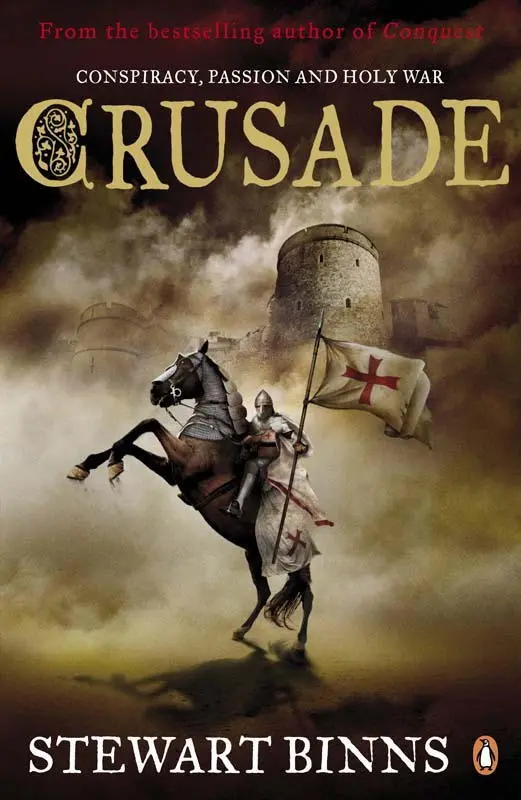
- Название:Crusade
- Автор:
- Издательство:Penguin Books
- Жанр:
- Год:2012
- Город:London
- ISBN:978-0-241-95758-5
- Рейтинг книги:3 / 5. Голосов: 1
-
Избранное:Добавить в избранное
- Отзывы:
-
Ваша оценка:
Crusade: краткое содержание, описание и аннотация
Предлагаем к чтению аннотацию, описание, краткое содержание или предисловие (зависит от того, что написал сам автор книги «Crusade»). Если вы не нашли необходимую информацию о книге — напишите в комментариях, мы постараемся отыскать её.
In the face of chaos and death, Edgar and his allies form a secret brotherhood, pledging to fight for justice and freedom wherever they are denied. But soon they are called to fight for an even greater cause: the plight of the Holy Land. Embarking on the epic First Crusade to recapture Jerusalem, together they will participate in some of the cruellest battles the world has ever known, the savage Siege of Antioch and the brutal Fall of Jerusalem, and together they will fight to the death.
Crusade — читать онлайн бесплатно полную книгу (весь текст) целиком
Ниже представлен текст книги, разбитый по страницам. Система сохранения места последней прочитанной страницы, позволяет с удобством читать онлайн бесплатно книгу «Crusade», без необходимости каждый раз заново искать на чём Вы остановились. Поставьте закладку, и сможете в любой момент перейти на страницу, на которой закончили чтение.
Интервал:
Закладка:
‘It hurts a little… But what of Edwin? Did I see him fall?’
‘He’s gone, Adela. He took an arrow through the back of the neck.’
She sank her head into Hereward’s broad back and closed her eyes in a grimace – not for her pain, but for Edwin. She must have been in great agony; the arrow had gone through the fleshy part of her buttock and impaled itself in the saddle of Hereward’s mount, pinning her to the leather in the process.
Every lurch of the horse’s gait must have sent a jolt of torture through her entire body.
The journey back to the Crusader column seemed interminable. Adela was losing a lot of blood, but we thought it better to keep moving; attempting to move her and extract the arrow without the help of the physicians would almost certainly have made her injury worse.
When we finally reached the column, joyous celebrations had already begun to greet the arrival of the Turkish provisions. We were hailed as heroes, as if we had returned with the keys to the gates of Jerusalem. Suddenly the English contingent, previously only an insignificant appendage to the great Norman-Frankish-Germanic host, had saved the day, even for their Norman masters.
Robert’s physicians were summoned to help Adela, but in her forthright way she made it clear what she wanted done.
‘Please lift me and the saddle off the horse as one and put me on a saddle stand. I would also like a shirt to cover me, please.’
She was placed on a tack stand, as requested, and one of the English knights gave her a shirt.
‘It’s a bit big.’
She tried to raise a smile, but she looked very pale and her voice started to quiver.
‘Let us help you.’
‘Thank you, Edgar, but there is only one way to do this.’
She and the saddle were soaked in blood, the colour matching Hereward’s cloak, which she now threw off, nonchalantly exposing herself, then put on the shirt. She asked Hereward to help her: ‘Would you break off the arrow?’
Hereward’s large hands made it look puny, and he snapped it with ease. It had entered Adela’s buttock, making a deep wound, but only appeared to be pinning soft tissue.
‘Edgar, would you now help Hereward lower me down. I need the saddle to be raised off the ground so that I can use my legs to lever myself off this cursed thing.’
She seemed very weak by now, and I was not certain her plan would work.
‘Are you sure? If the barb is still in your flesh, it may not be as easy as all that.’
‘Don’t fuss; I think the arrowhead is in the saddle. Besides, I can’t think of another way to do this – other than letting an army of physicians loose on me with my arse in the air and a saddle sticking out of it.’
Hereward nodded and so did the physicians; she was right, as usual. A pile of saddle blankets was used as a support about a foot off the ground and we carefully lowered Hereward’s saddle and Adela on to it. She then put her heels underneath herself in a squatting position and took a deep breath.
‘Gentlemen, I may curse a little in a moment!’
She placed one hand on the saddle’s pommel and the other on its cantle and gave a mighty heave, as if giving birth. She did not curse, but did let forth a deep, guttural rumble, which turned from a growl of agony to a cry of relief as she freed herself.
Blood started to flow more copiously, and she fell into Hereward’s arms. She was very pale and her voice thin.
‘Now it’s time for the physicians to stitch me. Would you and Edgar hold me? I need a piece of leather to bite on.’
The physicians moved towards her. Although barely conscious, she did issue one final command.
‘Only one of them – the old one. I don’t want some young tup thinking about what else he might stick in me as he brandishes his cordwainer’s needle.’
Just as she had in Sicily, Adela bore the pain stoically. The arrow’s entry and exit holes, each the size of an English shilling, were about two inches apart.
She would not be going anywhere near a saddle for some time.
The Latin Princes, relieved that the decline of their army – almost to the point of oblivion – had been averted, convened their Council of War. The discussion was brief and the conclusion unanimous: the army would avoid terrain like the inhospitable ground we had just crossed and instead turn north-east at Heraclea to find more fertile land. It would take us on a long, meandering detour via Caesarea, Coxon and Marash, costing us many weeks, but would ensure that many more of us were likely to reach our destination.
Three days later, with the army rested, fed and watered and provisioned sufficiently for some time, we moved off. Adela, now fêted as a heroine rather than shunned as an oddity, rode in a cart like a queen of Egypt, with people coming up to her to thank her and give her presents.
There had been no sign of Sweyn and Estrith, and we began to fear that they had not made a safe escape after all, or had been cornered subsequently. Hereward went out several times to try to track them, but found nothing.
It was ten days later when they finally appeared, early one morning, silhouetted against the far horizon – two blurred figures, with a third mount strung behind them – almost like a mirage in the rising heat of the desert.
They were moving painfully slowly, their horses stumbling beneath them. Riders were sent to bring them in. Huge cheers echoed up and down the column when the Crusaders realized that Sweyn, the young English knight who had acquitted himself so well against the Seljuks, and Estrith, who had become known as the English angel for her care of the sick and aged, had survived their ordeal.
When we saw them close up, they were a pitiful sight.
Estrith had lost consciousness and was barely alive; Sweyn was only able to mutter a few incoherent words. They had clearly not eaten or drunk anything for days. The dust of the desert, baked to their skin and clothes, made them look like they were already desiccated by death. Even more abject was the baggage on the third horse – Edwin’s rapidly decomposing body, which we assumed they had discovered along their route, thus explaining why our recovery missions had been unable to find it.
After a few gulps of water, Sweyn managed to explain that they wanted to bring Edwin back to us so that we could all be present at his interment. And so, Robert picked out a small retinue and stayed behind with us as the Crusader column moved on.
We found a peaceful spot next to a small, bushy hillock, where we planned to put Edwin to rest. Then we made camp, waiting for Estrith and Sweyn to recover sufficiently so that we could conduct a ceremony together to mark his passing.
It took several days, but eventually we gathered at the side of Edwin’s grave and Estrith said a few words.
‘Here lies Edwin of Glastonbury, a noble knight of the royal blood of Wessex, Knight of Normandy, Knight of Islam and a Brother of the Blood of the Talisman. Always loyal, ever honest, never self-serving; he was a true knight. May he rest in peace. Amen.’
Then we each placed one of our belongings into an oak casket given by Robert.
Adela offered a bronze brooch which Edwin had always admired, Estrith a small silver crucifix which blazed in the early morning sun, Sweyn a Saxon seax with a finely tooled leather scabbard, and Hereward a lance with a pennon of crimson, gold and black, the colours under which they had fought in 1069.
My tribute was chosen easily. Edwin was a cousin to King Harold, of the Cerdician blood of Wessex, so I wrapped the casket in my war banner, the Wyvern of Wessex, and we dug it deep into the ground next to him.
That night, we celebrated his life with a feast of dried-mutton stew, while Estrith and Sweyn told us the story of their isolation in the desert.
Читать дальшеИнтервал:
Закладка:
Похожие книги на «Crusade»
Представляем Вашему вниманию похожие книги на «Crusade» списком для выбора. Мы отобрали схожую по названию и смыслу литературу в надежде предоставить читателям больше вариантов отыскать новые, интересные, ещё непрочитанные произведения.



Обсуждение, отзывы о книге «Crusade» и просто собственные мнения читателей. Оставьте ваши комментарии, напишите, что Вы думаете о произведении, его смысле или главных героях. Укажите что конкретно понравилось, а что нет, и почему Вы так считаете.