Stewart Binns - Crusade
Здесь есть возможность читать онлайн «Stewart Binns - Crusade» весь текст электронной книги совершенно бесплатно (целиком полную версию без сокращений). В некоторых случаях можно слушать аудио, скачать через торрент в формате fb2 и присутствует краткое содержание. Город: London, Год выпуска: 2012, ISBN: 2012, Издательство: Penguin Books, Жанр: Историческая проза, на английском языке. Описание произведения, (предисловие) а так же отзывы посетителей доступны на портале библиотеки ЛибКат.
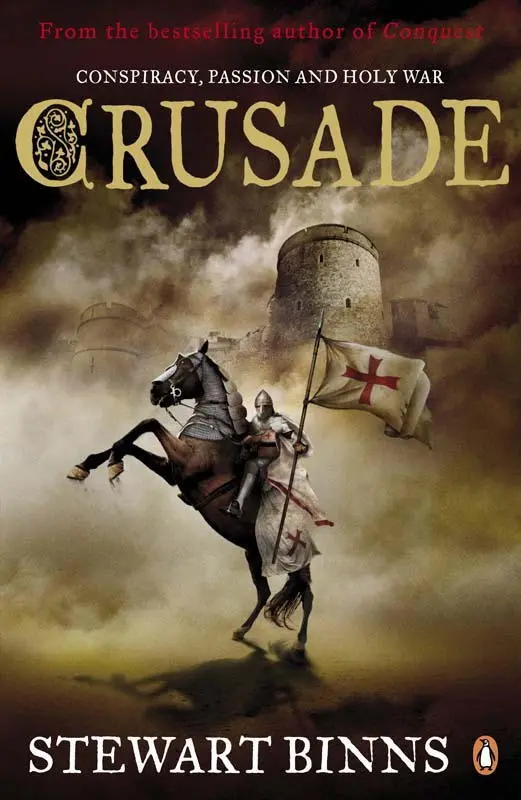
- Название:Crusade
- Автор:
- Издательство:Penguin Books
- Жанр:
- Год:2012
- Город:London
- ISBN:978-0-241-95758-5
- Рейтинг книги:3 / 5. Голосов: 1
-
Избранное:Добавить в избранное
- Отзывы:
-
Ваша оценка:
Crusade: краткое содержание, описание и аннотация
Предлагаем к чтению аннотацию, описание, краткое содержание или предисловие (зависит от того, что написал сам автор книги «Crusade»). Если вы не нашли необходимую информацию о книге — напишите в комментариях, мы постараемся отыскать её.
In the face of chaos and death, Edgar and his allies form a secret brotherhood, pledging to fight for justice and freedom wherever they are denied. But soon they are called to fight for an even greater cause: the plight of the Holy Land. Embarking on the epic First Crusade to recapture Jerusalem, together they will participate in some of the cruellest battles the world has ever known, the savage Siege of Antioch and the brutal Fall of Jerusalem, and together they will fight to the death.
Crusade — читать онлайн бесплатно полную книгу (весь текст) целиком
Ниже представлен текст книги, разбитый по страницам. Система сохранения места последней прочитанной страницы, позволяет с удобством читать онлайн бесплатно книгу «Crusade», без необходимости каждый раз заново искать на чём Вы остановились. Поставьте закладку, и сможете в любой момент перейти на страницу, на которой закончили чтение.
Интервал:
Закладка:
Although we insisted that the army camp outside the city, many of the young knights were restless and knew that, like any other thriving port, Thessaloniki’s waterfront would have available all the diversions a saddle-weary soldier would require. By mid-evening on the first night, the noise of mayhem was already drifting up the hillsides of the city. Most of our leadership was indifferent to the problem, but Robert asked me to mount my contingent and bring order to the city. He gave me two of his conrois to add his authority to our presence.
What we found when we arrived in the narrow streets of the docks area was akin to a battleground. The Emperor’s men had scattered to the hills, intimidated by the huge number of ill-disciplined Christians. Shops and warehouses were ablaze, carts were piled high with anything of value, and bodies were strewn everywhere. The brothels were empty – the girls had presumably recognized the danger signs and left – but women were screaming from every direction as our valiant Christian Crusaders marauded through the streets, kicking down doors and looking for women and girls.
I organized small squads of a dozen men, with a senior knight leading each one, and sent them on street-by-street missions to stop the looting and rape. Their task was unpleasant, but not difficult, as most of the miscreants were so drunk they were unable to put up much of a fight. Adela was a particularly effective admonisher, kicking and punching the men until they did her bidding but dealing gently with the women she found, making sure that someone was on hand to take care of them.
We organized carts to transport the men back to camp in disgrace, and we helped the locals to identify their belongings and then returned what was left of them. Sadly, as in the examples from central Europe, it was Thessaloniki’s Jewish community which bore the brunt of the crimes. The docks area was a Jewish enclave and, once again, they had been in the wrong place at the wrong time.
As we got close to Constantinople, the final groups of Crusaders joined us – Germans, north Europeans and Lotharingians, led by Duke Godfrey of Bouillon – making us into an army over 80,000 strong.
Both Duke Godfrey and Count Raymond had had difficult journeys, beset by indiscipline, poor morale and clashes with local communities. Robert called several Councils of War to try to restore discipline, but each ended in chaos as the rival lords argued every point. I tried hard to use common sense in the debates and argued vociferously for unity. I think my words won me some admirers, but they made little difference to the outcome. Obduracy ruled – egos were too big to listen to reason.
When we reached Byzantium’s fabled capital, we found its gates barred against us and an envoy from Emperor Alexius waiting to escort us to an audience with the man who wore the Purple of Rome – a ruler whose empire was over 1,200 years old and who still thought of himself as Roman.
Just as we called the Byzantines ‘Greeks’ because of their language and affiliation to the Eastern Church, they called western Europeans ‘Latins’ because of our use of the Latin language for all our formal documents and because of our adherence to the Church of Rome. Although it had been only forty years since the Great Schism between the two Churches, it looked like it was going to be a permanent rupture in the faith.
All the senior command staffs of the Crusader armies were summoned, and Robert managed to obtain places for Adela and Estrith in the entourage as interpreters. The cream of European aristocracy – over 200 dukes, counts and knights, and some of their wives and daughters – were escorted through the gates of the world’s most magnificent city and seated in royal carriages to be given a ceremonial entrance.
Horns and trumpets signalled the beginning of the procession as a company of the Emperor’s personal bodyguard, the legendary Varangian Guard, led the procession. The entire route was lined with soldiers from the many themes of the Byzantine army: Macedonians, Thracians, Thessalonians and men recruited from as far away as Cyprus, Mesopotamia and Crete.
We ‘Latin Princes’ were people used to the best that money could buy, but none of us had seen anything on such a scale or possessed of such opulence and grandeur.
Shaped like a triangle pointing at the sea, the city was surrounded by water on two sides. On the landward side, it was defended by not one but two mighty walls – each five miles long, sixteen feet thick and over seventy feet high – with huge open spaces in between. It was impossible to imagine them ever being breached.
We were told that more than half a million people lived in the city, ten times the number of inhabitants in the biggest cities in the West. We had seen Rome, and the superb basilica of St Peter’s, but most of the population lived in modest wooden homes amidst the crumbling remains of the city’s former imperial glory. But Constantinople was awash with magnificent palaces, churches and public buildings; its homes were full of the finest furnishings, marbles and mosaics; its people were dressed in the finest cottons and silks and adorned in gold and precious gems.
Constantine himself watched over the city, represented as Apollo in a huge bronze statue atop a column 170 feet high. The Emperor Justinian, captured on horseback in marble three times lifesize, presided over the Hippodrome, an arena with a capacity for 100,000 people. The most impressive sight of all was the Basilica of St Sophia, a building of great antiquity, but far bigger than any Christian church in the West, even the ones newly constructed. The top of its dome was as high as the statue to Constantine and over a hundred feet across.
Estrith stared at it, open-mouthed.
‘My mother told me about it. Isn’t it magnificent? The calculations are outstanding! They were done by the architect Isidorus of Miletus and the mathematician Arthamius of Tralles. No need for my hammer beams; the key is the circular dome. The weight is distributed evenly to the massive walls, buttressed by the even bigger corner columns. But the strength comes from the apex, which holds the roof like the locking ring at the top of a tripod; the pressure from any one direction is held by an equal force fighting against it.’
She made it sound simple; I was sure it wasn’t.
The Emperor’s palace, the Blachernae, stood proudly on a hilltop in the north-west corner of the city with views of the sea and the surrounding countryside. Without wishing to be too disparaging about the abodes of my noble comrades, it made their ducal palaces look like peasants’ hovels. Emperor Alexius had granted us a rare privilege in greeting us at the Blachernae, his private palace, rather than at the Great Palace, usually used for ceremonial occasions. The Great Palace had been built by the Emperor Constantine hundreds of years ago but had, like Byzantium itself, fallen on hard times. An important part of Alexius’s rebuilding of his city and empire had been the commissioning of a new palace to match those of the great Caesars of the past.
Alexius had been one of Byzantium’s highest nobility, and was a highly renowned general, when he became Emperor in a palace coup over fifteen years earlier. The empire was on its knees: the army was demoralized after a crushing defeat at the infamous Battle of Manzikert; the treasury was bare; and a succession of weak or despotic emperors had sapped the energy of the people.
In truth, the empire had been in a constant state of struggle for hundreds of years against fierce warrior-tribes from the North and the messianic valour of Islam from the south. By the time of Alexius’s accession, the chalice of the Purple could well have been a poisoned one and the empire in its death throes. However, slowly and shrewdly, with a combination of diplomacy and aggression, generosity and ruthlessness, Alexius had managed to rebuild the army, refill his treasury and restore the vigour of the people.
Читать дальшеИнтервал:
Закладка:
Похожие книги на «Crusade»
Представляем Вашему вниманию похожие книги на «Crusade» списком для выбора. Мы отобрали схожую по названию и смыслу литературу в надежде предоставить читателям больше вариантов отыскать новые, интересные, ещё непрочитанные произведения.




Обсуждение, отзывы о книге «Crusade» и просто собственные мнения читателей. Оставьте ваши комментарии, напишите, что Вы думаете о произведении, его смысле или главных героях. Укажите что конкретно понравилось, а что нет, и почему Вы так считаете.