Vladimir Bartol - Alamut
Здесь есть возможность читать онлайн «Vladimir Bartol - Alamut» весь текст электронной книги совершенно бесплатно (целиком полную версию без сокращений). В некоторых случаях можно слушать аудио, скачать через торрент в формате fb2 и присутствует краткое содержание. Город: Berkeley, Год выпуска: 2012, ISBN: 2012, Издательство: North Atlantic Books, Жанр: Историческая проза, на английском языке. Описание произведения, (предисловие) а так же отзывы посетителей доступны на портале библиотеки ЛибКат.
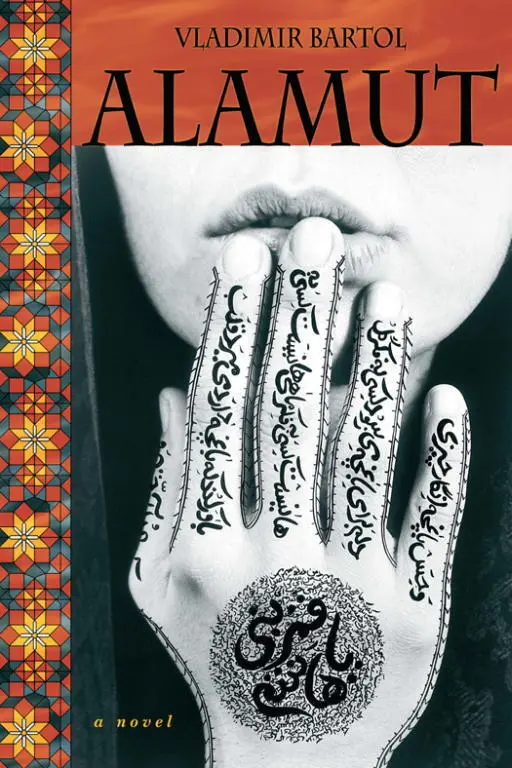
- Название:Alamut
- Автор:
- Издательство:North Atlantic Books
- Жанр:
- Год:2012
- Город:Berkeley
- ISBN:9781583946954
- Рейтинг книги:2.8 / 5. Голосов: 5
-
Избранное:Добавить в избранное
- Отзывы:
-
Ваша оценка:
Alamut: краткое содержание, описание и аннотация
Предлагаем к чтению аннотацию, описание, краткое содержание или предисловие (зависит от того, что написал сам автор книги «Alamut»). Если вы не нашли необходимую информацию о книге — напишите в комментариях, мы постараемся отыскать её.
Alamut — читать онлайн бесплатно полную книгу (весь текст) целиком
Ниже представлен текст книги, разбитый по страницам. Система сохранения места последней прочитанной страницы, позволяет с удобством читать онлайн бесплатно книгу «Alamut», без необходимости каждый раз заново искать на чём Вы остановились. Поставьте закладку, и сможете в любой момент перейти на страницу, на которой закончили чтение.
Интервал:
Закладка:
“There’s not much to say about our teacher. He quoted a lot of authors and he knew the Koran from the first sura to the last by heart. But he wasn’t able to satisfy my passion for knowledge one whit. So the encounter with my two classmates was all the more powerful. The eventual vizier was from Tus, just like me, and we both shared the same name: Hasan ibn Ali. He was eight to ten years older than I was and his knowledge, especially of astronomy and mathematics, was already quite extensive. But issues of faith, the search for truth in its own right—none of this mattered to him. That’s when it first dawned on me what huge gaps there are between individuals. He had never heard of Ismaili teachers passing through Tus, and he had never gone through any kind of intellectual crisis that practically cost him his life, as I had. And yet he had a powerful intellect, superior to most others.
“Omar, on the other hand, was completely different. He was from Nishapur and he seemed to be quiet and meek. But when we were alone he’d make fun of everything and be skeptical of everybody. He was totally unpredictable, sometimes so amazingly clever that you could listen to him for days on end, then he’d become introspective and moody. We grew very fond of him. We would get together in his father’s garden every evening and make great plans for the future. The scent of jasmine wafted over us while the evening butterflies sucked the nectar from its flowers. We would sit in an arbor, shaping our fate. Once—I remember it as though it were last night—in the grips of some desire to show off to them, I told them I was a member of a secret Ismaili brotherhood. I told them about my encounters with the two teachers, and I explained Ismaili doctrine to them. I identified the struggle against the Seljuk rulers and their lackey, the caliph of Baghdad, as being at its heart. When I saw how astonished they were, I cried out, ‘Do you want us, the descendants of the Khosrows, of the kings of Iran, of Rustam, Farhad and Firdausi, to be the hirelings of those horse thieves from Turkestan? If their flag is black, then let ours be white. Because the only shame is in groveling before foreigners and bowing down to barbarians!’ I had hit a sore spot. ‘What should we do?’ Omar asked. I replied, ‘We have to try to climb up the social ladder as quickly as possible. The first one to succeed should help the other two.’ They agreed. All three of us swore allegiance to each other.”
He fell silent and Miriam drew closer to him.
“It’s true, life is like a fairy tale,” she said in a thoughtful voice.
“But somewhere,” Hasan continued, “at the bottom of my heart, I still missed those fairy tales from my earliest youth, my tenacious faith in the coming of the Mahdi and the great mysteries of the Prophet’s succession. That wound still bled secretly, my first great disillusionment still stung. But the evidence was mounting in support of the thesis that nothing was true! Because just as much as the Shiites defended their claims, the Sunnis defended theirs. What’s more, Christians of all sects, Jews, Brahmans, Buddhists, fire worshippers and pagans were just as passionate about their teachings. Philosophers of all persuasions made their claims and refuted each other, one claiming there was only one god, another that there were many of them, and a third claiming there was no god and that everything happened by pure coincidence. More and more I began to see the supreme wisdom of the Ismaili dais. Truth is unattainable to us, it doesn’t exist for us. What then is the proper response? If you’ve concluded that you can know nothing, if you don’t believe in anything, then everything is permitted, then follow your passions. Is that really the ultimate possible knowledge? Studying, learning about everything, this was my first passion. I was in Baghdad, Basra, Alexandria, Cairo. I studied all the sciences—mathematics, astronomy, philosophy, chemistry, physics, biology. I delved into foreign languages, other peoples, other ways of thinking. And the Ismaili doctrine kept making more and more sense. But I was still young and it began to bother me that the vast majority of humanity was entangled in ignorance and subject to stupid fabrications and lies. It occurred to me that my mission on earth was to sow the truth, to open mankind’s eyes, to liberate it from its false assumptions and especially from the frauds who were responsible for them. Ismaili doctrine became my flag in the struggle against lies and illusions, and I saw myself as the great torchbearer who would light the way for mankind out of its ignorance. How sadly mistaken I turned out to be again! All of our brotherhoods accepted me as a great warrior for the Ismaili cause, but when I explained my plan to enlighten the masses to the leaders, they shook their heads and warned me against it. At every step they undermined me, and it was then I realized that the leadership was intentionally withholding the truth from the people and keeping them ignorant for selfish reasons. So then I started addressing the masses directly during my travels. At bazaars, in caravanserais and on pilgrimages I told them that everything they believed in was illusory, and that if they didn’t shake off the fairy tales and the lies, they would die thirsting for and bereft of the truth. The result was that I had to flee from a hail of stones and ugly curses. Then I tried to open just the brighter individuals’ eyes. Many of them listened to me carefully. But when I would finish, they would reply that they had had similar doubts themselves, but that it seemed more practical to them to hold onto something solid than to grope their way through eternal uncertainty and endless negation. Not just simple folk from the masses, even the more exalted minds preferred a tangible lie to an ungraspable truth. All my attempts to enlighten individuals or groups came to nothing. Because truth, which for me stood at the summit of all values, was worthless to the rest of humanity. I abandoned my would-be mission and gave up. I had wasted many years with those efforts. I went to see what my two classmates had achieved in the meantime, and I found out that I’d lagged far behind them. My namesake from Tus had entered into the service of a Seljuk prince, and just then, in recognition of his statesmanship, the sultan at that time, Alp Arslan Shah, had invited him to serve as vizier at his court. Omar had gained a reputation as a mathematician and an astronomer and, true to his youthful promise, Nizam al-Mulk was providing him with a government annuity of twelve hundred gold pieces. I felt a desire to visit Omar on his estate in Nishapur. I set out on the journey—it will have been a good twenty years ago now—and surprised my old classmate amidst his wine, girls and books. My appearance must not have been particularly reassuring, because as imperturbable as he was, he looked startled when he saw me. ‘What’s happened to you!’ he exclaimed once he recognized me. ‘A person would think you were coming straight from hell, you look so parched and sunburnt …’ He hugged me and invited me to stay with him as his guest. I made myself right at home too, finally enjoying witty and wise conversations over wine after so many years. We told each other about everything that had happened to us. We also confided our life experiences and intellectual theories to each other, and to our mutual surprise we determined that both of us had come to surprisingly similar conclusions, though each in his own way. And he had barely moved an inch away from home, while I had wandered through practically half the world. He said, ‘If I needed confirmation that I was on the right track in my search, I heard it from your mouth today.’ I replied, ‘Now that I’m talking with you and we’re in such complete agreement, I feel like Pythagoras when he heard the stars humming in the universe and merging with the harmony of the spheres.’ We talked about the possibility of knowledge. He said, ‘Ultimate knowledge is impossible, because our senses lie to us. But they’re the only mediator between the things that surround us and our thoughts, our intellect.’ ‘That’s exactly what Democritus and Protagoras claim,’ I agreed. ‘That’s why people condemned them as atheists and praised Plato to high heavens, because he fed them fairy tales.’ ‘The masses have always been like that,’ Omar continued. ‘They’re afraid of uncertainty, which is why they prefer a lie that promises something tangible to even the most exalted truth if it doesn’t give them anything to hold on to. There’s nothing you can do about it. Whoever wants to be a prophet to the masses has to treat them like children and feed them fairy tales and falsehoods. That’s why a wise man always keeps his distance from them.’ ‘But Christ and Mohammed wanted good for the masses.’ ‘That’s right,’ he replied. ‘They wanted good for them, but they also recognized all their utter hopelessness. Pity moved them to conjure up fairy tales about an otherworldly paradise that would be theirs as a reward for their suffering in this world.’ ‘Why do you think Mohammed would have let thousands die for his teachings if he knew they were based on a fairy tale?’ ‘Probably,’ he answered, ‘because he knew that otherwise they would have slaughtered each other for even baser reasons. He wanted to create a kingdom of happiness on earth for them. To do that, he invented his dialogues with the archangel Gabriel, otherwise they wouldn’t have believed him. He promised them heavenly delights after death, and in so doing made them brave and invincible.’ I thought for a while and then told him, ‘It seems to me that there’s no longer anyone who would joyfully go to his death just for the promise of getting into heaven.’ ‘Nations age too,’ he replied. ‘The thought of paradise has atrophied in people and isn’t a source of joy anymore like it used to be. People only keep believing in it because they’re too lazy to seize onto anything new.’ ‘So do you think,’ I asked him, ‘that a prophet preaching paradise to win over the masses today would fail?’ Omar laughed. ‘No question. Because the same torch doesn’t burn twice and a wilted tulip won’t bloom again. People are contented with their little comforts. If you don’t have the key to open the gates to paradise before their eyes, you might as well give up any thought of becoming a prophet.’ I grabbed at my head as though I were thunderstruck. Omar had jokingly articulated a thought that began spreading through my soul like wildfire. Yes, people wanted fairy tales and fabrications and they were fond of the blindness they blundered through. Omar sat drinking wine. But at that moment a powerful and immutable plan was born in me, the likes of which the world had never seen. To test human blindness to its utmost limits! To use it to attain absolute power and independence from the whole world! To embody the fairy tale! To turn it into such reality that our remotest descendants would talk about it! To conduct a great experiment on man!”
Читать дальшеИнтервал:
Закладка:
Похожие книги на «Alamut»
Представляем Вашему вниманию похожие книги на «Alamut» списком для выбора. Мы отобрали схожую по названию и смыслу литературу в надежде предоставить читателям больше вариантов отыскать новые, интересные, ещё непрочитанные произведения.








Обсуждение, отзывы о книге «Alamut» и просто собственные мнения читателей. Оставьте ваши комментарии, напишите, что Вы думаете о произведении, его смысле или главных героях. Укажите что конкретно понравилось, а что нет, и почему Вы так считаете.