Nicola Griffith - Hild
Здесь есть возможность читать онлайн «Nicola Griffith - Hild» весь текст электронной книги совершенно бесплатно (целиком полную версию без сокращений). В некоторых случаях можно слушать аудио, скачать через торрент в формате fb2 и присутствует краткое содержание. Город: New York, Год выпуска: 2013, ISBN: 2013, Издательство: Farrar, Straus and Giroux, Жанр: Историческая проза, на английском языке. Описание произведения, (предисловие) а так же отзывы посетителей доступны на портале библиотеки ЛибКат.
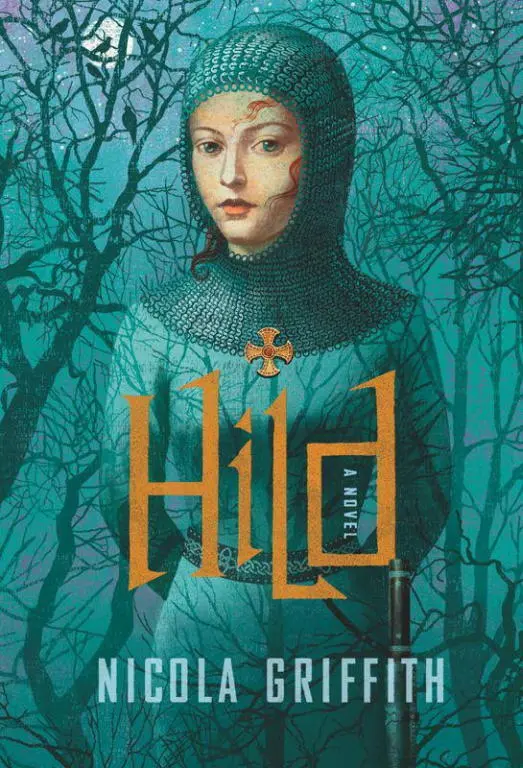
- Название:Hild
- Автор:
- Издательство:Farrar, Straus and Giroux
- Жанр:
- Год:2013
- Город:New York
- ISBN:978-0-374-28087-1
- Рейтинг книги:5 / 5. Голосов: 1
-
Избранное:Добавить в избранное
- Отзывы:
-
Ваша оценка:
Hild: краткое содержание, описание и аннотация
Предлагаем к чтению аннотацию, описание, краткое содержание или предисловие (зависит от того, что написал сам автор книги «Hild»). Если вы не нашли необходимую информацию о книге — напишите в комментариях, мы постараемся отыскать её.
But now she has only the powerful curiosity of a bright child, a will of adamant, and a way of seeing the world—of studying nature, of matching cause with effect, of observing her surroundings closely and predicting what will happen next—that can seem uncanny, even supernatural, to those around her.
Her uncle, Edwin of Northumbria, plots to become overking of the Angles, ruthlessly using every tool at his disposal: blood, bribery, belief. Hild establishes a place for herself at his side as the king’s seer. And she is indispensable—unless she should ever lead the king astray. The stakes are life and death: for Hild, for her family, for her loved ones, and for the increasing numbers who seek the protection of the strange girl who can read the world and see the future.
Hild is a young woman at the heart of the violence, subtlety, and mysticism of the early Middle Ages—all of it brilliantly and accurately evoked by Nicola Griffith’s luminous prose. Working from what little historical record is extant, Griffith has brought a beautiful, brutal world—and one of its most fascinating, pivotal figures, the girl who would become St. Hilda of Whitby—to vivid, absorbing life.
Hild — читать онлайн бесплатно полную книгу (весь текст) целиком
Ниже представлен текст книги, разбитый по страницам. Система сохранения места последней прочитанной страницы, позволяет с удобством читать онлайн бесплатно книгу «Hild», без необходимости каждый раз заново искать на чём Вы остановились. Поставьте закладку, и сможете в любой момент перейти на страницу, на которой закончили чтение.
Интервал:
Закладка:
She said to him in British, “An Anglisc oath is like water. It pours into every part of you, every crevice. You can’t hold any piece apart from it.”
The sword was his path, and what better road to walk than the king’s?
His eyes glistened. He rubbed his upper lip with his knuckle. Eventually he said in British, rusty from disuse, “I am not Anglisc.”
She grinned fiercely. Cian. Hers. But he kept rubbing his lip. She said, still in British, “Cian, I will not ask an oath. The oath is yours, like your wooden sword of long ago. But perhaps, for now, you will loan it to me, unspoken, and you may ask its return at any time, because it is yours.”
He smiled. The smile wobbled a little, but it was there. “Any time?”
“Any time.” He remembered. She touched his arm, the scar, and said, now in Anglisc, “A spear, like Owein?”
He shook his head. A tear flew loose, he brushed it away. “A boar.”
“Fearsome, no doubt?”
The queen’s quarters in Derventio were large and bright. Like the chapel, the ceiling and walls were plastered and whitewashed. Like the chapel, the room was cool. The queen, as wide as an ox, found warmth unbearable. Hild didn’t mind, but Begu stood with her arms wrapped around herself, and Wilnoð, the queen’s gemæcce, sitting with Arddun by the empty brazier sorting embroidery threads, wore a heavy overdress. Unlike the chapel, though, the queen’s room had a bed draped with rich blankets—striped and with chevrons in yellow and a red so dark it was almost black—where Æthelburh rested, and a finely woven rug imported from the East via Frankia covered the wide elm floorboards.
The queen looked up from the worked fabrics she had asked Begu to show her and nodded at Hild’s bare arms. “You’re the only woman who doesn’t huddle and shiver and give me reproachful looks.”
Hild nodded, wondering why they were there. Begu watched the queen anxiously.
“My husband”—she never called him the king —“tells me these rooms are as welcoming as an empty barn, though a barn is warmer. I told him I’ll paint and hang as soon as the walls are properly dry.”
Still sorting thread, Wilnoð said, “Not if the chapel dries first. Paulinus Crow will hog the painters and gilders for himself.”
“For the greater glory of God,” Æthelburh said, but Hild could read neither her tone nor her expression. “And speaking of God,” she said to Hild and Begu, “I hope you will both attend chapel with us in the morning. James has been working on a special Mass for Easter. The music, he assures me, would make an angel weep and hens fly. The feast will begin in hall immediately afterwards.”
Hild nodded again. She was curious about the Christ ritual.
“Good.” The queen smiled and stroked the veil band and girdle Begu had brought to show her. “This is fine work. Yours?”
“Oh, no,” said Begu. “That is, yes. Onnen—my father’s new, that is, my— Anyway, Onnen helped.”
Hild opened her mouth to say Onnen is my mother’s— But her mother’s what?
“And the embroidery on your veil band?” the queen asked.
“All mine. Mostly.”
“Come here, let me look.” Begu knelt by the bed. Æthelburh examined the band closely, then ran her fingertips over the violet-and-blue stitching. “Nicely done.”
She sat up straight, arranged her blankets to her satisfaction, and stroked the raised nap while she studied both girls, back and forth. Her attention settled on Begu.
“You are of good family.” Her voice now was strong and formal, and Hild’s blood began to beat hard in her chest and stomach. “Tell me, your father and—Onnen?—would want you to stay?”
“I think so. Onnen sent me. She told me to stay close.”
“And you would like that, to stay close to the lady Hild?”
“Oh, yes!”
Æthelburh turned to Hild, who understood now some of what Cian must have felt that night on the beach when Mulstan unwrapped the sword. “And your mother, the lady Breguswith?”
Hild tried to swallow and speak at the same time. “Yes.” She sounded like a strangling toad. Begu giggled nervously. Hild swallowed again, took a slow breath. “My mother and Onnen know each other well.”
“And this would please you?”
“Yes!”
Æthelburh winced, and Hild thought for one horrible moment that she had bellowed, but then the queen put a hand on her belly and took two deep breaths. After a moment her pinched look faded. She smiled. “Then it shall be so.”
She smiled at Wilnoð, who smiled back fondly, and stood, holding a basket.
“Begu, you are welcome in my house in your own right and as the gemæcce of Hild, niece of the king. And the queen.”
Hild didn’t dare look at her gemæcce—gemæcce!—but Begu’s hand stole into hers. Hild squeezed it.
“To seal the bargain I have a gift.” The queen motioned for Begu to stand and for Hild to come forward.
She lifted items from Wilnoð’s basket one by one and held them up to the light. An ivory spindle each, and distaffs in two lengths. Shears, made of iron and inlaid with fantastical beasts in silver. “The smith swears they are harts, though they look very like foxes to me.” One gold thimble each. Two packets of the finest needles Hild had ever seen, and astonishingly bright. “And for you, Hild, when it’s time to wear your girdle, this.” A deep-dyed blue leather purse, its ivory lid held by three yellow-gold hinges, each inlaid with garnet. Hild longed to hold it to her face and smell the new-leather scent, test its suppleness. “To put inside it—” The queen’s hand, feeling about in the basket, clenched in a fist and her face tightened. Wilnoð laid a professional hand on her belly.
“You may not make tomorrow’s Mass, my lady.” She handed the basket to Begu. “Off you go. My lady needs rest. No, hush now. Tomorrow will be soon enough for thanks.”
Outside, they turned to each other but the courtyard was too busy. Hild looked at the sky. The clouds were little and white; it was unlikely to rain.
“I’ll show you a secret place,” Hild said.
She led Begu to the track worn long, long ago between the Roman villa and the ford. Part of it was overgrown, green and mysterious, a tube through woods coppiced generations ago, then run wild, and now gradually being reclaimed.
Every now and again Begu remembered what was in the basket and stopped swinging, stopped chattering, and looked solemn, but then she would notice something—“Look, the hedgepigs are awake already!”—and point and forget.
After a while they left the main track for a rougher, more spidery path. A woodcutter’s trail. They jumped over a rivulet, running busy and brown.
There were eleven ash boles in a circle, all cut early in the season. The woodcutters wouldn’t be back for years. In the centre, leaf mould had collected in a soft heap. Hild sat. Begu sat next to her. They spread their skirts to overlap and laid the queen’s gifts on the cloth one by one then held hands and gazed at their treasure.
The breeze was now soft and light, the sun warm. The woods smelt of green living things. The rivulet bibble-babbled. A nearby wren tut-tutted. Greenfinches sang their creaky mating songs. Hild wanted to laugh and shout and be still all at the same time.
“I feel like my insides just filled with sunshine.”
Begu nodded. “I could burst.” She squeezed Hild’s hand.
Hild squeezed back.
They gazed some more at their treasure. “I like the thimbles best,” Begu said. She let go of Hild’s hand and slid a thimble onto her middle finger, then the other onto her pointing finger. “I expect they’re too small for you,” she said hopefully.
Читать дальшеИнтервал:
Закладка:
Похожие книги на «Hild»
Представляем Вашему вниманию похожие книги на «Hild» списком для выбора. Мы отобрали схожую по названию и смыслу литературу в надежде предоставить читателям больше вариантов отыскать новые, интересные, ещё непрочитанные произведения.





Обсуждение, отзывы о книге «Hild» и просто собственные мнения читателей. Оставьте ваши комментарии, напишите, что Вы думаете о произведении, его смысле или главных героях. Укажите что конкретно понравилось, а что нет, и почему Вы так считаете.