Nicola Griffith - Hild
Здесь есть возможность читать онлайн «Nicola Griffith - Hild» весь текст электронной книги совершенно бесплатно (целиком полную версию без сокращений). В некоторых случаях можно слушать аудио, скачать через торрент в формате fb2 и присутствует краткое содержание. Город: New York, Год выпуска: 2013, ISBN: 2013, Издательство: Farrar, Straus and Giroux, Жанр: Историческая проза, на английском языке. Описание произведения, (предисловие) а так же отзывы посетителей доступны на портале библиотеки ЛибКат.
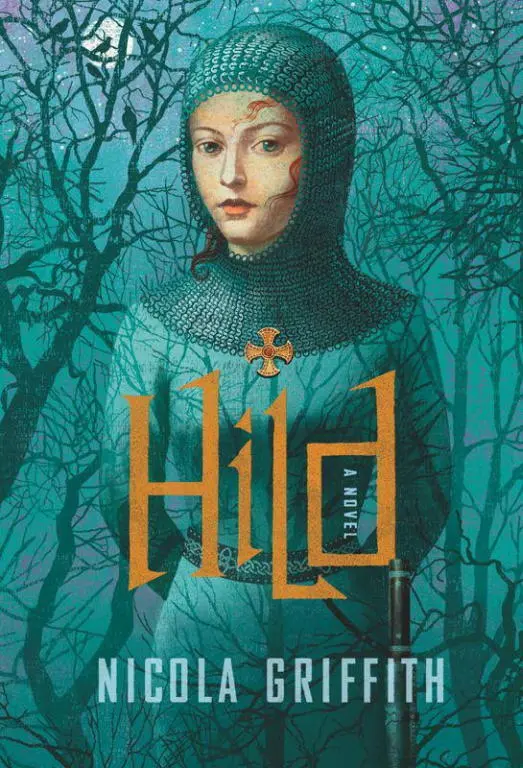
- Название:Hild
- Автор:
- Издательство:Farrar, Straus and Giroux
- Жанр:
- Год:2013
- Город:New York
- ISBN:978-0-374-28087-1
- Рейтинг книги:5 / 5. Голосов: 1
-
Избранное:Добавить в избранное
- Отзывы:
-
Ваша оценка:
Hild: краткое содержание, описание и аннотация
Предлагаем к чтению аннотацию, описание, краткое содержание или предисловие (зависит от того, что написал сам автор книги «Hild»). Если вы не нашли необходимую информацию о книге — напишите в комментариях, мы постараемся отыскать её.
But now she has only the powerful curiosity of a bright child, a will of adamant, and a way of seeing the world—of studying nature, of matching cause with effect, of observing her surroundings closely and predicting what will happen next—that can seem uncanny, even supernatural, to those around her.
Her uncle, Edwin of Northumbria, plots to become overking of the Angles, ruthlessly using every tool at his disposal: blood, bribery, belief. Hild establishes a place for herself at his side as the king’s seer. And she is indispensable—unless she should ever lead the king astray. The stakes are life and death: for Hild, for her family, for her loved ones, and for the increasing numbers who seek the protection of the strange girl who can read the world and see the future.
Hild is a young woman at the heart of the violence, subtlety, and mysticism of the early Middle Ages—all of it brilliantly and accurately evoked by Nicola Griffith’s luminous prose. Working from what little historical record is extant, Griffith has brought a beautiful, brutal world—and one of its most fascinating, pivotal figures, the girl who would become St. Hilda of Whitby—to vivid, absorbing life.
Hild — читать онлайн бесплатно полную книгу (весь текст) целиком
Ниже представлен текст книги, разбитый по страницам. Система сохранения места последней прочитанной страницы, позволяет с удобством читать онлайн бесплатно книгу «Hild», без необходимости каждый раз заново искать на чём Вы остановились. Поставьте закладку, и сможете в любой момент перейти на страницу, на которой закончили чтение.
Интервал:
Закладка:
He blushed.
“Take it off. Take your cloak off. Take it all off.”
“Not until you throw your knife in the corner.”
They sounded like six-year-olds. “I won’t throw it.”
She stood and carried it carefully to the nearest corner, by the table. Turned. Saw how his gaze fastened on her as she stood outlined by candlelight. Trust Gwladus. She let him look. It was a very thin undershift. He could probably see right through it, right to her. Her nipples sharpened.
He took off his cloak. She folded it carefully while he pulled off his shoes, then his belt, then his tunic. She laid them in a pile on the cloak, then carried it to the corner, next to her knife, out of reach. She turned, looked deliberately at him, at the lines of tight muscle under his hose. The baggy part, tented now. Growing, pointing a little to the left.
They both swallowed.
“I don’t know what to do,” he said.
That made no sense. “But you’ve had lots of women.”
“I know what to do with women. I don’t know what to do with you. No, I don’t mean— You’re not housefolk. You’re highfolk. And Anglisc.”
She didn’t know what to say.
“And I don’t know if you want me. I don’t know why you didn’t want me before.”
She took his hand, laid it on her breast. She knew how that would feel, knew the line of fire that would run to his belly, to his loins. “Of course I want you. I’ve put my hand on your belt since I could say my name. I’ve shown you magic, I’ve made magic for you. Drop your shield now, and we’ll give each other magic.”
She stepped against him, so his nose touched the arch of her ribs, so he could smell her, smell that earth and honeysuckle and sharp sap of woman running out of her. She put a hand on his shoulder—the fillet of muscle running from his neck to the bone at the point—and one on the back of his head. And it leapt between them, like the understanding between gesiths locked in combat, like the awareness running between a school of fish, a flock of birds, a herd of horses: We are us.
She did want him. She wanted all of him, everything, wanted to fill herself with him until she couldn’t breathe. Wanted to pull him through her from the outside, to pull his skin through her skin, his muscle to hers, his bone to her bone. She could squeeze him, crush him to her, flex, strain, and reach, fight without blood, without bruises.
And she did.
She closed tight around him, tight as a fist, tighter, and his eyes were the bluest blue she had ever seen, bluer than the sky, bigger than the sky, wide, endless, the horizon of home.
On the day after her wedding she lay at the edge of the hazel coppice, one cheek pressed to the moss that smelt of worm cast and the last of the sun, listening: to the wind in the elms, rushing away from the day, to the jackdaws changing their calls from “Outward! Outward!” to “Home now! Home!” In a while she would follow.
Author’s Note
Hild was real. She was born fourteen hundred years ago in Anglo-Saxon England. Everything we know about her comes from the Venerable Bede’s Ecclesiastical History of the English Nation , the foundational text of English history. [1] Read a translation, by Professor Roy M. Liuzza (Joseph Black et al., eds., Broadview Anthology of British Literature, Volume 1: The Medieval Period . Peterborough, Ont: Broadview Press, 2006; hosted and linked to with permission of the translator), of the relevant passages here: http://nicolagriffith.com/Bede_on_Hild.pdf .
The first half of her life can be summed up in one short paragraph:
She was born circa 614, after her mother, Breguswith, had a dream about her unborn child being a jewel that brings light to the land. Hild’s father, Hereric, of the royal house of Deira, was poisoned while in exile at the court of Ceredig, king of Elmet. Her older sister, Hereswith, married a nephew of Rædwald, king of East Anglia. Hild, along with much of Edwin’s household, was baptised by Paulinus circa 627, in York. She then disappeared from the record until 647, when she reappeared in East Anglia about to take ship for Gaul to join her sister—at which point she was recruited to the church by Bishop Aidan.
We don’t know exactly where Hild was born and when her father died—or her mother. We have no idea what she looked like, what she was good at, whether she married or had children. But clearly she was extraordinary. In a time of warlords and kings, when might was right, she began as the second daughter of a homeless widow, probably without much in the way of material resources and certainly in an illiterate culture, and ended up a powerful adviser to statesmen-kings and teacher of five bishops. Today she is revered as Saint Hilda.
So how did Hild ride this cultural transformation of petty kingdoms into sophisticated, literate states? We don’t know. I wrote this book to find out. I learnt what I could of the late sixth and early seventh centuries: ethnography, archaeology, poetry, numismatics, jewellery, textiles, languages, food production, weapons, and more. And then I re-created that world and its known historical incidents, put Hild inside the world, and watched, fascinated, as she grew up, influenced and influencing. (The deeper I go, the more certain I become that I’ve caught a tiger by the tail. I’m writing the next part of her story now.)
While people in Hild’s time may have understood their world a little differently from how we understand ours, they were still people—as human as we are. Their dreams, fears, political machinations, fights, loves, and hesitations were shaped by circumstance and temperament, as are ours. Hild, though singular, was singular within the constraints of her time. Her time was occasionally brutal.
I don’t pretend to be an historian. Although I did my utmost not to contravene what is known about the early seventh-century material culture, languages, natural world, power politics, and individuals of the British Isles, this is a novel. I made it up.
Hild would have encountered at least four languages on a regular basis: Old Irish (Irish), Ancient British (Brythonic), Latin, and Old English (Anglisc).
I won’t attempt to codify the pronunciation of Old Irish; it’s defeated better than me.
Ancient British is easier. If you think of it in the same terms as modern Welsh, you’ll get a sense of how to proceed. Every letter is sounded, c is pronounced k , dd as th , ff as v , rh as hr , and u , g, and w can be… mercurial. So:
Cian: KEE-an
Gwladus: OO-la-doose
Arddun: AR-thun
Rhroedd: HRO-eth
Urien: IRRI-yen
Uinniau: oo-IN-NI-eye (the short form sounds very like Winny )
Latin sounds much as it looks with the exception of v , which sounds like w . Consonants are hard ( g as in go , and c as k ).
Old English is a particular and deliberate tongue, with every consonant and vowel sounded, r ’s trilled, and dipthongs accented on the first element. Some simplified rules include pronouncing:
æ: like the a in cat
sc: sh, as in ship
g: sometimes y, as in yes
īc: usually as itch
f: sometimes as v, as in very
ð: th, as in then
So:
Gipswīc: Yips-witch
gesith: yeh-SEETH
gemæcce: yeh-MATCH-eh
thegn: thayn
Читать дальшеИнтервал:
Закладка:
Похожие книги на «Hild»
Представляем Вашему вниманию похожие книги на «Hild» списком для выбора. Мы отобрали схожую по названию и смыслу литературу в надежде предоставить читателям больше вариантов отыскать новые, интересные, ещё непрочитанные произведения.





Обсуждение, отзывы о книге «Hild» и просто собственные мнения читателей. Оставьте ваши комментарии, напишите, что Вы думаете о произведении, его смысле или главных героях. Укажите что конкретно понравилось, а что нет, и почему Вы так считаете.