Stewart Binns - Anarchy
Здесь есть возможность читать онлайн «Stewart Binns - Anarchy» весь текст электронной книги совершенно бесплатно (целиком полную версию без сокращений). В некоторых случаях можно слушать аудио, скачать через торрент в формате fb2 и присутствует краткое содержание. Город: London, Год выпуска: 2013, ISBN: 2013, Издательство: Penguin Books, Жанр: Историческая проза, на английском языке. Описание произведения, (предисловие) а так же отзывы посетителей доступны на портале библиотеки ЛибКат.
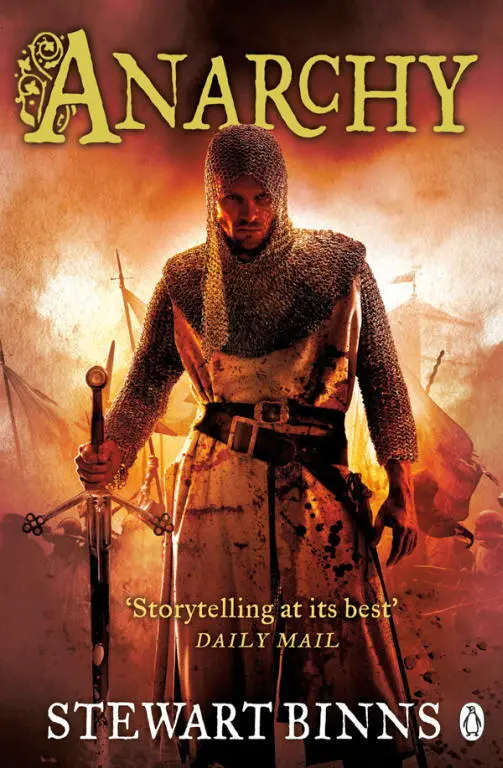
- Название:Anarchy
- Автор:
- Издательство:Penguin Books
- Жанр:
- Год:2013
- Город:London
- ISBN:978-0-718-19460-4
- Рейтинг книги:3 / 5. Голосов: 1
-
Избранное:Добавить в избранное
- Отзывы:
-
Ваша оценка:
Anarchy: краткое содержание, описание и аннотация
Предлагаем к чтению аннотацию, описание, краткое содержание или предисловие (зависит от того, что написал сам автор книги «Anarchy»). Если вы не нашли необходимую информацию о книге — напишите в комментариях, мы постараемся отыскать её.
The Making of England
Ruthless brutality, greed and ambition:
The year is 1186, the thirty-second year of the reign of Henry II.
Gilbert Foliot, Bishop of London, has lived through long Henry’s reign and that of his grandfather, Henry I. He has witnessed the terrifying civil war between Henry II’s mother, the Empress Matilda, and her cousin, Stephen; a time so traumatic it becomes known as the Anarchy.
The greatest letter writer of the 12th Century, Folio gives an intimate account of one of England’s most troubled eras. Central to his account is the life of a knight he first met over fifty years earlier, Harold of Hereford.
Harold’s life is an intriguing microcosm of the times. Born of noble blood and legendary lineage, he is one of the nine founders of the Knights Templar and a survivor of the fearsome battles of the Crusader States in the Holy Land.
Harold is loyal warrior in the cause of the Empress Matilda. On his broad shoulders, Harold carries the legacy of England’s past and its dormant hopes for the future.
Stewart Binns’
is a gripping novel in the great tradition of Conn Iggulden and Bernard Cornwell, and is the third in
trilogy, following
and
.
Anarchy — читать онлайн бесплатно полную книгу (весь текст) целиком
Ниже представлен текст книги, разбитый по страницам. Система сохранения места последней прочитанной страницы, позволяет с удобством читать онлайн бесплатно книгу «Anarchy», без необходимости каждый раз заново искать на чём Вы остановились. Поставьте закладку, и сможете в любой момент перейти на страницу, на которой закончили чтение.
Интервал:
Закладка:
He had lived all his life with the slur of cowardice. During the Great Crusade, forty years earlier, his father, Count Stephen II, had fled in panic to his home in Blois during the appalling Siege of Antioch. Such was the disgrace that his mother, the formidable Adela – the daughter of William, Conqueror of the English – forced him to return to the Holy Land two years later to try to redeem himself. Sadly, he was killed at the Second Battle of Ramla.
We camped on the south side of the Fosse Dyke, west of Brayford Pool on the River Witham, and plotted our strategy for the next morning. Miles of Gloucester would take the left flank to the north, leading his own men and reinforced by Welsh mercenaries. Ranulf of Chester would take the right flank, to the south, also supported by the Welsh. Robert of Gloucester, Brien FitzCount and I would lead the centre, with our most formidable group of men, an elite force of knights supported by archers and infantry. In all, we numbered close to 1,800 men, far superior to Stephen’s force of 1,200.
The night brought a fierce storm; the ferocious winds played havoc with our tents, and the hard ground was softened to heavy mud by torrential rain. Stephen would have to fight on foot, penned in by the walls of the castle at his back. With the River Witham to the south, his only viable escape route would be to his right, heading north along Ermine Street to the Humber.
Sunday 2 February 1141 did not start well for Stephen, as the monks who came out to hear the confessions of our men were eager to tell us. He had attended mass in St Mary’s Cathedral at dawn and, according to tradition as King of the realm, had carried the lighted candle for the service. But the candle broke and fell to the floor, extinguishing the flame. Even worse, during the service a pyx containing the Host fell from its fastening above the altar and broke on impact, scattering its contents at the priest’s feet. The audience gasped and crossed themselves; all agreed that it was a very bad omen for Stephen.
Rain was still falling as we rode across Fosse Dyke. Our mounted knights kept their torsos dry; not so our foot soldiers, who had to wade across the swollen dyke submerged up to their shoulders. Stephen’s men were not much better off. They had been formed up for almost an hour and stood in the pouring rain, sinking up to their ankles in freezing mud.
We formed up close to Stephen’s lines, close enough to hear one of Stephen’s supporters, Baldwin FitzGilbert, rallying his men for battle. Although they were outnumbered, they were led by seasoned warriors in the best Norman tradition. Besides FitzGilbert, Stephen’s left flank was commanded by William of Aumale and William of Ypres, who brought Flemish troops to the fray. His right flank was taken by Hugh Bigod, Earl of Norwich, once my mentor, who had since perjured himself by swearing that King Henry had changed his mind about the succession. Stephen held the centre with his senior men: William Warenne, Earl of Surrey; Simon de Senlis, Earl of Northumberland; Waleran, Earl of Worcester; and Alan of Penthièvre, Earl of Richmond, who had been our ambusher at Stephen’s court at Oxford.
Robert of Gloucester had asked me the night before if I would speak for Maud before the battle. I was not daunted by the challenge; I knew it was my duty. My grandfather had made his famous speech at Ely when the Brotherhood faced King William’s squadrons for the final battle, so I knew it was also my destiny.
I knew what should be said and rode in front of our line confidently. I was also fortified by the Talisman, which Maud had insisted I take with me. It had been worn by so many brave men: Macbeth at Lumphanan, Harold at Senlac Ridge, Hereward at Ely and Alexius Comnenus at Levunium. It was easy to feel inspired by it.
Eadmer acted as my standard-bearer and held aloft my gonfalon. I had had it made in Gloucester, displaying the colours – gules, sable and gold – that my grandfather fought under at Ely. I had also created a new shield: two gules lions rampant on a golden field, bordered by a tierce in sable. Maud had suggested the design, and I felt very proud to carry it. I had commissioned replicas of my grandfather’s helmet and sword to replace the ones I had lost while serving the Doge of Venice; I could feel the helmet’s nose guard resting gently on my face, and I gripped the pommel of my sword firmly.
I stood high in my stirrups to speak, as Eadmer led my mount backwards and forwards along the line. The ground was flat, and my voice carried far and wide.
‘Soldiers of England, warriors from Wales, fighting men of Normandy! We stand together today to right a terrible wrong. This land is in agony. Its people are suffering and dying in their thousands; its ruler is a usurper. Old King Henry’s wish that the throne should go to the Empress Matilda, our Lady of the English, is known to every soul in the realm. Opposite you are men of evil. They are men who have stolen a crown, men who have perjured themselves before God and before their kin, and men who have killed, tortured and maimed to further their own cause. We can end their savagery here today.’
I raised my sword high above my head and filled the sky with my voice.
‘For Matilda, Lady of the English, a daughter of the royal families of every Celt, Englishman and Norman! A Queen for all our lands!’
A great roar echoed across the battlefield and travelled all the way up the hill to Lincoln itself. The speeches were over, the battlelines set. I felt certain that, by the end of the day, England would have a new ruler.
Eadmer was the first to congratulate me on my rousing speech, but in his own distinct way.
‘Well done, Hal. I think you’ve just written a new ballad for me!’
Robert was also very complimentary.
‘Quite the orator, Earl Harold. If that doesn’t win us the day, nothing will!’
Robert ordered his herald to sound the advance. The Battle of Lincoln had begun.
We dismounted most of our knights, so that they could fight on foot, and left only a few cavalry in reserve. The mud was deep and progress was difficult, especially in trying to maintain close formation. I called for several volleys from our archers at the rear, aimed specifically at Stephen’s flanks, where his less committed Breton and Flemish mercenaries stood. The arrows plummeted to earth like hailstones; men covered their heads with their shields, but many arrows hit their targets, cutting into exposed legs, arms and feet. They were not fatal wounds, but they put men out of action and spread fear in the ranks.
As we advanced, it was clear that our numbers were significantly greater than Stephen’s. I could see the anxiety roll through his army like a wave. Sergeants began to bellow orders, commanders tried to steady their men.
Robert turned to me and shouted.
‘I am going to commit our left and right flanks!’
‘I agree – they should attack at a run, while we go on slowly. Stephen’s flanks are crumbling.’
Robert sent orders to Miles and Ranulf to charge, and I ordered more volleys of arrows to precede them.
‘Robert, I propose we divide the cavalry to attack those who desert the field. I will send most to Ermine Street, and some to cover those who try to cross the river.’
‘Yes, do it, my friend!’
The Welsh on our left and right hurled themselves forward like packs of hunting dogs. They made no attempt to keep formation, but just ran like banshees, screaming obscenities at the enemy. They attacked bravely, like a barbarian horde. Against resolute opponents it could have proved disastrous, but Stephen’s flanks were already beaten.
The front ranks of Breton and Flemish soldiers turned as the Welsh closed on them, running into those behind, so that when the Welsh horde struck, their lines were in disarray and easy prey for the ferocious Celts. The knights loyal to Miles and Ranulf were close behind the Welsh vanguard. When they lent their disciplined cohorts to the melee, the whole of Stephen’s forces on the left and right streamed from the field. It soon became a stampede, but one met by our cavalry, who started to cut into the fleeing men at will.
Читать дальшеИнтервал:
Закладка:
Похожие книги на «Anarchy»
Представляем Вашему вниманию похожие книги на «Anarchy» списком для выбора. Мы отобрали схожую по названию и смыслу литературу в надежде предоставить читателям больше вариантов отыскать новые, интересные, ещё непрочитанные произведения.






Обсуждение, отзывы о книге «Anarchy» и просто собственные мнения читателей. Оставьте ваши комментарии, напишите, что Вы думаете о произведении, его смысле или главных героях. Укажите что конкретно понравилось, а что нет, и почему Вы так считаете.