Stewart Binns - Anarchy
Здесь есть возможность читать онлайн «Stewart Binns - Anarchy» весь текст электронной книги совершенно бесплатно (целиком полную версию без сокращений). В некоторых случаях можно слушать аудио, скачать через торрент в формате fb2 и присутствует краткое содержание. Город: London, Год выпуска: 2013, ISBN: 2013, Издательство: Penguin Books, Жанр: Историческая проза, на английском языке. Описание произведения, (предисловие) а так же отзывы посетителей доступны на портале библиотеки ЛибКат.
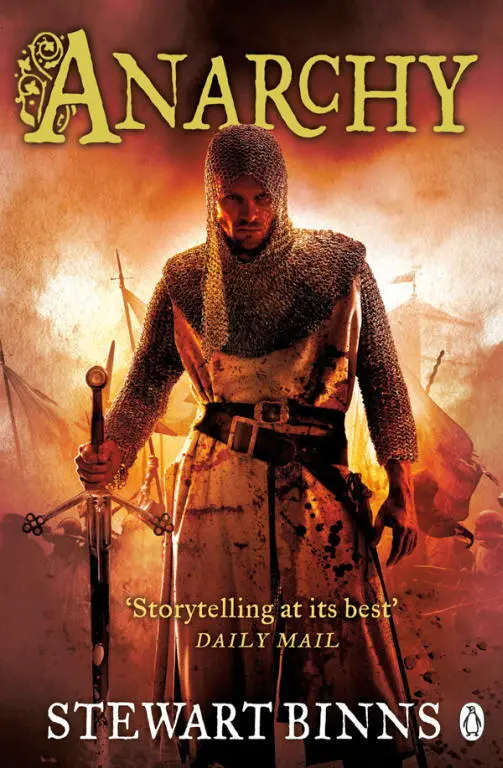
- Название:Anarchy
- Автор:
- Издательство:Penguin Books
- Жанр:
- Год:2013
- Город:London
- ISBN:978-0-718-19460-4
- Рейтинг книги:3 / 5. Голосов: 1
-
Избранное:Добавить в избранное
- Отзывы:
-
Ваша оценка:
Anarchy: краткое содержание, описание и аннотация
Предлагаем к чтению аннотацию, описание, краткое содержание или предисловие (зависит от того, что написал сам автор книги «Anarchy»). Если вы не нашли необходимую информацию о книге — напишите в комментариях, мы постараемся отыскать её.
The Making of England
Ruthless brutality, greed and ambition:
The year is 1186, the thirty-second year of the reign of Henry II.
Gilbert Foliot, Bishop of London, has lived through long Henry’s reign and that of his grandfather, Henry I. He has witnessed the terrifying civil war between Henry II’s mother, the Empress Matilda, and her cousin, Stephen; a time so traumatic it becomes known as the Anarchy.
The greatest letter writer of the 12th Century, Folio gives an intimate account of one of England’s most troubled eras. Central to his account is the life of a knight he first met over fifty years earlier, Harold of Hereford.
Harold’s life is an intriguing microcosm of the times. Born of noble blood and legendary lineage, he is one of the nine founders of the Knights Templar and a survivor of the fearsome battles of the Crusader States in the Holy Land.
Harold is loyal warrior in the cause of the Empress Matilda. On his broad shoulders, Harold carries the legacy of England’s past and its dormant hopes for the future.
Stewart Binns’
is a gripping novel in the great tradition of Conn Iggulden and Bernard Cornwell, and is the third in
trilogy, following
and
.
Anarchy — читать онлайн бесплатно полную книгу (весь текст) целиком
Ниже представлен текст книги, разбитый по страницам. Система сохранения места последней прочитанной страницы, позволяет с удобством читать онлайн бесплатно книгу «Anarchy», без необходимости каждый раз заново искать на чём Вы остановились. Поставьте закладку, и сможете в любой момент перейти на страницу, на которой закончили чтение.
Интервал:
Закладка:
Raucous cheering echoed around Bristol’s walls as Maud finished her rallying call. She asked me for my sword and raised it high above her head, creating even more enthusiastic support.
We spent the rest of 1139 campaigning in the west until, one by one, all the major fortifications west of Salisbury were loyal to Maud: Worcester, Trowbridge, Dunster, Gloucester, Devizes and Malmesbury, all were persuaded to become part of our growing domain.
In November, Roger, Bishop of Salisbury, died – as a direct result, it was said, of his treatment at the hands of Stephen. This further reinforced the clergy’s distaste for his rule.
The year 1140 saw a war of attrition unfold as Stephen struck back at every gain we had made in the previous year. Prompted by thuggery, bribery and blackmail, loyalties among the nobles wavered. Few battles were fought; Stephen’s tactics relied on a show of force, followed by threats or promises, then capitulation.
Vital resources of men and money started to become diminished for both protagonists. Treasuries were emptied on both sides of the Channel; heavy debts and obligations were incurred.
The gravediggers were exhausted and the moneylenders became rich. Everyone else suffered – especially the poor and the peasants, who died in their droves. In many parts of the land, the suffering populace endured a return to the death and destruction of the Great Conquest by William and his marauding army. Even those who were relatively secure in their walled fortresses, able to live off the resources they had plundered, had to live in a climate of terror.
It became a stalemate – not a temporary hiatus, but one that lasted for months – during which the suffering and anguish of the people continued unabated. Whole burghs were burned to the ground and homeless families littered the roadsides as they evacuated their meagre shelters to find refuge in the wildwood. Whole communities, some numbered in their thousands, scratched a living from the forest. Torture and mutilation were commonplace. Knotted ropes were used to slowly squeeze people’s heads until their skulls shattered. Others were crushed in what became known as ‘torture chambers’. Small iron boxes were made, into which victims would be placed before heavy stones were piled on top of the box to suffocate them. Iron collars, clamped around a victim’s throat and chained high up on a wall, were used to bring a lingering death as, bound at the wrists, the prisoner could neither sit nor lie down, being denied sleep or rest. Eventually the poor unfortunate choked to death, unable to hold their weight any longer.
Priests prayed, and masses were said to bring an end to the misery. But to no avail; the torment continued.
Stephen’s brother, Bishop Henry, tried to negotiate a treaty of peace at the end of the year and even crossed the Channel to discuss it with Maud’s husband – who was now in complete control in Normandy – and with the French King, Louis VII. Maud was prepared to accept a negotiated settlement to put an end to the suffering, but Stephen refused.
By the autumn of 1140, Robert had agreed that Maud should have her own court at his castle at Gloucester, and we had been living there for several months. Eadmer and Greta, our loyal companions, were with us, as always; she had started to accompany him in his ballads, bringing a sweet female pitch to his lyrics. Eadmer’s singing became well known among the army and many men could, in moments of happiness or melancholy, be heard singing them – especially the best-known one, ‘The Ballad of Robyn of Hode’.
But winter was beckoning, with no prospect of a respite from the agony.
Maud had had enough.
‘Hal, I can’t bear it any more. The two armies are exhausted, our coffers are almost empty, and the people are dying like flies.’
I felt the same, but knew I had to encourage her to keep going.
‘We’ve come too far, my darling. If we capitulate now, Stephen’s vengeance will know no limit. The suffering will be even worse.’
‘But don’t you think the price being paid by the people of England is too high already?’
‘You’re right, it is a terrible price. But our cause is just, and we have to see it through.’
‘Is that what your father and grandfather would have done?’
‘Of course! And your father and grandfather too. Remember, our grandfathers fought over this land more than seventy years ago. The fight still goes on.’
‘But I am a woman. I’m not sure I have the stomach any more.’
‘Yes, you do. You’re every bit as strong as Stephen. And don’t forget that my mother and grandmother, as well as the brave Adela, were also part of the fight. Adela became a Knight of Islam and fought alongside my father.’
‘I know in my heart that you’re right, Hal. I can accept the campaigning and the days in the saddle, the terrible food and the makeshift latrines. But it’s the people’s faces I can’t cope with: sunken cheeks, hollow eyes, the vacant look of hunger. I can barely look them in the eye, because they know I’m to blame.’
‘You’re not to blame, your cousin is the guilty party. And one day, when the suffering is over, the people of England will thank you for delivering them from his disastrous rule.’
‘Oh, Hal, I pray you’re right.’
29. Battle of Lincoln
Several councils of war were called at the end of 1140, where it was agreed that the fight against King Stephen must go on. Count Geoffrey sent vital resources of money, food and weapons from Normandy to fuel his wife’s cause.
As there was little chance of breaking the deadlock of strike and counter-strike in the west of England, we turned our attentions to the east, where we already had the support of the two nephews of Roger of Salisbury. There had been several risings against Stephen in the east, each of which he suppressed.
But at the end of 1140, at our instigation, Ranulf, Earl of Chester – the most powerful lord in the north, and more inclined to Maud than to Stephen – attacked and captured the castle at Lincoln.
It was a ruse designed to bring Stephen to the burgh, where we would ambush him.
Stephen responded to our provocation as we knew he would and, with typical speed, descended on Lincoln on Twelfth Night, 1141. We were well prepared and left Gloucester for Lincoln as soon as the trap was set. Maud had developed a fever, accompanied by a hacking cough, and I insisted that she stay behind to be nursed by Greta, guarded by Otto and Berenger. She was reluctant to stay, but a forced march on horseback across 120 miles of open country in the middle of winter was out of the question.
Her parting words to me were a reflection of the two things that she meant to me, as my lover and my sworn liege.
‘Bring me my crown, if you can. But come back safely, if you can’t. If I may not have an empire in England, then we’ve always got our empire at St Cirq Lapopie.’
In the west, the winter had been wet, with significant snow; in Lincoln the ground was dry, but hard from weeks of frost. It reminded me of Norwich – pleasant enough on most days, but when the wind blew from the east, it was a cold and miserable place.
Stephen had not brought a large force to Lincoln. Its garrison was not formidable, and it was a long way away from the heartland where most of England’s conflict was occurring. The burgh’s castle was of significant proportions, reworked on an original Roman fortress. In order to join our ambush, Ranulf had ensured that Lincoln was well supplied and secure before he slipped out of its ancient Newport Arch – from where, in another age, Rome’s legions had marched to conquer the distant north.
He left his wife, Maud of Gloucester – the daughter of our loyal friend, Robert of Gloucester – to reject Stephen’s demands to relinquish the castle, which she did resolutely. By the time our force arrived, Stephen was in the midst of constructing his siege engines and organizing his assault teams. We caught him completely unawares and outnumbered. But to his credit, he chose to stand his ground – as a man of courage, retreat was anathema to him.
Читать дальшеИнтервал:
Закладка:
Похожие книги на «Anarchy»
Представляем Вашему вниманию похожие книги на «Anarchy» списком для выбора. Мы отобрали схожую по названию и смыслу литературу в надежде предоставить читателям больше вариантов отыскать новые, интересные, ещё непрочитанные произведения.








Обсуждение, отзывы о книге «Anarchy» и просто собственные мнения читателей. Оставьте ваши комментарии, напишите, что Вы думаете о произведении, его смысле или главных героях. Укажите что конкретно понравилось, а что нет, и почему Вы так считаете.