Stewart Binns - Anarchy
Здесь есть возможность читать онлайн «Stewart Binns - Anarchy» весь текст электронной книги совершенно бесплатно (целиком полную версию без сокращений). В некоторых случаях можно слушать аудио, скачать через торрент в формате fb2 и присутствует краткое содержание. Город: London, Год выпуска: 2013, ISBN: 2013, Издательство: Penguin Books, Жанр: Историческая проза, на английском языке. Описание произведения, (предисловие) а так же отзывы посетителей доступны на портале библиотеки ЛибКат.
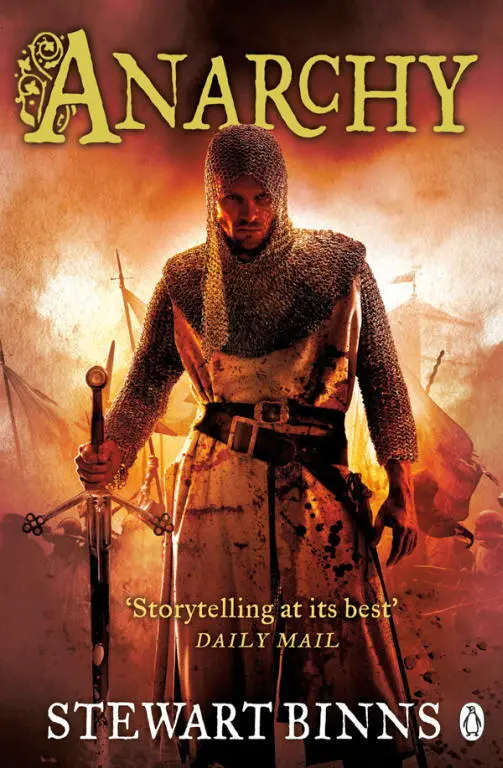
- Название:Anarchy
- Автор:
- Издательство:Penguin Books
- Жанр:
- Год:2013
- Город:London
- ISBN:978-0-718-19460-4
- Рейтинг книги:3 / 5. Голосов: 1
-
Избранное:Добавить в избранное
- Отзывы:
-
Ваша оценка:
Anarchy: краткое содержание, описание и аннотация
Предлагаем к чтению аннотацию, описание, краткое содержание или предисловие (зависит от того, что написал сам автор книги «Anarchy»). Если вы не нашли необходимую информацию о книге — напишите в комментариях, мы постараемся отыскать её.
The Making of England
Ruthless brutality, greed and ambition:
The year is 1186, the thirty-second year of the reign of Henry II.
Gilbert Foliot, Bishop of London, has lived through long Henry’s reign and that of his grandfather, Henry I. He has witnessed the terrifying civil war between Henry II’s mother, the Empress Matilda, and her cousin, Stephen; a time so traumatic it becomes known as the Anarchy.
The greatest letter writer of the 12th Century, Folio gives an intimate account of one of England’s most troubled eras. Central to his account is the life of a knight he first met over fifty years earlier, Harold of Hereford.
Harold’s life is an intriguing microcosm of the times. Born of noble blood and legendary lineage, he is one of the nine founders of the Knights Templar and a survivor of the fearsome battles of the Crusader States in the Holy Land.
Harold is loyal warrior in the cause of the Empress Matilda. On his broad shoulders, Harold carries the legacy of England’s past and its dormant hopes for the future.
Stewart Binns’
is a gripping novel in the great tradition of Conn Iggulden and Bernard Cornwell, and is the third in
trilogy, following
and
.
Anarchy — читать онлайн бесплатно полную книгу (весь текст) целиком
Ниже представлен текст книги, разбитый по страницам. Система сохранения места последней прочитанной страницы, позволяет с удобством читать онлайн бесплатно книгу «Anarchy», без необходимости каждый раз заново искать на чём Вы остановились. Поставьте закладку, и сможете в любой момент перейти на страницу, на которой закончили чтение.
Интервал:
Закладка:
‘It’s the King!’
‘King Henry Is here!’
As I turned round, I was astonished to see a vanguard of cavalry ride into the cathedral precincts. Behind them, flanked by Hugh Bigod, Earl of Norwich, and Everard of Calne, the new Bishop of Norwich, was Henry Beauclerc, King of England, followed by his resplendent retinue. He had aged a good deal since I had last seen him in Wales, over ten years earlier, but he still had the air of a supremely confident ruler and the easy manner of a man at the centre of attention every moment of his life.
We all bowed as the King passed, and we watched him dismount less than ten yards from us. He did not recognize me – indeed, I had not expected he would – but Hugh Bigod did see me and called me over.
‘Harold, I am sorry to hear about your mother.’
‘Thank you, my Lord.’
‘You have grown, young man. And you’re the colour of a blackamoor. Where have you been?’
‘Many places, my Lord – Venice, Antioch, Jerusalem.’
‘What is the medallion around your neck? It looks important.’
I looked at my feet uneasily.
‘It is nothing, sire. I was given it by the Doge of Venice.’
‘Really! And what does it signify?’
‘Well, sire, I am a Knight Commander of Venice–’
At that point, Eadmer interrupted. He grinned from ear to ear as he spoke.
‘Earl Hugh – if I may be so bold – my Lord Harold is too modest to mention his accomplishments, but I am not. Sir Harold saved the shipwrecked men of a Venetian warship, scaled the walls of Zadar, protected the Lady Livia Michele at the Battle of the Field of Blood, fought at the siege of Tyre and was personally commended by His Majesty, Baldwin II, King of Jerusalem.’
‘Did he, indeed! It is Eadmer, is it not?’
‘It is, my Lord.’
‘How are you?’
‘I am well, sire. Service with Sir Harold agrees with me.’
‘I can see that… young Harold, a Knight Commander of Venice and such a long list of accomplishments. You have done well, Harold of… Forgive me, I mean, Sir Harold.’
‘Thank you, my Lord.’
The Earl got down from his mount.
‘What are your plans now?’
‘We are going to go north. There is someone I would like to see.’
‘Come with me. I’ll introduce you to the King.’
I gulped a little as Hugh Bigod led me over to the King and told him about my family’s background on the Great Crusade and my recent exploits. I addressed the King in Norman, which pleased him, and was sorely tempted to reveal all the details of my family’s role in the English Revolt and our support for Henry’s brother, Robert, at the Battle of Tinchebrai. But I thought better of it – there was no point condemning myself in the eyes of the King at the first meeting.
Then Hugh Bigod made an audacious suggestion.
‘Sire, while you are here in Norwich, may I recommend Harold as a member of your bodyguard. He is a child of this burgh, much admired by its people.’
The King looked at me with a questioning frown.
‘The Earl is encouraging me to add Englishmen to my bodyguard and retinue. He likes the English. I suppose I do as well, but most are a mystery to me. You speak excellent Norman. Where did you learn it so well?’
‘It is a long story, sire. A very long story.’
‘Is it? Very well – the Earl wants me to stay here for a month, God help me! You will have plenty of time to tell me your story.’
So, to Eadmer’s consternation and to my surprise, I was unexpectedly a member of the hearthtroop of England’s Norman ruler – a son of William the Bastard and a man against whom I had conspired only a few years earlier.
Eadmer was, as usual, blunt in his response.
‘I thought we were heading north to find the true heir to the English throne. Yet now we’re part of the personal bodyguard of our Norman King – the son of the Conqueror!’
‘Well, I was not exactly in a position to refuse – especially after you’d told the Earl about our exploits on behalf of the Venetians. And remember, my grandfather was in the service of the Normans – and even William himself. And the King’s brother, Duke Robert, is the other surviving member of the Brethren of the Blood of the Talisman.’
‘And we’re also Knights Templar! It’s all too complicated for me – it’s little wonder we’re always in trouble!’
‘Let’s just keep our heads down while the King is in Norwich. We may hear something about his daughter, Matilda. If it’s true that she has been declared his successor, then we will have a Cerdician queen on the throne.’
‘But she is also a Norman!’
‘Of course – but half a body of Cerdician blood is better than none at all. And not only that: her uncle is Prince Edgar, and she may allow him to return to court. She may even free Duke Robert.’
‘But the King isn’t dead yet…’
‘No, my friend, but he will be one day!’
During our time with the King, we saw little of him. My main role was to present an English face to the people of Norwich as part of the King’s retinue, which included stewards, apothecaries and physicians. While we helped the Earl and the Bishop restore normal life to the ravaged burgh of Norwich, the King spent most of his time hunting. But he was in good humour, and whenever he passed through the streets and along the roads, he smiled dutifully and offered words of support and encouragement.
As for information about the Empress Matilda, we heard little. However, we did hear a good deal more about the problems the King had been having in Normandy.
Duke Robert’s son, William Clito – a prodigious young man in his mid-twenties, his only child with the lovely Sybilla of Conversano – had already led two rebellions of disenchanted Norman lords against the King and each time had won the support of the King of France and the Count of Flanders. Clito’s rebellions were the main reason why the King refused to release his father from captivity in Cardiff – in fact, many people thought it was surprising that the King had not had Robert executed in retaliation for Clito’s behaviour.
Clito had a strong claim to the throne – especially among those Norman families that remained loyal to his father, Duke Robert. This claim had been strengthened significantly when King Henry’s only legitimate son, William Adelin, was drowned in the White Ship disaster in 1120.
The news about the activities of William Clito made me reflect on the sad circumstances of Duke Robert’s imprisonment. Twenty years of incarceration must have been a living hell for Robert. Once Duke of mighty Normandy, and a hero of the Great Crusade, he had spent the last decades of his life languishing in an austere and remote keep on the fringes of the kingdom. I thought long and hard about how I might be able to see him and at least take him some news of my mother and the exploits of his son. I hoped that my role as a knight with the King’s bodyguard might offer at least the beginnings of an opportunity.
I could sense the King becoming impatient with his mission to Norwich during its third week. He had hunted almost every day and had clearly become bored with the surrounding countryside and its game. I recommended Foxley Wood to him, an area of ancient forest I knew well, about twenty miles north of Norwich on the road to Fakenham. I knew the hunting was good there and would offer the King fine sport. He decided to ride out, accompanied by his retinue. He enjoyed an excellent day’s hunting, and stayed overnight.
After supper, the King called me over and asked me to tell him the story of my adventures in Venice and the Holy Land. I made the account as brief and as lively as possible, which he seemed to find interesting, and I then explained to him that my mother had been part of Edgar the Atheling’s English contingent on the Great Crusade. I added that I was about to journey to the north to find him and inform him of my mother’s death.
Читать дальшеИнтервал:
Закладка:
Похожие книги на «Anarchy»
Представляем Вашему вниманию похожие книги на «Anarchy» списком для выбора. Мы отобрали схожую по названию и смыслу литературу в надежде предоставить читателям больше вариантов отыскать новые, интересные, ещё непрочитанные произведения.









Обсуждение, отзывы о книге «Anarchy» и просто собственные мнения читателей. Оставьте ваши комментарии, напишите, что Вы думаете о произведении, его смысле или главных героях. Укажите что конкретно понравилось, а что нет, и почему Вы так считаете.