Stewart Binns - Anarchy
Здесь есть возможность читать онлайн «Stewart Binns - Anarchy» весь текст электронной книги совершенно бесплатно (целиком полную версию без сокращений). В некоторых случаях можно слушать аудио, скачать через торрент в формате fb2 и присутствует краткое содержание. Город: London, Год выпуска: 2013, ISBN: 2013, Издательство: Penguin Books, Жанр: Историческая проза, на английском языке. Описание произведения, (предисловие) а так же отзывы посетителей доступны на портале библиотеки ЛибКат.
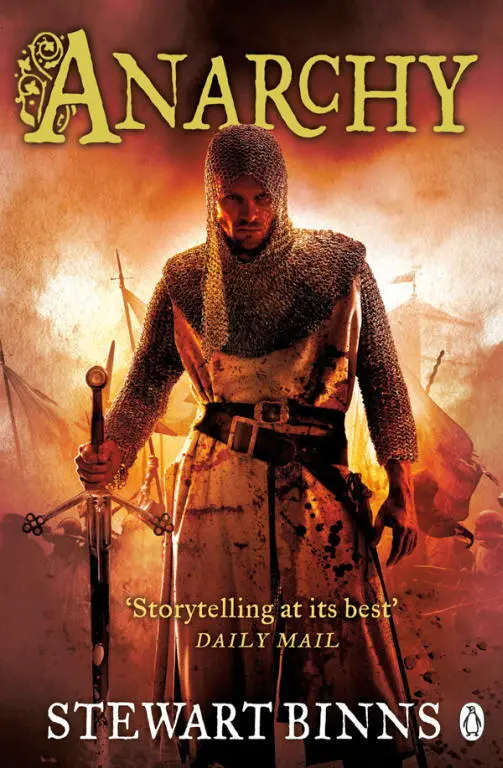
- Название:Anarchy
- Автор:
- Издательство:Penguin Books
- Жанр:
- Год:2013
- Город:London
- ISBN:978-0-718-19460-4
- Рейтинг книги:3 / 5. Голосов: 1
-
Избранное:Добавить в избранное
- Отзывы:
-
Ваша оценка:
Anarchy: краткое содержание, описание и аннотация
Предлагаем к чтению аннотацию, описание, краткое содержание или предисловие (зависит от того, что написал сам автор книги «Anarchy»). Если вы не нашли необходимую информацию о книге — напишите в комментариях, мы постараемся отыскать её.
The Making of England
Ruthless brutality, greed and ambition:
The year is 1186, the thirty-second year of the reign of Henry II.
Gilbert Foliot, Bishop of London, has lived through long Henry’s reign and that of his grandfather, Henry I. He has witnessed the terrifying civil war between Henry II’s mother, the Empress Matilda, and her cousin, Stephen; a time so traumatic it becomes known as the Anarchy.
The greatest letter writer of the 12th Century, Folio gives an intimate account of one of England’s most troubled eras. Central to his account is the life of a knight he first met over fifty years earlier, Harold of Hereford.
Harold’s life is an intriguing microcosm of the times. Born of noble blood and legendary lineage, he is one of the nine founders of the Knights Templar and a survivor of the fearsome battles of the Crusader States in the Holy Land.
Harold is loyal warrior in the cause of the Empress Matilda. On his broad shoulders, Harold carries the legacy of England’s past and its dormant hopes for the future.
Stewart Binns’
is a gripping novel in the great tradition of Conn Iggulden and Bernard Cornwell, and is the third in
trilogy, following
and
.
Anarchy — читать онлайн бесплатно полную книгу (весь текст) целиком
Ниже представлен текст книги, разбитый по страницам. Система сохранения места последней прочитанной страницы, позволяет с удобством читать онлайн бесплатно книгу «Anarchy», без необходимости каждый раз заново искать на чём Вы остановились. Поставьте закладку, и сможете в любой момент перейти на страницу, на которой закончили чтение.
Интервал:
Закладка:
‘I thought you would bring us an easy victory. The men believe your crimson cross heralds the courage of the Great Crusaders.’
The King ordered that we make camp a mile or so from the battlefield. As the army filed away, he turned to address me.
‘Take your sergeant and ride up and down the column with the Holy Cross. It will be the perfect end to a good day for the men.’
Despite my doubts about Hugh de Payens and our eminent Order, what followed in his name and that of my brother Templars was one of the most invigorating moments of my life. While I stood tall in my stirrups waving my sword in salute, with the setting sun blazing through it, Eadmer carried the Templar’s crimson cross along the length of the Christian column. The cheers followed us like waves running along a beach and echoed all around us. At that moment, I realized that the Knights Templar were a force to be reckoned with in the Holy Land and that their influence may well extend way beyond its borders – even reaching back into Europe.
I had come through yet another challenging skirmish and was at last beginning to believe that my quest to write my own chapter in the illustrious history of my family might, after all, meet with success.
Three weeks later, we were back beneath the walls of Tyre, with the King freshly invigorated and determined to break the siege. News had also reached the defenders that the relief army from Egypt had been turned back, which must have weakened their resolve. Although Hugh de Payens’ small force had been unable to stop the Emir from replenishing his supplies, he had been under siege for several months and morale within the city must have been running low.
Over the decades of their occupation, the Christians had brought in large numbers of pigs from Europe for plentiful supplies of pork and bacon, of which the Franks were particularly fond. Conversely, Muslims regard the pig as a filthy animal and loathe its presence, quite apart from finding it abhorrent as a food. The King ordered the collection and slaughter of dozens of pigs, and the army was fed roast pork for the coming days. However, the pigs’ heads were spared the pot and instead hurled into the city by the basketful. Then, to compound the insult, after consuming pork for several days, he ordered his men to defecate into earthenware pots provided for the purpose. These too were launched on to the inhabitants of the city.
The King found the whole distasteful exercise amusing – in stark contrast to the revulsion that must have been felt behind Tyre’s walls.
The catapults were then put to more conventional use and soon boulders, incendiaries and hot oil began to cascade from the skies. The Venetian ships also began to bombard the city, until missiles rained down on all sides. The barrage was relentless; a shift system was organized among the Christian sappers so that the aerial attacks continued all day and every night. For those trapped inside the city, sleep was almost impossible – especially for the citizens charged with extinguishing the many fires that were started by the flaming pitch. Despite the onslaught, there was no sign of capitulation from the besieged inhabitants.
But then, an unexpected development caught all of us unawares in late June 1124. I remember the date well because some of the men who still had hankerings after their old pagan traditions had just celebrated the Summer Solstice a few days earlier. It was about half an hour before dawn when the gates of the city suddenly opened to release a tumult of humanity. People of all ages ran in every direction. Many tried to run through our camp, some begged for mercy at our tents, and a few made for boats in the harbour to try to escape by sea. They were mainly civilians, but a few were armed and appeared to be from the Emir’s garrison.
Within minutes, the city gates had been closed again and most of the escapees had been rounded up – a group of several thousand. There was no violence; these poor souls had simply had enough and had stormed Tyre’s gates from the inside in a bid for freedom from the agony of the unremitting siege. They said that unrest was widespread – even among the Emir’s men – and that disease had taken hold, killing dozens by the day.
The King immediately ordered that the runaways be quarantined, but within sight of the city. And then he made a shrewd decision: he ordered his cooks, stewards and healers to care for them. In full view of vantage points on the city walls, food was cooked and distributed, plentiful supplies of water were given out and even wine was made available for those who wanted it. The sick were treated, and sappers were stood down from their duties servicing the siege engines and preparing ammunition in order to erect shelters for the evacuees.
It took only two days for the King’s generosity to work its magic inside the city. We could hear shouting and screaming from inside the walls, followed by the clash of weapons. Then, towards the end of the second afternoon, amidst much uproar and cheering, a large group of men appeared on the walls, just above the main gate. In the centre of the group, tied hand and foot, was a bloodied and beaten Emir of Tyre, al-Malik. The leader of the group then shouted down to us in good Norman, asking for food and water and safe passage to the Muslims of the east, rather than to Fatimid Egypt. He said that everyone in the garrison loyal to the Emir had been killed in fighting that had lasted for two days and that the Emir was now alone and defenceless.
Under instruction from the King, Hugh de Payens then walked forward and agreed to the citizens’ requests. But he said it was conditional on the Emir being released.
Wild celebrations followed, both inside and outside the city. The next day, the Muslims of Tyre began their long walk to the east and a precarious future, while the Christian army entered their city – the last Muslim enclave in Palestine. But before the Muslims left, the King had his revenge for the blinding of the Armenians.
Al-Malik, already drenched in blood and only semi-conscious, was dragged into the citadel’s main square and tied to a column in the marketplace. A hot iron was prepared which Hugh de Payens brandished – with a relish unbecoming the Grand Master of a brotherhood of good men – before proceeding to take out the Emir’s eyes. He was then cut down and made to kneel in front of the Grand Master, who raised his sword high above his head and cried: ‘Go to your god to face his wrath and know that this is the punishment for anyone who defiles the children of the true God.’ To my shame, our Grand Master then started to hack at the neck of the Emir until he had detached it from his body. It was an act a merciful executioner would have accomplished in one or two blows, but which Hugh de Payens took at least a dozen ham-fisted attempts to achieve.
Despite the brutality, the men of the army roared their approval – so much so that, in the weeks that followed, Jerusalem saw long queues of knights wanting to enlist as Knights Templar. I looked at the King, who had a troubled expression.
He had unleashed a beast in this man; I hoped he could contain it.
~
Fulham Palace, 15 February 1187
Dear Thibaud,
Another Sabbath today and the warmth of the sun is on our backs. Winter is nearly over, and I think the worst has passed.
I find it fascinating that over sixty years after the events Harold has described in so much detail, the same names and places are still part of the story of the Holy Land. More crusades, yet another Baldwin as King of Jerusalem. Cities fall and are retaken; it goes on and on. And we’re only a few years away from the hundredth anniversary of the First Crusade.
Surely the great religions can live together? Do the Muslims not accept Christ as a great prophet? Could we not accept their prophet, Mohammed, in the same way?
Читать дальшеИнтервал:
Закладка:
Похожие книги на «Anarchy»
Представляем Вашему вниманию похожие книги на «Anarchy» списком для выбора. Мы отобрали схожую по названию и смыслу литературу в надежде предоставить читателям больше вариантов отыскать новые, интересные, ещё непрочитанные произведения.









Обсуждение, отзывы о книге «Anarchy» и просто собственные мнения читателей. Оставьте ваши комментарии, напишите, что Вы думаете о произведении, его смысле или главных героях. Укажите что конкретно понравилось, а что нет, и почему Вы так считаете.