John Passos - Mr. Wilson's War
Здесь есть возможность читать онлайн «John Passos - Mr. Wilson's War» весь текст электронной книги совершенно бесплатно (целиком полную версию без сокращений). В некоторых случаях можно слушать аудио, скачать через торрент в формате fb2 и присутствует краткое содержание. Год выпуска: 1962, ISBN: 1962, Издательство: Doubleday, Жанр: Историческая проза, Биографии и Мемуары, на английском языке. Описание произведения, (предисловие) а так же отзывы посетителей доступны на портале библиотеки ЛибКат.
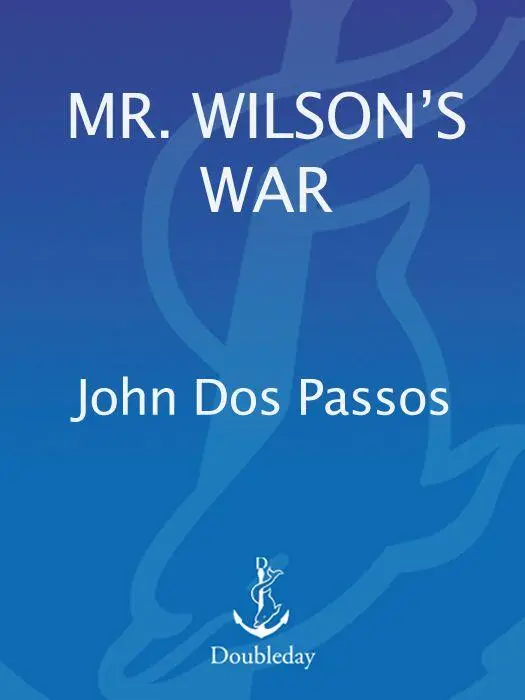
- Название:Mr. Wilson's War
- Автор:
- Издательство:Doubleday
- Жанр:
- Год:1962
- ISBN:9780385028288
- Рейтинг книги:3 / 5. Голосов: 1
-
Избранное:Добавить в избранное
- Отзывы:
-
Ваша оценка:
Mr. Wilson's War: краткое содержание, описание и аннотация
Предлагаем к чтению аннотацию, описание, краткое содержание или предисловие (зависит от того, что написал сам автор книги «Mr. Wilson's War»). Если вы не нашли необходимую информацию о книге — напишите в комментариях, мы постараемся отыскать её.
Foremost in the cast of characters is Woodrow Wilson, the shy, brilliant, revered, and misunderstood “schoolmaster”, whose administration was a complex of apparent contradictions. Wilson had almost no interest in foreign affairs when he was first elected, yet later, in proposing the League of Nations, he was to play a major role in international politics. During his first summer in office, without any…
Mr. Wilson's War — читать онлайн бесплатно полную книгу (весь текст) целиком
Ниже представлен текст книги, разбитый по страницам. Система сохранения места последней прочитанной страницы, позволяет с удобством читать онлайн бесплатно книгу «Mr. Wilson's War», без необходимости каждый раз заново искать на чём Вы остановились. Поставьте закладку, и сможете в любой момент перейти на страницу, на которой закончили чтение.
Интервал:
Закладка:
Ludendorff immediately called in divisional commanders and field officers to meet with him at his headquarters at Avesnes. “I was told of deeds of glorious valor, but also of behavior which, I openly confess, I should not have thought possible in the German army.”
He laid the blame on pacifist propaganda. Prince Lichnowsky, who had been German ambassador in London in 1914, had allowed his account of British efforts to preserve the peace to be published in a pamphlet. The inference was that the German Imperial Government bore most of the guilt for provoking the war. The authorities were not interfering with its distribution, even to the troops. Wilson’s Fourteen Points were in every hand. Soldiers who had been prisoners of war in Russia were re-enrolled under protest and spread the Bolshevik infection through their new regiments. Joffe, Bolshevik ambassador to Berlin, was making his embassy the center for the spreading of treason and defeatism. “The army,” wrote Ludendorff, “was literally swamped with enemy propaganda.”
“The failure of August 8,” Hindenburg admitted in his memoirs, “was revealed to all eyes as the consequence of open weakness … The enemy had learned a good deal from us since the spring … he had employed against us those tactics with which we had soundly beaten him time after time.”
So seriously did Ludendorff take the defeat before Amiens that he went to Hindenburg and offered to resign as Chief of Staff. Neither Hindenburg nor the Kaiser would accept his resignation.
At an imperial conference at the Hotel Britannique at Spa on August 13 Ludendorff announced brusquely that the war must be ended. The Kaiser instructed his Foreign Secretary to start immediately working for negotiations, if possible through the Queen of the Netherlands. Next day the Emperor Charles of Austria arrived with the news that the Austro-Hungarian Army could not be expected to resist through another winter. Although Hindenburg remained optimistic, Ludendorff repeated the facts as he saw them. The impression he gave to the conference at Spa was, in his own words, that “I no longer believed in a victorious issue of the war.”
Chapter 20
TO SAVE THE RUSSIANS FROM THEMSELVES
IN Washington the summer of 1918 was unusually hot. Woodrow Wilson continued his relentless routine. At eight he presided, with Edith Wilson at the other end of the table, at his customary family breakfast. Visiting relatives from the large Wilson and Bolling connections were expected to appear with fresh morning faces. Through the windows Edith would point out the fourteen sheep and four lambs “doing their bit” cropping the White House lawns. After breakfast the President walked over to his office in the wing, and there dictated to his stenographer until a little before ten, when congressmen, cabinet members, or delegations that for some reason or another could not be shunted off on Tumulty, began to be admitted.
The President would listen to what his visitors had to say with cool affability. His replies were invariably noncommittal. He would ask for the problems to be put in writing so that he could decide on them later in the quiet of his study.
Lunch was at one but the President was often late. After lunch, if there were no cabinet meeting scheduled, would come formal calls from ambassadors and the like. If there were any of the afternoon left and the weather weren’t too hot he would hurry with Grayson or sometimes with Edith to the country club for a little golf, coming back to the White House in time for a bath before dressing for dinner.
When he was dressed the great mass of letters and documents that had to be signed that day were brought to him. Sometimes he had time for a glass of scotch and soda before the formal evening meal. At table guests were discouraged from talking about politics or international affairs.
After dinner came consultations with close advisers such as Baker or Creel or with Colonel House if he were in town. Then the President would retire to his study, often helped by Edith, who liked to arrange his manuscripts for him, and would pore over the papers he’d collected during the day and make his shorthand notes or type out on his own typewriter the private memoranda from which his state papers or public speeches would gradually evolve. It was often long after midnight before he got to bed.
Saturday mornings he would try to play a full eighteen holes of golf, usually with Grayson, or with Edith if she felt up to it. Sundays he attended the Central Presbyterian Church. He always listened to the sermon with attention: he was a connoisseur of sermons as some men are of wines. In the afternoon he would collect the ladies of the family and take them motoring around one of his unchangeable itineraries in the White House car.
Woodrow Wilson’s first wife’s brother Stockton Axson, then serving as Secretary of the American Red Cross, was a frequent visitor that summer. “Stock,” as he called him, was one of the men the President loved best. Their friendship was tinged perhaps by a certain nostalgia for academic days and for his lost life with Ellen whose death he still could not bear to think of.
Dr. Axson remembered a conversation they had one Sunday afternoon in late June of that year as so significant that, when Ray Stannard Baker asked him for anecdotes to include in his Life and Letters some years later, he told about it in detail. Axson came to lunch at the White House after church and found the President in “one of his most loveable talking moods.” When Axson and the Wilsons were alone after the meal, Wilson suddenly asked him whom he would name for the next President.
Present company was excepted, they agreed. Axson suggested McAdoo. The President answered that he loved Mac as much as Stock did, but that the next President must have great powers of reflection as well as being a man of action. “Now nobody can do things better than Mac, but if Mac ever reflects, I never caught him in the act.” He said Newton D. Baker was the best man but he could never be nominated. “The next President will have to be able to think in terms of the whole world,” he went on. “He must be internationally minded … the only really internationally minded people”—Wilson was thinking aloud—“are the labor people. They are in touch with world movements.”
After the war the world would change radically. Governments would have to do things now done by individuals and corporations. Waterpower, coalmines, oilfields would have to be government owned. “If I should say that outside,” he exclaimed, “people would call me a socialist, but I am not a socialist. And it is because I’m not a socialist that I believe these things.”
He added that he believed this was the only way communism could be prevented — Dr. Axson told Ray Baker he wasn’t sure Wilson used the word communism, which wasn’t yet in circulation, perhaps he said bolshevism—“the next President must be a man who is not only able to do things, but after having taken counsel and made a full survey, be able to retire alone, behind his own closed door, and think through the processes, step by step.”
Woodrow Wilson, during those summer months, though brilliantly persuasive in his public appearances, was tortured by perplexities whenever he retired behind his own closed door, to think through the processes, step by step.
At home, now freshly stimulated by Bolshevik propaganda against capitalism and war, there was that “baneful seething” among the workingclass and the foreign born that never ceased to worry him.
The very Sunday Dr. Axson remembered as the date of their cosy after-luncheon talk, Eugene V. Debs, who proclaimed himself a socialist but whose basic notions of the democratic process were not too different from the President’s, was arrested in Cleveland charged with making statements that violated the Espionage Act.
Читать дальшеИнтервал:
Закладка:
Похожие книги на «Mr. Wilson's War»
Представляем Вашему вниманию похожие книги на «Mr. Wilson's War» списком для выбора. Мы отобрали схожую по названию и смыслу литературу в надежде предоставить читателям больше вариантов отыскать новые, интересные, ещё непрочитанные произведения.

Обсуждение, отзывы о книге «Mr. Wilson's War» и просто собственные мнения читателей. Оставьте ваши комментарии, напишите, что Вы думаете о произведении, его смысле или главных героях. Укажите что конкретно понравилось, а что нет, и почему Вы так считаете.