John Passos - Mr. Wilson's War
Здесь есть возможность читать онлайн «John Passos - Mr. Wilson's War» весь текст электронной книги совершенно бесплатно (целиком полную версию без сокращений). В некоторых случаях можно слушать аудио, скачать через торрент в формате fb2 и присутствует краткое содержание. Год выпуска: 1962, ISBN: 1962, Издательство: Doubleday, Жанр: Историческая проза, Биографии и Мемуары, на английском языке. Описание произведения, (предисловие) а так же отзывы посетителей доступны на портале библиотеки ЛибКат.
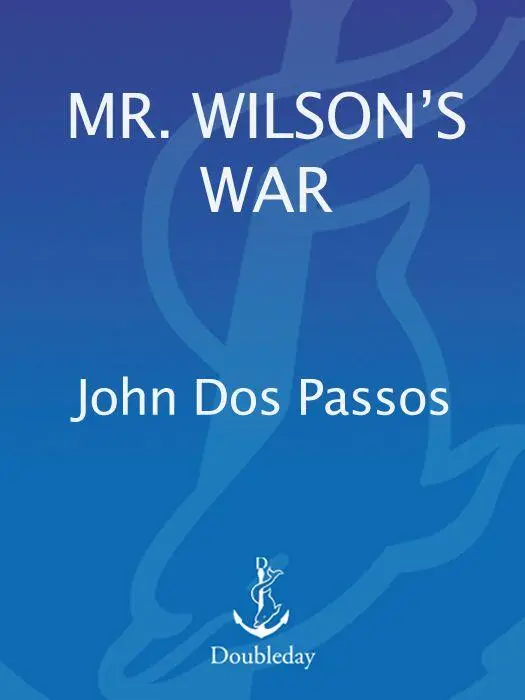
- Название:Mr. Wilson's War
- Автор:
- Издательство:Doubleday
- Жанр:
- Год:1962
- ISBN:9780385028288
- Рейтинг книги:3 / 5. Голосов: 1
-
Избранное:Добавить в избранное
- Отзывы:
-
Ваша оценка:
Mr. Wilson's War: краткое содержание, описание и аннотация
Предлагаем к чтению аннотацию, описание, краткое содержание или предисловие (зависит от того, что написал сам автор книги «Mr. Wilson's War»). Если вы не нашли необходимую информацию о книге — напишите в комментариях, мы постараемся отыскать её.
Foremost in the cast of characters is Woodrow Wilson, the shy, brilliant, revered, and misunderstood “schoolmaster”, whose administration was a complex of apparent contradictions. Wilson had almost no interest in foreign affairs when he was first elected, yet later, in proposing the League of Nations, he was to play a major role in international politics. During his first summer in office, without any…
Mr. Wilson's War — читать онлайн бесплатно полную книгу (весь текст) целиком
Ниже представлен текст книги, разбитый по страницам. Система сохранения места последней прочитанной страницы, позволяет с удобством читать онлайн бесплатно книгу «Mr. Wilson's War», без необходимости каждый раз заново искать на чём Вы остановились. Поставьте закладку, и сможете в любой момент перейти на страницу, на которой закончили чтение.
Интервал:
Закладка:
An hour before dawn, muffled by a thick ground mist made thicker by smoke bombs, the British tanks swarmed across the German lines. When they were well started a barrage dropped in front of them. The Aussies and Canadians followed in their trail. The big guns of the British artillery concentrated on knocking out enemy batteries. Whippets and armored cars broke through and romped about behind the German lines. The surprise was so great that one corps headquarters was caught at breakfast.
“Everywhere else the situation had developed more favorably for us than I, optimist though I am, dared to hope,” Haig noted. “The enemy was completely surprised, two reliefs of Divisions were in progress, very little resistance was offered and our troops got their objectives quickly with little loss.”
“On August 8, 1918 I commanded Whippet tank ‘Musical Box,’ ” reported Lieutenant C. B. Arnold. He told of crossing the railway at Villers-Bretonneux, a town hotly contested ever since the German March attack. His formation proceeded due east. “I found myself to be the leading machine, owing to the others having become ditched. To my immediate front I could see more Mark V tanks being followed very closely by Australian infantry … We came under direct shell fire from a four gun field battery of which I could see the flashes.”
Shells exploded near. Two Mark V tanks a hundred and fifty yards on the right of him were knocked out. He saw clouds of smoke coming from the machines and the crews tumbling out of them. Men were dropping, among the infantry that tagged after. Lieutenant Arnold’s whippet passed behind a screen of trees along the side of a road.
“I ran along this belt until level with the battery when I turned full right and engaged the battery in the rear … The gunners some thirty in number abandoned their guns and tried to get away. Gunner Ribbans and I accounted for the whole lot. I cruised forward making a detour to the left and shot a number of the enemy who appeared to be demoralized and were moving about the country in all directions.”
He advanced through a railroad siding and found Australian infantrymen occupying a sunken road beyond the battery he’d knocked out. After asking their lieutenant if they needed any help he proceeded in an easterly direction along the railway embankment passing two British cavalry patrols which were taking punishment from a group of Germans in a wheatfield. He advanced on the Huns, scattered them and then proceeded along the railroad tracks, noting that a burning train was being towed away by its engine. He was searching for a spot marked on his map as a German cantonment.
“Many enemy were visible packing kits and others retiring. On our opening fire on the nearest many others appeared from huts making for the end of the valley, their object being to get over the embankment and so out of our sight. We accounted for many of these.”
Then he cruised across country firing at retreating files of enemy infantry. As he was well ahead of his supporting troops the Musical Box was taking a lot of machinegun and rifle fire. Nine tins of gasoline for refueling carried on the roof of the tank were riddled. Gasoline dripped down over the cab.
“The fumes and the heat of the engine”—Lieut. Arnold noted that he had been in action for nine hours by this time—“made it necessary to breathe through the mouthpiece of the box respirator.”
He shot up an airfield. He knocked out a truck crossing a bridge. He crossed the railway line and fired into a convoy of horsedrawn wagons with canvas tops. By this time he was under intense machinegun fire.
“The left hand port cover was shot away. Fumes and heat were very bad.” Lieutenant Arnold was shouting to his driver to turn and discontinue the action when there were two heavy concussions and the cab burst into flames.
“Carney and Ribbans got to the door and collapsed. I was almost overcome but managed to get the door open and fell out onto the ground and was able to drag out the other two men. Burning petrol was running on to the ground where we were lying. The fresh air revived us and we all got up and made a short rush to get away from the burning petrol. We were all on fire. In this rush Carney was shot in the stomach and killed. We rolled over and over to try to extinguish the flames. I saw numbers of the enemy approaching from all around. The first arrival came for me with rifle and bayonet. I got hold of this and the point of the bayonet entered my right forearm. The second man struck at my head with the butt end of his rifle, hit my shoulder and neck and knocked me down. When I came to there were dozens all around me, and anyone who could reach me did so and I was well kicked: they were furious.”
After a number of interrogations and a certain amount of face slapping Lieutenant Arnold was taken to a fieldhospital where he was given an antitetanus injection and his burns treated. When he refused to answer questions he was locked in a room with no window and kept there for five days with only a bowl of soup and a small piece of bread a day to eat. He still refused to answer questions and finally found himself at a camp for British officer prisoners at Freiburg. It wasn’t until he was freed after the armistice that he was able to turn in his report.
“August 8 was the black day of the German army in the history of this war,” wrote Ludendorff. German fear of tanks became obsessive. Crack units broke and ran. The Australians and Canadians carried their objectives in jig time. The British corps had trouble but advanced.
The French army to the south, which had few tanks, attacked after the usual artillery bombardment from Montdidier north to the Amiens sector. At first they had heavy going, but, as the confusion caused by the British penetration spread, they began to make headway.
Haig couldn’t help recording the difficulties of the French: “I returned to my train for lunch,” he noted, “and about 4 pm I called on H.Q. First French army at Conty. Debeney was much distressed and almost in tears because three batallions of his Colonial Infantry had bolted before a German machine gun. I told him that the British advance would automatically clear his front.”
By night Rawlinson’s army had advanced seven miles, had captured four hundred guns, among them a longrange weapon of the Bertha type that had been pounding the British rear back of Amiens, and taken thirteen thousand prisoners. The French caught up with them on the second day.
After the first twentyfour hours the tempo slacked. The waterlogged entrenchments of the old Somme battlefields proved a greater obstacle than the enemy. Tanks broke down and ran out of fuel. Tank crews were exhausted.
The British generals still relied on cavalry to exploit a breakthrough. The Germans proved again that with a very few machineguns they could make mincemeat of horses and riders. The whippets which had run far ahead of their units were handicapped by orders to stand by to help the cavalry. The advance petered out. By the third day the Germans were digging in tenaciously on a shortened line, but their hope of taking Amiens was gone.
Although in some ways a minor operation the German High Command heard the voice of doom in their defeat at Amiens. For the first time their armies had broken under assault. Officers had allowed themselves to be swept by panic. Divisional headquarters had allowed their records to be captured.
“We had to resign ourselves now,” wrote Ludendorff, “to the prospect of the continuance of the enemy’s offensive. Their success had been too easily gained. Their wireless was jubilant, and announced — and with truth — that the morale of the German army was no longer what it had been. The enemy had also captured many documents of inestimable value to them.”
Читать дальшеИнтервал:
Закладка:
Похожие книги на «Mr. Wilson's War»
Представляем Вашему вниманию похожие книги на «Mr. Wilson's War» списком для выбора. Мы отобрали схожую по названию и смыслу литературу в надежде предоставить читателям больше вариантов отыскать новые, интересные, ещё непрочитанные произведения.





Обсуждение, отзывы о книге «Mr. Wilson's War» и просто собственные мнения читателей. Оставьте ваши комментарии, напишите, что Вы думаете о произведении, его смысле или главных героях. Укажите что конкретно понравилось, а что нет, и почему Вы так считаете.