Wu Ming - 54
Здесь есть возможность читать онлайн «Wu Ming - 54» весь текст электронной книги совершенно бесплатно (целиком полную версию без сокращений). В некоторых случаях можно слушать аудио, скачать через торрент в формате fb2 и присутствует краткое содержание. Год выпуска: 2006, Издательство: Houghton Mifflin Harcourt, Жанр: Историческая проза, на английском языке. Описание произведения, (предисловие) а так же отзывы посетителей доступны на портале библиотеки ЛибКат.
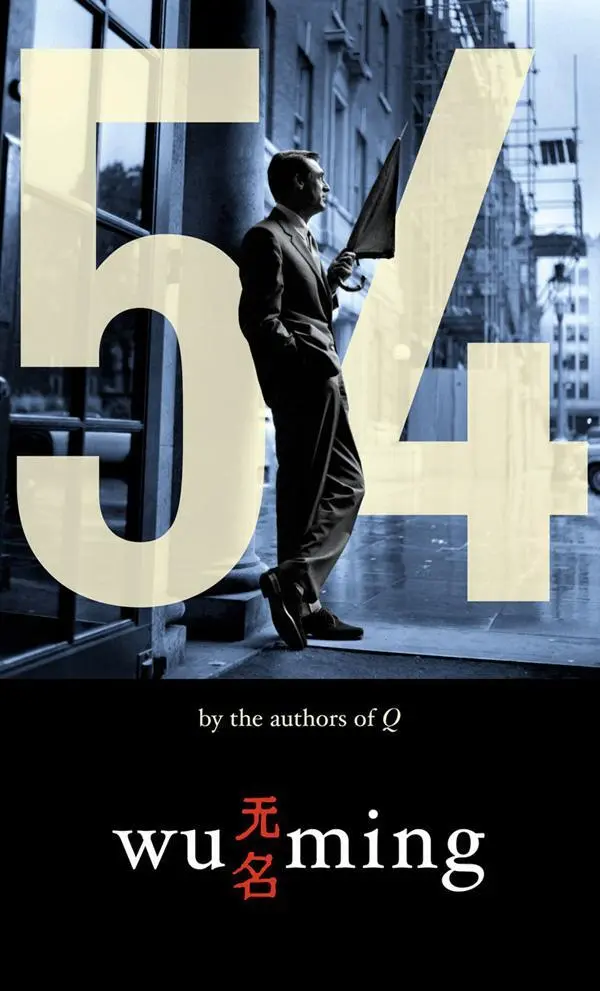
- Название:54
- Автор:
- Издательство:Houghton Mifflin Harcourt
- Жанр:
- Год:2006
- ISBN:нет данных
- Рейтинг книги:5 / 5. Голосов: 1
-
Избранное:Добавить в избранное
- Отзывы:
-
Ваша оценка:
54: краткое содержание, описание и аннотация
Предлагаем к чтению аннотацию, описание, краткое содержание или предисловие (зависит от того, что написал сам автор книги «54»). Если вы не нашли необходимую информацию о книге — напишите в комментариях, мы постараемся отыскать её.
Set during the height of the Cold War-with the world divided into East and West-54 features Italian partisans, KGB agents, Parisian lowlifes, and cameos by David Niven, Marshal Tito, and Grace Kelly. Wu Ming brings us a cinematic romp that is by turns edgy social satire and modern comic send up.
54 — читать онлайн бесплатно полную книгу (весь текст) целиком
Ниже представлен текст книги, разбитый по страницам. Система сохранения места последней прочитанной страницы, позволяет с удобством читать онлайн бесплатно книгу «54», без необходимости каждый раз заново искать на чём Вы остановились. Поставьте закладку, и сможете в любой момент перейти на страницу, на которой закончили чтение.
Интервал:
Закладка:
Ettore nodded.
‘You and I had an agreement. I hope you haven’t forgotten it.’
Pierre leaned on the basin.
‘I know. Don’t worry.’
‘Fine. Then drop by the office one of these days and we’ll talk about it.’
He was already halfway out the door when he turned round and added, ‘Ah, Pierre, a word of advice: stay away from the Redhead, she’s trouble. A good few guys have lost their heads over her. Mark my words.’
He went out, closing the door behind him.
Pierre stared at the floor and thought about how complicated life could get from one day to the next.
Chapter 3
Bologna, night between 5 and 6 May
Ettore didn’t ride a bike. He preferred to walk. ‘I cycled in my partisan days,’ he said, ‘and now I don’t cycle any more.’
He lived near Porta San Felice and walked to the workshop. To go dancing or go and see a film, he put on a good suit with a well-pressed collar, the right tie and gleaming shoes. He preferred to walk under the arcades, to show off the crease in his trousers falling like a plumb-line.
And if you had a woman, why carry her on the bar of your bicycle that hurts her bum, rather than taking her by the arm? Strolling, as though there was nothing worth hurrying for, not even making love.
It was a reaction to the ‘job’ he did: always up and down, back and forth, never missing appointments, getting the goods there on time, putting his foot down, covering the greatest possible distance before he got tired.
In his free time, he wanted nothing to do with wheels and speed.
And anyway, he lived in the centre, on his own, and his bed was big enough for two. Bringing women home was easy.
That night, leaving ‘Seventh Heaven’, Ettore was alone and thoughtful.
He was thirty years old and he had a vague but well-founded reputation as a layabout. The Party and the National Partisans’ Association had expelled him for ‘moral turpitude’ in 1949, but no one knew the real reason. People talked about drugs, prostitution and who knows what else.
It should be pointed out that these things were said in his absence, to avoid a good kicking. *
Ettore Bergamini had been a partisan at Monte Sole, in the Apennines, with the ‘Red Star’ Brigade led by Mario Musolesi, the mythical Lupo , the ‘Wolf’.
He had been involved in extremely violent and interminable gunfights.
He had used explosives, stretched ambush wires, executed enemies, fought shoulder to shoulder with Englishmen, Czechs, Russians and even one Indian. Sad. Not a redskin, an Indian from India, with a turban on his head.
He had seen Ettore Ventura, the ‘Aeroplane’, charging Germans riding on a white horse.
He had seen Fonso’s mother turn up right in the middle of a battle, heedless of the bullets, an expedition of several kilometres, to bring her son a bowl of zabaglione.
‘Poor thing, you’ve been fighting for hours, and you haven’t had a bite to eat!’
Fonso had looked at her, shocked, unable to believe his eyes.
Then he had drunk the zabaglione, and said, ‘Thanks, mamma . But now get yourself to safety!’
On 27 June, because of serious strategic and political differences with the Wolf, Sugano Melchiorri had formed a new battalion of fortysix partisans. One of them was Ettore.
After a thousand vicissitudes, ‘Red Star’ Sugano had gone down into the plain and joined the 7th partisan group, Anzola detachment. Those had been the last times Ettore had used a bicycle. There he had met Amleto Benini, ‘Bianco’ (because of his grey hair), who would later give him a job. This job.
In October ’44 they had taken part in the battle of Porta Lame, three incredible days, the only open clash between Germans and partisans inside a European city.
On 21 April ’45 Ettore had liberated Bologna, along with his other comrades.
Sure, but who had they liberated it from?
The fascists, the ones who’d been given amnesty.
The partisans, thrown out of the newly formed police corps and persecuted by the law courts.
Sugano, victim of a judicial set-up, forced to escape to Czechoslovakia, like many other comrades.
Ettore had also ended up the focus of a few inquiries. Minor stuff, accusations of extortion and looting. He had always been released, but he still had some charges pending.
And the Carlino ? It had changed its name time and again, it was still churning out lines as when, on 11 October 1944, it had denied that the massacre of Marzabotto had ever taken place. Ettore had kept the cutting. He had reread it so many times that he knew some passages off by heart.
The usual uncontrolled rumours, the typical product of galloping fantasies in time of war, ensured until yesterday that in the course of a police operation against a band of outlaws, a good 150 people, including women, old men and children, were massacred by German troops mopping up in the town of Marzabotto. So we confront a new ploy by the usual reckless characters destined for ridicule because anyone who had bothered to question any honest inhabitant of Marzabotto, or even a survivor from that area, would have learned the true version of the facts.
Shitheads.
Pain, tears, fear, hatred. But also euphoria, the desire to see an end to the war and to fascism, the longing to create a new Italy. Life had a meaning in those days; it wasn’t just a matter of running from hour to hour, dragging yourself from one day to the next.
Why deny it? Ettore knew: those months in the mountains had been the finest in his life. Afterwards, there had been nothing of real interest.
He didn’t head for home. He turned into Via Lame, and arrived at the Porta. The sky was full of stars, hundreds of stars, maybe thousands.
He had done it a thousand times, and he did it again. He remembered the battle, shot for shot. There was fog, and someone shouted, ‘Garibaldi’s fighting!’ He had yelled with all his might, ‘Red Star is winning!’
Chapter 4
Report produced for the Italian authorities by Charles Siragusa, District Supervisor, US Bureau of Narcotics, on 6 May 1954
In my opinion Salvatore Lucania, alias Charles ‘Lucky’ Luciano, comes back under the jurisdiction of Chapter V of the control of Italian Public Security, relating to police internment, and could be destined for the penal colony of Ustica.
He would come under category 3 of article 181, relating to a person who pursues and intends to pursue criminal activities damaging to Italian national interests.
Since his expulsion from the United States to Italy, his activity has been such as to compel the forces of Italian Public Security and customs officials to investigate him thoroughly.
Lucania has maintained contact with the principal American criminals, through various avenues, and in particular through members of the underworld. Proof exists that Lucania has received considerable sums of money from these individuals, given to him personally by gangsters who had come from Italy with that specific intent.
He has already been incriminated in and fined for the illegal importation of American dollars and an American automobile. His name has been mentioned in various important inquiries conducted in Italy concerning the traffic of narcotics and the smuggling of large quantities of heroin into the United States. He has even been discussed by the United States Narcotics Commission.
Unfortunately the traffickers implicated in these investigations would never make declarations damaging to Lucania. This is understandable, given the terror that he provokes among the Italian underworld. Lucania has not been found guilty of the charges relative to the narcotics market; but that is not to say that he is not implicated in the trafficking. It is, furthermore, impossible to explain how he is able to enjoy such a luxurious lifestyle, without having any apparent source of income.
Читать дальшеИнтервал:
Закладка:
Похожие книги на «54»
Представляем Вашему вниманию похожие книги на «54» списком для выбора. Мы отобрали схожую по названию и смыслу литературу в надежде предоставить читателям больше вариантов отыскать новые, интересные, ещё непрочитанные произведения.









Обсуждение, отзывы о книге «54» и просто собственные мнения читателей. Оставьте ваши комментарии, напишите, что Вы думаете о произведении, его смысле или главных героях. Укажите что конкретно понравилось, а что нет, и почему Вы так считаете.