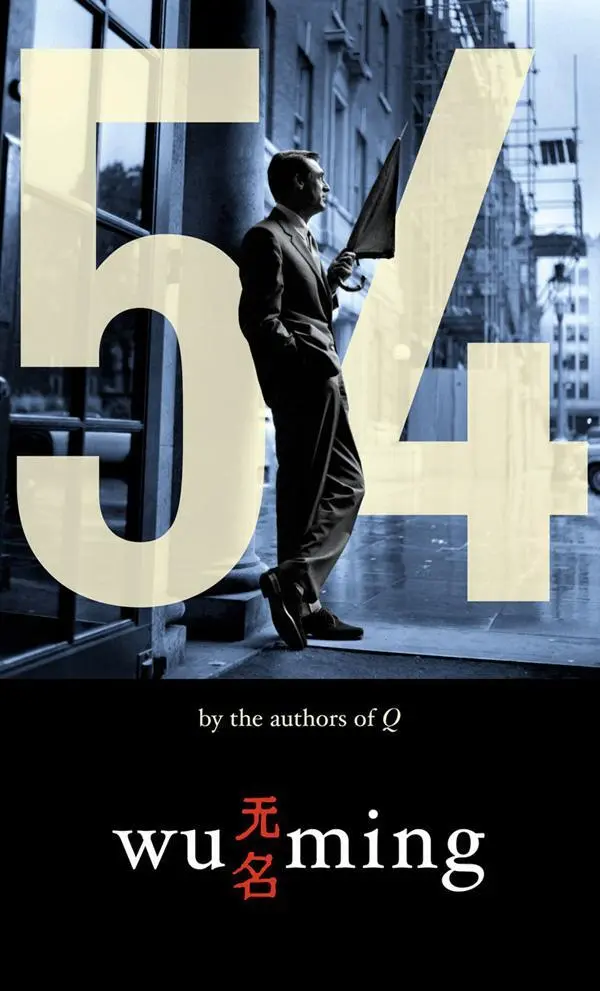
Wu Ming - 54
Здесь есть возможность читать онлайн «Wu Ming - 54» весь текст электронной книги совершенно бесплатно (целиком полную версию без сокращений). В некоторых случаях можно слушать аудио, скачать через торрент в формате fb2 и присутствует краткое содержание. Год выпуска: 2006, Издательство: Houghton Mifflin Harcourt, Жанр: Историческая проза, на английском языке. Описание произведения, (предисловие) а так же отзывы посетителей доступны на портале библиотеки ЛибКат.
- Название:54
- Автор:
- Издательство:Houghton Mifflin Harcourt
- Жанр:
- Год:2006
- ISBN:нет данных
- Рейтинг книги:5 / 5. Голосов: 1
-
Избранное:Добавить в избранное
- Отзывы:
-
Ваша оценка:
54: краткое содержание, описание и аннотация
Предлагаем к чтению аннотацию, описание, краткое содержание или предисловие (зависит от того, что написал сам автор книги «54»). Если вы не нашли необходимую информацию о книге — напишите в комментариях, мы постараемся отыскать её.
Set during the height of the Cold War-with the world divided into East and West-54 features Italian partisans, KGB agents, Parisian lowlifes, and cameos by David Niven, Marshal Tito, and Grace Kelly. Wu Ming brings us a cinematic romp that is by turns edgy social satire and modern comic send up.
54 — читать онлайн бесплатно полную книгу (весь текст) целиком
Ниже представлен текст книги, разбитый по страницам. Система сохранения места последней прочитанной страницы, позволяет с удобством читать онлайн бесплатно книгу «54», без необходимости каждый раз заново искать на чём Вы остановились. Поставьте закладку, и сможете в любой момент перейти на страницу, на которой закончили чтение.
Интервал:
Закладка:
‘Don’t you know? The police have forbidden any placards against the government, the atom bomb and so on. It’s Labour Day, they say, so you can talk about work and don’t fret over anything else. I’d say the fists’ll start flying shortly.’
Bottone has seen a good few demonstrations. The first time was in 1911, a procession against Giolitti and the war in Libya. But he had felt a blow from a rifle butt only eight years after that, during the revolt against the rising cost of living, when the shops were looted. He had ended up in hospital with his head split open, and stayed there for almost a week, but the scar, under his hair, had never gone away.
The experience had left him with an ability to sense the moods of the crowd and the police, to work out when and where the sparks would fly. He grabbed Garibaldi by an arm and dragged him into the middle of the street, elbowing his way through to the other side of the square.
At the head of the procession, on Via dei Mille, were the union big-shots, some city councillors and even Senator Zanardi. The police would never charge at that point. They couldn’t afford to do so over by Via Marconi either, because that was where Trade Union Headquarters was, and they risked getting a damned good hiding. For that reason, Bottone worked out that the attack would have to come from the station or somewhere behind it. But he ruled out the latter hypothesis, because there were very few controversial placards there, and the riot squad needed a pretext for sounding the charge.
In fact, at the designated crossroads, they found themselves facing the classic scene: rifles on one side, red banners on the other, and in the middle an invisible and magnetic trough, as there is when you try and bring together the same poles of a pair of magnets.
‘This is your last warning. Hand in the forbidden placards or we will be obliged to break up the demonstration with the use of force.’
The reply was a unanimous shout, and hundreds of fists raised to the sky. ‘One, two, three, four, Scelba you’re a fucking whore!’
Then everyone launched into a rendition of the Internationale while Bottone and Garibaldi were sucked towards the front ranks.
It was then that something unexpected happened. The script had allowed for another minute or two of confrontation, then the marshal would give the order to charge and the first round would begin. Instead, at the first notes of the workers’ anthem, a solitary individual, immediately identified by certain experts as Giuseppe Zanasi, a former amateur boxer, broke away from the cordon of comrades, took four steps forwards and went and took up position right in the middle of the magnetic field.
There was a moment’s hesitation in the ranks of the riot squad, then one of them advanced towards Zanasi with his rifle raised, intimating that he should leave.
He didn’t move a muscle, arms along his sides, eyes fixed on his shoes. The cop got even more aggressive and struck him on the shoulder to persuade him to shift. The former boxer’s hand grabbed the barrel of the rifle and forced the cop to lower it. The two men stared at each other for a long time. Zanasi said something that many people later swore they had heard perfectly.
‘He said, “Put this away, it’s nasty ,” that’s what he said.’
‘No, no, I heard him very clearly, he said “So now what are you going to do? Shoot me?”’
‘What are you on about? He said, “This would look better up your arse.” And there’s an end to it.’
Bottone and Garibaldi weren’t near enough to have a version of their own. Neither did they hear the order to charge, but that was because, in the confusion of the moment, nobody had remembered to give it. Bottone didn’t see the fist coming either. Garibaldi did: he was taller, and saw it very clearly. Zanasi barely looked up, as though his boxer’s instinct suggested where he should strike. The cop went down like a tree. Then they were swept aside in the clash.
Zanasi was arrested along with another man who had just taken a few knocks, two riot police ended up in hospital, and five placards were confiscated.
Bottone was limping by the time he arrived at the gardens, from a kick in the shin that he claimed had been delivered by the marshal in person; Garibaldi’s shirt was torn off in the scuffle, and Walterún, by way of consolation, offered him a glass at the wine stall. But there was nothing to be done, he would just have to live with it, and he was worried that his wife would chew his face off when he got home.
Chapter 55
Between Dubrovnik and Bari, 1 May
At the end of the day he didn’t mind the sea. Let’s not get carried away, now, but he had developed a certain affection for it. Ok, the smell of the docks turned his stomach, he hated the salt on his skin, and the lounge bar millionaires with their passion for sailing; in spite of that, when he fantasised about the place where he would spend his last years, without even doing it on purpose he always found himself there, with his arse in the sun and the sea in front of him. It wasn’t a conscious choice: his selection was guided by more important criteria.
First of all a place where Luciano wouldn’t have any contacts. That ruled out a good proportion of the planet: at least all of the United States, a good chunk of Central America and the more civilised countries of the old continent.
Second, there couldn’t be any fanatics around, it would be politically calm and the laws were very comprehensive, with citizens dedicated to alcohol, gambling and fornication. That completely ruled out Muslim countries, Soviet satellites and colonies in ferment.
Third, there would have to be at least one bar within a radius of five kilometres where the barman didn’t serve bourbon instead of Scotch, and was capable of shaking up a decent Manhattan. Which ruled out Central Africa, India and possibly even Japan.
Fourth, the most you would need in the depths of winter was a woolly jumper. Out went Scandinavia, Canada and England.
Clearly, the sea wasn’t on the list of basic requirements. And yet it came up time and again. Perhaps because Steve had learned his geography from cabin boys and bo’suns and couldn’t think of a single town that didn’t at least look out on an ocean.
Or perhaps because he had always lived in cities by the sea, even if, in New York, there are children in Queens who have never been to Coney Island or Orchard Beach, and don’t even know that the ocean begins just beyond the Verrazzano Narrows Bridge. Because, in the end, Upper Bay is very like a lake, and you can be sure that the guy who drives the Staten Island ferry wouldn’t be able to pilot a dinghy on the open sea.
So, to recapitulate: Montevideo? Full of Italians. And they have cold winters down there. The Bahamas? Too many goddamned Americans. Or how about Sydney? No, Steve, too many Italians in Sydney too; what about New Zealand? No, it would get cold down there too from time to time. Hong Kong? Singapore? Could they make a decent Manhattan in Singapore?
The sailor had told him to behave himself in there and make sure nobody saw him. It probably wasn’t in the captain’s interests to report him once they’d got there, but it wouldn’t be a good idea to worry him, either. He wasn’t a very understanding guy.
For the first two hours of the journey, Pierre remained true to the task. Crouching in his hole, with the little cage between his knees and the leather bag under his arm, he did everything he could think of to go to sleep, the only way he could give his stomach peace. But not even a fakir could have put him to sleep in those conditions. There was a terrible heat, the air was dense, a compress of salt and lubricants on the skin, the taste of rotten fish in his mouth and nose. Chin resting on his knees, Pierre kept his eyes on his travelling companion, concerned that it might drop dead at any moment.
Читать дальшеИнтервал:
Закладка:
Похожие книги на «54»
Представляем Вашему вниманию похожие книги на «54» списком для выбора. Мы отобрали схожую по названию и смыслу литературу в надежде предоставить читателям больше вариантов отыскать новые, интересные, ещё непрочитанные произведения.








Обсуждение, отзывы о книге «54» и просто собственные мнения читателей. Оставьте ваши комментарии, напишите, что Вы думаете о произведении, его смысле или главных героях. Укажите что конкретно понравилось, а что нет, и почему Вы так считаете.