Wu Ming - 54
Здесь есть возможность читать онлайн «Wu Ming - 54» весь текст электронной книги совершенно бесплатно (целиком полную версию без сокращений). В некоторых случаях можно слушать аудио, скачать через торрент в формате fb2 и присутствует краткое содержание. Год выпуска: 2006, Издательство: Houghton Mifflin Harcourt, Жанр: Историческая проза, на английском языке. Описание произведения, (предисловие) а так же отзывы посетителей доступны на портале библиотеки ЛибКат.
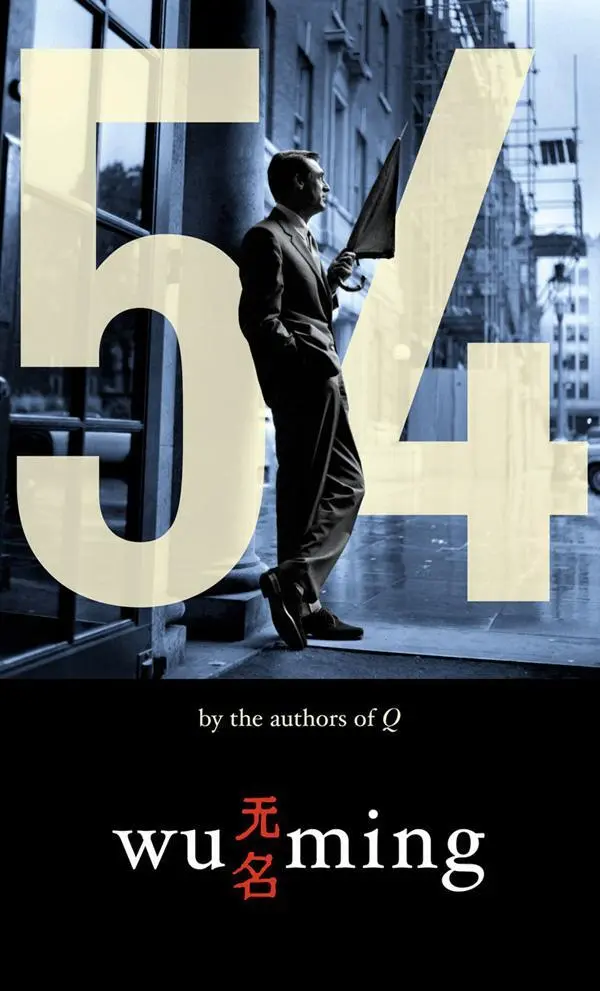
- Название:54
- Автор:
- Издательство:Houghton Mifflin Harcourt
- Жанр:
- Год:2006
- ISBN:нет данных
- Рейтинг книги:5 / 5. Голосов: 1
-
Избранное:Добавить в избранное
- Отзывы:
-
Ваша оценка:
54: краткое содержание, описание и аннотация
Предлагаем к чтению аннотацию, описание, краткое содержание или предисловие (зависит от того, что написал сам автор книги «54»). Если вы не нашли необходимую информацию о книге — напишите в комментариях, мы постараемся отыскать её.
Set during the height of the Cold War-with the world divided into East and West-54 features Italian partisans, KGB agents, Parisian lowlifes, and cameos by David Niven, Marshal Tito, and Grace Kelly. Wu Ming brings us a cinematic romp that is by turns edgy social satire and modern comic send up.
54 — читать онлайн бесплатно полную книгу (весь текст) целиком
Ниже представлен текст книги, разбитый по страницам. Система сохранения места последней прочитанной страницы, позволяет с удобством читать онлайн бесплатно книгу «54», без необходимости каждый раз заново искать на чём Вы остановились. Поставьте закладку, и сможете в любой момент перейти на страницу, на которой закончили чтение.
Интервал:
Закладка:
Pierre remembered the moment on the course when Fanti had talked about A Streetcar Named Desire . His astonishment at finding that someone else knew the film, and the day he had given him a ticket for Rashomon . Then the idea of English lessons, and the discovery that the professor had lost his wife just as he had lost his mother. The same illness: tuberculosis.
Down at the Section they didn’t approve of his friendship with the professor. An anti-fascist, certainly, who had been removed from the university because he loved American literature too much and the blackshirts too little. But they called him bourgeois, and a political cynic.
Certainly, Fanti wasn’t a comrade, and he wasn’t a member of the working class either. He sided neither with Moscow nor with the imperialists. Perhaps he was an anarchist, who could tell, it was almost certain that he didn’t vote. Where books were concerned, he wasn’t scared of the alleged ideas of the authors, and he remained a great admirer of John Fante even though the communist newspaper La Rinascita said he was halfway to being a Nazi.
Once he’d finished Dos Passos, he would have to ask the professor to lend him something by Fante.
Chapter 10
Bologna, Sunday, 24 January
She leaned forward between the front seats, and pointed the driver towards the tree-lined avenue on the right.
The trunks of the poplar trees disappeared into the pile of snow on the sides of the road, and the car wheels splashed muddy puddles on the side windows. Angela had put on her high-heeled shoes specially, hoping to use them as an excuse to persuade Ferruccio not to go for a walk.
The usher recognised Signora Montroni the moment he saw her come in, and immediately sent for the nurse who looked after her brother.
Angela wasn’t very fond of Villa Azzurra, but at least it wasn’t a mental hospital. After the war, in the first few months of ’48, Ferruccio had been given two weeks’ respite in a psychiatric hospital. The memory of that place still made her shiver. Screams, bodies trapped in absurd positions, lakes of piss on the floor, smells that would turn your stomach. Until one day she had gone into her brother’s room and found him strapped to his bed with belts. It had taken three orderlies to keep her from untying them. Another few moments and they would have confined her as well, because she wouldn’t stop weeping and crying. The next day she had persuaded her boyfriend, Odoacre, to assume legal responsibility. Ferruccio had come home.
‘So, how are things?’ Angela asked the nurse, as if reading from a script. She asked him the same question every time she came, and she knew the reply as well. ‘Everything’s fine, Signora Montroni, we’re making progress.’
‘. he’s having a bit of trouble sleeping, he wakes up, he wants to have his breakfast at three o’clock in the morning, he insists on having cigarettes, then during the day he settles down and hardly creates any problems.’
‘He settles down.’ ‘He doesn’t create problems.’ A way of saying that his new tranquilliser was working. They were very pleasant at the Villa Azzurra, and Ferruccio, Dr Montroni’s brother-in-law, was treated with the greatest respect. And Marco, the nurse, was a fine person, you could tell that he was fond of Ferruccio. But there was nothing to be done: in there, ‘being well’ meant ‘not creating problems’. If her brother changed and hit someone, that meant he was ill. If he spent all day in the garden, at three degrees below zero, staring at the clouds, then everything was fine, he was well.
‘If he’s not on the swing near the fountain, we’ll find him under the cypress tree, on his usual seat,’ said the nurse, opening the glass door giving on to the park.
A few old men were defying the cold. They were walking along the avenue of statues on the arms of their children or grandchildren. An elderly lady with half her face wrapped in bandages was engrossed in some unlikely gardening work, while two men sat chattering on a stone bench, beneath a yew tree sprinkled with snow. As she passed them, Angela noticed that they were talking to themselves.
‘Hi! Got a cigarette?’ said Ferruccio without turning round, when the crunch of dry leaves announced the arrival of his sister.
‘Hi, Fefe,’ Angela put her arms around his shoulders and kissed him on the cheek. ‘Come on, the taxi’s waiting for us outside.’
‘Are we going for a walk?’
‘I’m not wearing the right shoes, Fefe, we’d at least have to stop by at the house.’
An arm swung through the air to dismiss the suggestion. ‘No, no. Let’s stay here, then. Let’s stay here.’
‘But you’re here every day, I’m sorry, always shut up in the building,’ Angela objected, and then realised why her brother was so reluctant. ‘Odoacre isn’t at home, he had to meet a friend, he’s gone out.’
‘Have you got a cigarette?’ asked Ferruccio, rising to his feet, and miming the gesture of someone smoking. Angela handed him the pack.
‘Can I keep it, really?’
Angela gave a resigned nod. It always took a while before Ferruccio let himself go. At least an hour or so, then he became distracted, lost his thread, stopped asking for cigarettes, or asking the time, or why on earth you had come to get him. Once that was over it was like being with a normal person, apart from the fact that sometimes his replies were a little off kilter, and he tended to change the subject without warning.
The taxi driver had gone to sleep. Angela knocked on the window, and he gave a start as though he had been woken at the dead of night. He raised his hand in apology and hurried out to open the door.
‘I told my wife, I told her not to give me fried food when I’ve got to go to work, but she doesn’t understand. Sooner or later there’s going to be an accident and then, no, well, that is, that’s all we need, when I drive I’m wide awake, but God almighty, I’m losing customers.’
‘Have you got a cigarette?’ Ferruccio began the moment he sat down.
‘A cigarette? Yeah, of course, why not?’
‘Fefe, why do you need a cigarette?’ Angela intervened. ‘I just gave you a whole pack!’
But the driver had already passed a Chesterfield over his shoulder, and Ferruccio had pounced on it straight away. The good thing was that he didn’t smoke. Every Monday, in Villa Azzurra, he did the rounds of the rooms, offering cigarettes to the patients, to the nurses, to the doctors. They all smiled at him, they thanked him, and he felt happy.
‘Why did you come and get me today?’ he asked again.
‘Because it’s Sunday. Don’t I come and get you every Sunday?’
‘Yes, but last time your friend came too.’
‘Teresa? She can’t come every time.’
‘Can’t she? Shame, I really like your friend. You must tell her. She’s nice, you know. As far as I’m concerned you can stay at home if you’re busy, send Teresa to see me, we can go to the cinema, drink some hot chocolate, and I’ll be fine, really fine.’
He was almost shouting, very excited at the idea. Angela would just have been irritated by his speech if she hadn’t known that Ferruccio had a precise reason for saying these things. And it wasn’t that he preferred Teresa to her. In fact, he knew very well why it was that Angela sometimes left him with Teresa on Sundays. And because he didn’t much care for his brother-in-law, he was pleased that his
sister was enjoying herself a bit.
‘So you’ll tell your friend, yes?’
‘What?’
‘That I really like her. You’ve got to tell her.’
‘Fine, Fefe, I’ll tell her as soon as I see her.’
They sat there in silence for a few minutes. A dense group of people were chatting in front of the church of Santa Maria dei Servi, while others, beneath the portico, made their way to mass. Little boys were throwing snowballs under the skeletal lime-trees in Piazza Aldrovandi, while their parents laid siege to a patisserie. When they reached the towers, the taxi turned left into Via Castiglione.
Читать дальшеИнтервал:
Закладка:
Похожие книги на «54»
Представляем Вашему вниманию похожие книги на «54» списком для выбора. Мы отобрали схожую по названию и смыслу литературу в надежде предоставить читателям больше вариантов отыскать новые, интересные, ещё непрочитанные произведения.










Обсуждение, отзывы о книге «54» и просто собственные мнения читателей. Оставьте ваши комментарии, напишите, что Вы думаете о произведении, его смысле или главных героях. Укажите что конкретно понравилось, а что нет, и почему Вы так считаете.