Wu Ming - 54
Здесь есть возможность читать онлайн «Wu Ming - 54» весь текст электронной книги совершенно бесплатно (целиком полную версию без сокращений). В некоторых случаях можно слушать аудио, скачать через торрент в формате fb2 и присутствует краткое содержание. Год выпуска: 2006, Издательство: Houghton Mifflin Harcourt, Жанр: Историческая проза, на английском языке. Описание произведения, (предисловие) а так же отзывы посетителей доступны на портале библиотеки ЛибКат.
- Название:54
- Автор:
- Издательство:Houghton Mifflin Harcourt
- Жанр:
- Год:2006
- ISBN:нет данных
- Рейтинг книги:5 / 5. Голосов: 1
-
Избранное:Добавить в избранное
- Отзывы:
-
Ваша оценка:
54: краткое содержание, описание и аннотация
Предлагаем к чтению аннотацию, описание, краткое содержание или предисловие (зависит от того, что написал сам автор книги «54»). Если вы не нашли необходимую информацию о книге — напишите в комментариях, мы постараемся отыскать её.
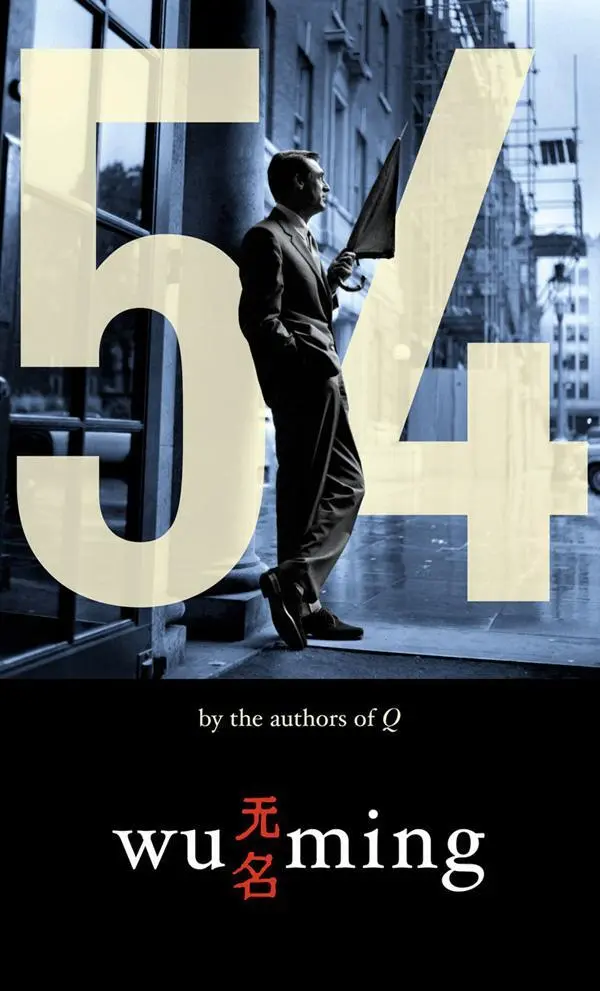
Set during the height of the Cold War-with the world divided into East and West-54 features Italian partisans, KGB agents, Parisian lowlifes, and cameos by David Niven, Marshal Tito, and Grace Kelly. Wu Ming brings us a cinematic romp that is by turns edgy social satire and modern comic send up.
54 — читать онлайн бесплатно полную книгу (весь текст) целиком
Ниже представлен текст книги, разбитый по страницам. Система сохранения места последней прочитанной страницы, позволяет с удобством читать онлайн бесплатно книгу «54», без необходимости каждый раз заново искать на чём Вы остановились. Поставьте закладку, и сможете в любой момент перейти на страницу, на которой закончили чтение.
Интервал:
Закладка:
‘Oh, I see.’
Was he winding him up, or what? Was it a way of saying he didn’t believe a word? Or when someone says one thing, and the other person has to come out with something even bigger? Like the bloke with three balls on the tram who goes over to someone and says, ‘You know that you and I have five balls between us?’ And the other man says, ‘Oh, you poor thing, have you only got the one?’
Kociss locked his fingers behind his head and lay back on the sacks.
Pierre did more or less the same thing, rocked about by the potholes and the engine. A moment before falling asleep, he managed to catch the beginning of a long monologue.
‘Here, mate, I really did meet Cary Grant! And I wasn’t giving you a load of bollocks about that film, either, I exaggerated the bit about being an actor, because at the end of the day I’m still at the beginning of my career, it was pure chance, I did make an appearance, but everyone told me I was really good, and they even paid me, and I’m sure that some Italian director. Oi, Peer, are you listening to me?’
In the war you didn’t count them.
In fact some people did count them, and cut notches in the barrel of their gun.
In clashes in the middle of the woods it was hard to tell who was killing who.
And it had been hard at Porta Lame, as well. There was fog. There were smoke bombs. Ettore was sure he had killed at least fifteen, firing his Thompson gun and throwing two hand grenades.
There had been loads of them, in Bologna. More than a hundred partisans, between their base in the ruins of the main hospital and the one in the building in Via del Macello. At dawn on 7 November the Germans had encircled the block and captured some guards. The battle had begun at seven. The Germans, flanked by the Black Brigade, had had rifles, machine-guns, light guns and two cannon. They were shooting from the roofs of the nearby buildings as well. On the other side, nothing but automatic weapons, rifles and hand grenades. After five or six hours of fighting, with the block practically razed to the ground, the partisans had managed to move and take up position in another building.
The Krauts had brought in an armoured car, they had brought it into the courtyard and were shouting ‘ Giff up! Giff up! ’ A Houdinistyle escape route had been found (that’s Houdini the conjuror, not Houdini the greengrocer in the Cirenaica district): a wall was knocked down, and they had escaped along the canal, leaving smoke bombs to cover their retreat and splitting up into little groups. They had actually managed to evacuate the wounded. Late in the afternoon reinforcements had arrived. The partisan detachment from Medicina. Germans and fascists, taken by surprise, had made off, leaving behind 260 dead, a few injured and vehicles loaded with ammunition.
The partisans had got away with twelve fatalities.
He had never done a job like that before. But the game was worth the candle. There was the money. And there was the shiver along the spine. For too many years he hadn’t risked his skin. His life had gone flat. No great joy, no great grief, no great rage. Many women, but no major relationship. One-night stands. Hours and hours spent with Palmo, who was a moron.
If I’d died at Porta Lame, or up in the mountains, my face would be up on the memorial in the Piazza del Nettuno. With my friends, for ever. With the fallen of the Valanga group, with Dubat, who killed himself in a cave rather than allow himself to be captured by the Germans, with Carioca, Ettore Bruni, Edoardo, Ribino, Aldo, Ferro, Silenzio, Renato. With Stelio, who had been tortured for thirtysix hours in Via Siepelunga, like Irma Bandiera, like Sante Vincenzi the night before the Liberation. Stelio disfigured, tortured, hanged in Via Venezian. ‘Justice is done’ was the headline in Il Carlino .
But if I die tonight, what will people remember of me? That I was a smuggler, a criminal. They’ve thrown me out of everything, I have no right to be remembered as a partisan.
Who knows what Il Carlino will write about me if I die tonight.
I should have died at Porta Lame. And instead here I am, protecting someone transporting drugs. A scary guy. I wonder if he’s a friend of that famous ‘Steve Cement’, the one whose name is used to frighten children?
I would guess that in those little circles, no one is a friend of anyone.
Chapter 49
Sospel, 3 July
Time 2.40 a.m. Sospel. A hamlet. Pungent air. Around it, woods and mountains.
Ahead, the plain. The headlights reveal a sign: ‘ Relais l’Étape , 500 m’. The white road climbs among the chestnut trees.
Zollo gestures to Ettore. We’re there .
The lorry draws up to the crossroads. Ettore picks up his arsenal and jumps out. Thompson gun, hand grenades and a flare pistol. As in Porta Lame.
He runs through their roles again. ‘The young guys keep an eye on the lorry. I go and take up my post. You show up at three on the dot.’
Zollo nodded. Rien ne va plus . He raps his knuckles on the back of the lorry. ‘Ok, come out for a moment.’
They appear after a few minutes. They have the creased faces of people who have just woken up. They need to be reactivated. Two simpamine tablets for his migraine and two to fight their sleep. Ettore prefers to use dialectics.
‘Lads, listen to me. If we get it right, in less than an hour we’ll be walking happily away from here. To get things right you have to be alert. Each of you will have a gun, and eight shots. Only use them if you have to. Your task is to protect the lorry. If the lorry is damaged, we won’t get away. Is that clear?’
Zollo looked at the ex-fighter. We know what to do .
Pierre turned the gun around between his hands as though it was a Martian’s dick. Ettore gave him some hints about how to use it, then slipped into the wood.
The hamlet seemed to be enclosed in a silent glass bowl. A gigantic hand might suddenly have turned it upside down and unleashed a storm of fake snow. Pierre leaned his back against the lorry. Fake papers, an undercover expatriate, a storehouse of illegal goods, smuggling. Whether he ended up using it or not, that gun was the cherry on the cake.
The American gestured to him to get up, all three of them into the cabin. Pierre gripped the wheel and put the lorry in gear.
Kociss seemed to be hypnotised. Eyes wide open, staring. From the movements of his lips you would have said that he was praying.
Mr Rock-Hard said nothing. Every now and again he rolled his neck around and rearranged the gun in his trouser pocket.
It’s all going to go smoothly, Steve, come on.
Precautions aren’t the same as paranoia. The era of cock-ups is past. The age of the diamond is beginning.
Toni has given us a guarantee. Moby Dick is a decent son-of-abitch.
The breakdown of the car forewarned of the final cock-up. Turning up alone for the meeting, with twelve kilos of heroin and the king of Agnano keeping him covered. Script courtesy of Steve ‘Dickhead’ Zollo.
The Relais l’Étape hadn’t served soupe de pistou for at least ten years. The sign that extolled its high quality and moderate prices was peeling. The lorry turned around the building. Zollo peered through the glass: not a table, not a chair. Empty.
The car park was badly lit. Old banners hung from a string. A flash of headlights greeted the arrival of the lorry.
‘Stop here.’
Pierre parked on the right, by a low wall.
Zollo picked up the bag and jumped down. The gun barrel froze him, from groin to shoulders. Contrary to his usual form, he wore his shirt out of his trousers like a Hawaiian twat. Just to cover the weapon.
He took two steps forward into the dust, slipped his hand under his shirt and rested the bag between his legs.
Читать дальшеИнтервал:
Закладка:
Похожие книги на «54»
Представляем Вашему вниманию похожие книги на «54» списком для выбора. Мы отобрали схожую по названию и смыслу литературу в надежде предоставить читателям больше вариантов отыскать новые, интересные, ещё непрочитанные произведения.








Обсуждение, отзывы о книге «54» и просто собственные мнения читателей. Оставьте ваши комментарии, напишите, что Вы думаете о произведении, его смысле или главных героях. Укажите что конкретно понравилось, а что нет, и почему Вы так считаете.