Wu Ming - 54
Здесь есть возможность читать онлайн «Wu Ming - 54» весь текст электронной книги совершенно бесплатно (целиком полную версию без сокращений). В некоторых случаях можно слушать аудио, скачать через торрент в формате fb2 и присутствует краткое содержание. Год выпуска: 2006, Издательство: Houghton Mifflin Harcourt, Жанр: Историческая проза, на английском языке. Описание произведения, (предисловие) а так же отзывы посетителей доступны на портале библиотеки ЛибКат.
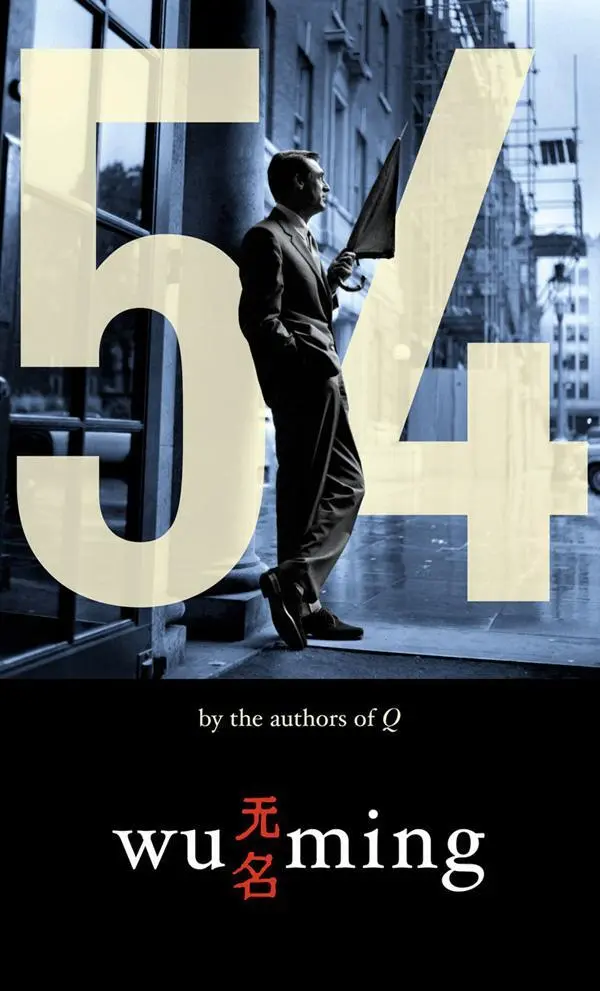
- Название:54
- Автор:
- Издательство:Houghton Mifflin Harcourt
- Жанр:
- Год:2006
- ISBN:нет данных
- Рейтинг книги:5 / 5. Голосов: 1
-
Избранное:Добавить в избранное
- Отзывы:
-
Ваша оценка:
54: краткое содержание, описание и аннотация
Предлагаем к чтению аннотацию, описание, краткое содержание или предисловие (зависит от того, что написал сам автор книги «54»). Если вы не нашли необходимую информацию о книге — напишите в комментариях, мы постараемся отыскать её.
Set during the height of the Cold War-with the world divided into East and West-54 features Italian partisans, KGB agents, Parisian lowlifes, and cameos by David Niven, Marshal Tito, and Grace Kelly. Wu Ming brings us a cinematic romp that is by turns edgy social satire and modern comic send up.
54 — читать онлайн бесплатно полную книгу (весь текст) целиком
Ниже представлен текст книги, разбитый по страницам. Система сохранения места последней прочитанной страницы, позволяет с удобством читать онлайн бесплатно книгу «54», без необходимости каждый раз заново искать на чём Вы остановились. Поставьте закладку, и сможете в любой момент перейти на страницу, на которой закончили чтение.
Интервал:
Закладка:
What the hell were those little white bricks inside the television?
A moment later, he half understood.
That was why the bloody thing didn’t work. That was the swindle. They’d taken out the mechanism and filled it up so that no one could tell the difference. Ingenious.
His third thought took him three-quarters of the way to complete comprehension.
Strange little bricks. Couldn’t they have used rocks?
He stretched out a hand. He weighed one of the packages in his hand. Unrolled the cellophane.
White powder.
Well fuck me with a ragman’s trumpet!
He had got there.
He went to run his hands through his hair, but just ended up stroking his bald pate. He had never even seen this stuff. What sort of stuff was it, in fact? Cocaine, heroin, morphine? Who the hell had put it inside the television? The package seemed to glow.
He tried to calm down. Fine, old man, here you are with — how much? Ten kilos? Twenty kilos? Of what? Heroin? Cocaine? It looks as though, potentially, you’re rather a wealthy man.
Potentially: you don’t know anyone who could tell you what it is. No one who could buy it. No one.
He tried to calm down. In the meantime you’re going to have to hide it. Then phone Fattori and tell him you won’t be selling the television. Then find a new screen and put in some real bricks and sell it again. But in the meantime you’re going to have to sell that stuff.
Potentially, you’re very rich.
Chapter 42
Naples, 30 June, 1 p.m., during the partial eclipse of the sun
Three men who were lost in the forest were captured by cannibals. The cannibal king told the prisoners that they could live if they passed a trial. The first step of the trial was to go to the forest and get ten pieces of the same kind of fruit. So all three men went separate ways to gather fruits.
The first one came back and said to the king, ‘I brought ten apples.’ The king then explained the trial to him. ‘You have to shove the fruits up your arse without any expression on your face or you’ll be eaten.’
The first apple went in. but on the second one he winced in pain, so he was killed.
The second one arrived and showed the king ten berries. When the king explained the trial to him he thought to himself that this should be easy. 1. 2. 3. 4. 5. 6. 7. 8. and on the ninth berry he burst out laughing and was killed.
The first guy and the second guy met in heaven. The first one asked, ‘Why did you laugh, you almost got away with it?’ The second one replied, ‘I couldn’t help it, I saw the third guy coming with pineapples.’
The boy had told the story on their long journey back from France. He had never stopped talking. Shithead. Nonsense, all of it, that was all he needed. Salvatore.
What was he to do? Shake him off, get rid of him?
No.
Are you getting old, Steve?
The boy knew almost everything. Too much, without a doubt.
He had a knack of getting himself into trouble, but energy, vitality, burst from every inch of his skin.
His instinct told him: the boy isn’t the problem. You’ve got other problems.
‘Because everyone’s after it, everyone wants it, this new miracle of progress, isn’t that right, Steve?’
Shit. Did the old man know everything? Was he delivering those long speeches just to give his fucking mouth some exercise?
Pay attention, Steve. The ball is spinning.
Rien ne va plus.
The number played, always the same one. Fifteen. The kilos stolen from Luciano. The pension. Three of them already at their destination, then another twelve inside the McGuffin. In Bologna. Fuck.
‘Stiiiiiv! You have no idea, you can’t even imagine what Lisetta and I have done. With the help of your car, obviously. Try and guess, Stiv, go on, try. No? Fine, then I’ll tell you: we’ve found it. It’s in Bologna.’
Yes, ok, Bologna. He could be right. But who had it? And after all this time was the powder still inside?
Almost impossible.
The meeting on the other side of the border was imminent. Skullface Toni was itching to collect his last cut. Monsieur Alain had the stinking breath of his Parisian friends on him: pimps, toffs and doped-up musicians.
‘I’ve spoken to Albert Anastasia: you’re going back with them at the end of the year. To New York. The thought that you might not always be with me already fills me with gloom.’
Luciano. The biggest son-of-a-bitch on the planet. Dull-eyed, gazing into the distance. Behind corners, behind walls. At racetracks, in televisions. That was why he was still alive. And still the boss.
What possibilities did he have? Pointless question, now. He’d have to get moving. Rien ne va plus . Try. The life-and-death triple jump of Cement Zollo.
Bologna.
The lorry driver.
Over the border. Alain the fat guy. With or without the powder: different plans, same result.
Paris. Airport.
Where to? Was there some asshole in the universe that Luciano’s dick couldn’t penetrate?
‘While we were shooting the film, Stiv, there were these two guys, they were Italian as well, talking about a rich man from far away, someone like the emperor of China, and he’d bought this huge diamond, a thing this big that cost God knows how many millions. They said it was called Durban . The diamond. And that it came from Cape Town, which is in South Africa. And that in South Africa, in that place, it’s full, can you imagine, Stiv, full of diamonds like that. So much so that I found myself thinking: why don’t we go there, Stiv, why don’t we go and take a look? We could buy the diamonds and then come here and sell them, eh, Stiv? To all those rich guys drowning in money who like that kind of thing. Sure, first we’d have to go and talk to the city boss. Otherwise he’d get pissed off, wouldn’t he, Stiv?’
Durban.
Cape Town.
South Africa.
Why not?
Far away. Hot. Sea. Business.
Improvise, it might be the solution.
Cape Town. Why not?
The boy had balls. He had demonstrated as much. He pointed the way.
He would come after him. He couldn’t stay in Naples. Then he would decide.
The ball is in motion, Steve.
A shadow has fallen across the sun.
You can’t be Cement all your life.
Chapter 43
Bologna, 30 June, shortly after the eclipse
The Certosa cemetery was half deserted. It wasn’t visiting day for the dead. In the summer, people want to think about life, so almost everyone was out on the street or in the hills looking at the eclipse.
Cemeteries didn’t make him feel sad. Whenever he went there he always found himself reading the names on tombstones, with dates, photographs, Latin phrases, wondering what kind of life was hidden behind each of the tombs. He imagined lives consumed in a flash or worn away over a long period of time, to the very last drop. He thought of the friends and relatives that those people had left behind.
He was early, and he whiled away his time doing the same thing. He wandered about in the middle, flowers in his hand. When he felt his heart pounding he knew she was there. He looked up and saw her.
He didn’t walk towards her, but took the path and walked to the grave, stopping and waiting for her there.
Angela had brought flowers as well. White ones.
Pierre reflected that she had more class than many daughters of the bourgeoisie. Perhaps it was something innate. Either that or it was simply taste, attention to detail, a graceful way of being in the world.
Fefe’s photograph showed him smiling.
He had to tell her. He had so many things to tell her and he didn’t know where to start.
She looked at him. Her features were more relaxed, and she had a strange gleam in her eyes.
Читать дальшеИнтервал:
Закладка:
Похожие книги на «54»
Представляем Вашему вниманию похожие книги на «54» списком для выбора. Мы отобрали схожую по названию и смыслу литературу в надежде предоставить читателям больше вариантов отыскать новые, интересные, ещё непрочитанные произведения.








Обсуждение, отзывы о книге «54» и просто собственные мнения читателей. Оставьте ваши комментарии, напишите, что Вы думаете о произведении, его смысле или главных героях. Укажите что конкретно понравилось, а что нет, и почему Вы так считаете.