Calvin Baker - Dominion
Здесь есть возможность читать онлайн «Calvin Baker - Dominion» весь текст электронной книги совершенно бесплатно (целиком полную версию без сокращений). В некоторых случаях можно слушать аудио, скачать через торрент в формате fb2 и присутствует краткое содержание. Год выпуска: 2007, Издательство: Grove Press, Жанр: Историческая проза, на английском языке. Описание произведения, (предисловие) а так же отзывы посетителей доступны на портале библиотеки ЛибКат.
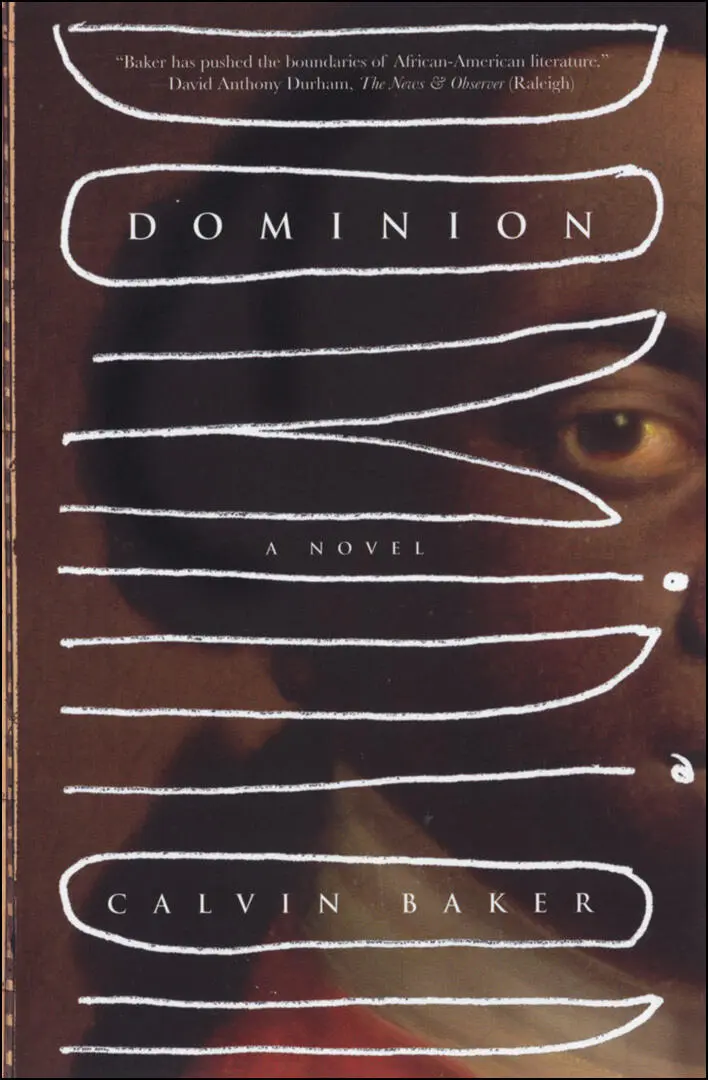
- Название:Dominion
- Автор:
- Издательство:Grove Press
- Жанр:
- Год:2007
- ISBN:нет данных
- Рейтинг книги:5 / 5. Голосов: 1
-
Избранное:Добавить в избранное
- Отзывы:
-
Ваша оценка:
Dominion: краткое содержание, описание и аннотация
Предлагаем к чтению аннотацию, описание, краткое содержание или предисловие (зависит от того, что написал сам автор книги «Dominion»). Если вы не нашли необходимую информацию о книге — напишите в комментариях, мы постараемся отыскать её.
, he was named a “Notable First Novelist” by Time magazine. Since his second novel,
, Baker has continued to be acclaimed by the major media from the
to
. Now, with Dominion, Baker has written a lush, incantatory novel about three generations of an African American family in the years leading up to the Revolutionary War. Dominion tells the story of the Merian family who, at the close of the seventeenth century, settle in the wilderness of the Carolinas. Jasper is the patriarch, freed from bondage, who manages against all odds to build a thriving estate with his new wife and two sons — one enslaved, the other free. For one hundred years, the Merian family struggles against the natural (and occasionally supernatural) world, colonial politics, the injustices of slavery, the Revolutionary War and questions of fidelity and the heart. Footed in both myth and modernity, Calvin Baker crafts a rich, intricate and moving novel, with meditations on God, responsibility, and familial legacies. While masterfully incorporating elements of the world’s oldest and greatest stories, the end result is a bold contemplation of the origins of America.
Dominion — читать онлайн бесплатно полную книгу (весь текст) целиком
Ниже представлен текст книги, разбитый по страницам. Система сохранения места последней прочитанной страницы, позволяет с удобством читать онлайн бесплатно книгу «Dominion», без необходимости каждый раз заново искать на чём Вы остановились. Поставьте закладку, и сможете в любой момент перейти на страницу, на которой закончили чтение.
Интервал:
Закладка:
“Your father would be very pleased for you,” Magnus told him, putting onto his brother what he himself felt, as they rode back to the stable. Caleum was silent in response, and Magnus allowed him to remain so but only added, “You must never think ill of him. You cannot judge them.”
“No, sir,” Caleum replied.
In truth he sometimes thought his father the meanest man in the world, and at other times greater than everything else he knew, and both feelings made larger from their seed by his absence. No matter his thoughts, however, he never spoke ill of either his parents, neither when alone nor with others, as he would not dream of giving voice to such personal inner grievance.
They returned to the house at suppertime, to find Merian, who sometimes but very seldom still joined them for meals, at the table.
He spoke, when he did at all, in a garbled way, which those around him had learned to decipher, though not always accurately — so that one sentence might be taken to mean a certain thing by Adelia, another thing by Magnus, and yet something else entirely by Caleum. Despite this, they tried to keep him informed of all the goings-on in the family, not certain how much he took in or failed to but honoring his position there.
“Caleum and I have just chosen the spot for his house,” Magnus said, as they sat down to table that evening.
Adelia, who was just about to bring a spoonful of warm mashed potatoes to Merian’s mouth, paused to see whether or not he would answer.
It was clear that he understood the words and their meaning but was slow to formulate his response. When he did, he spoke extremely slowly. “Is he separating now?”
“Soon,” Caleum hazarded to answer.
One side of Merian’s mouth curled in an enigmatic smile when he heard this reply. He turned then to Magnus and asked, “What ground?”
“The southern side of the lake,” Magnus said. “I thought it was the best after Stonehouses itself.”
“It was hard husbanding.”
No one knew what to make of this, and they all looked to one another for guidance until Adelia replied, “He will be a good husband.”
Merian looked to his bowl for more food, which Adelia brought dutifully to his mouth. After he had swallowed, he looked at his grandson and asked, “The wife?”
“She will be good as well,” Caleum said, looking directly at his ancient grandfather. “I am sure of it.”
“Caleum has made a good match,” Magnus vouched for him.
Merian tried to nod his head, as to say he agreed with marrying while young, but it had become a very difficult maneuver. Frustrated by his body’s refusal to do as he would have it, he swiped at the bowl in front of him and sent it to the floor. As Adelia cleaned it up, he sat there sphinxlike, feeling prisoner to the decay that had claimed him, mind and body. No one knew then what it was he wished to communicate, as even his simplest gestures were not what they always seemed.
Caleum and Magnus both knew, however, better than to pity Merian, as his fate might be either of theirs. Rather, they continued to treat him as if he had never known dementia and was still as he had been in the major part of his life.
The morning of Caleum’s wedding to Libbie Darson, a pale blue sky arched unblemished overhead like the ceiling of a godly cathedral. The air was also warm enough to go about with naught but a vest, and the day seemed soft and tremulous with possibility. Merian called his grandson to him in the parlor that morning, where he sat dressed very handsomely in an old-fashioned suit. When Caleum entered, Merian pointed over the mantel to the sword Purchase had crafted long ago and indicated for him to take it down. Caleum walked to the place where it stood and lifted it from its hooks, which made Merian smile from the side of his mouth that still cooperated with him. Caleum went then to embrace his grandfather, and when he did Merian pressed his carved wooden doll into his hand. “For young husbands,” he said.
Besides his lands it was the most cherished of his possessions. The thing third most valuable to him was a golden pocket watch, which hung in his vest and was bequeathed in his will to Purchase, if he ever returned to their lands.
Caleum had long been curious about the wooden doll, which frightened Adelia and made Magnus none too happy. He was honored to have it, though, and placed it in his pocket before either his aunt or uncle could come into the room. “For luck at Caleum’s house,” Merian said again emphatically.
When Magnus came into the room old and young parted conspiratorially, Magnus looked suspiciously from one to the other but decided against asking what they were about. He only dusted away invisible lint from Caleum’s vest, telling him it was time for them to set out and he should help him take Merian to the waiting carriage — whence they made their way to the Darson place for the ceremony.
When they entered the Darson house that morning everyone grew hushed to see Jasper Merian present, for he was the oldest man in the county after Content’s death and had been one of the first to settle there. He was also said to be one of the richest, so an undeniable mystique attached to him.
They were careful about noticing his frail condition, however, and only the smallest children and boldest of the men came directly to greet him. He seemed very aloof to many of them and would barely speak to any save Mrs. Darson and Libbie, though he could not remember her name.
Jasper sat still as a mountain while everyone else moved around him and came to offer good wishes for the union. Mr. Darson was especially desirous of his attention, seeking to shake his arthritic hand several times, and deeply hurt when Merian failed to receive it.
“Did you feed my horses?” Merian asked, the final time Solomon Darson held his hand out to him, as if he were the stable boy instead of the bride’s father.
Darson knew better than begrudge such an ancient soul, but he could not help feeling abused and thought again of the high price Magnus had set for the marriage contract, which is perhaps why he did not stop his sons later that morning.
Promptly at eleven of the clock Libbie came into the hall, glorious and radiant in her wedding dress, and Caleum took his place beside her. When the minister, who suffered from religious melancholy and was extremely dour, asked ceremonially whether any protested the union, Eli Darson and his brother, George, both stood to speak.
Mr. Darson was embarrassed that they might already be drunk and anxious of what mischief they were up to, especially in the instant he looked at his daughter and saw the mortification on her face. Still, he did nothing to intervene.
“On what grounds do you object?” the minister asked them impatiently, as the time for such matters was during the engagement period.
When the preacher asked this, everyone, including George and Eli themselves, could see the childishness of what they had done, for they had no serious grounds but only a general dislike of the groom. Both of them jogged nervously from foot to foot, trying to think of something to redeem themselves, as the guests waited with horror upon their faces.
“If there is no objection,” the minister then went on, seeing it was only boys being churlish.
“On grounds,” Eli Darson spat out at last, “that neither his religion nor his origin is generally known.”
The preacher was very annoyed at their shenanigans, but when Eli said the groom’s religion was not known he paused amid the babble that had overtaken the room to ask Caleum whether he was Christian and had renounced Satan and all his works.
Caleum answered in the affirmative, as Magnus shot daggers from his eyes at Mr. Darson and Libbie began crying. Everyone present was made exceptionally uncomfortable and thought the Darson boys either nefarious or simple. Having started, though, they refused to give up. “Ask him about his father,” George said, grown bold with foolishness. “He is not decent people.”
Читать дальшеИнтервал:
Закладка:
Похожие книги на «Dominion»
Представляем Вашему вниманию похожие книги на «Dominion» списком для выбора. Мы отобрали схожую по названию и смыслу литературу в надежде предоставить читателям больше вариантов отыскать новые, интересные, ещё непрочитанные произведения.




Обсуждение, отзывы о книге «Dominion» и просто собственные мнения читателей. Оставьте ваши комментарии, напишите, что Вы думаете о произведении, его смысле или главных героях. Укажите что конкретно понравилось, а что нет, и почему Вы так считаете.