Jerzy Kosiński - The Painted Bird
Здесь есть возможность читать онлайн «Jerzy Kosiński - The Painted Bird» весь текст электронной книги совершенно бесплатно (целиком полную версию без сокращений). В некоторых случаях можно слушать аудио, скачать через торрент в формате fb2 и присутствует краткое содержание. Год выпуска: 1965, ISBN: 1965, Жанр: Детская проза, на английском языке. Описание произведения, (предисловие) а так же отзывы посетителей доступны на портале библиотеки ЛибКат.
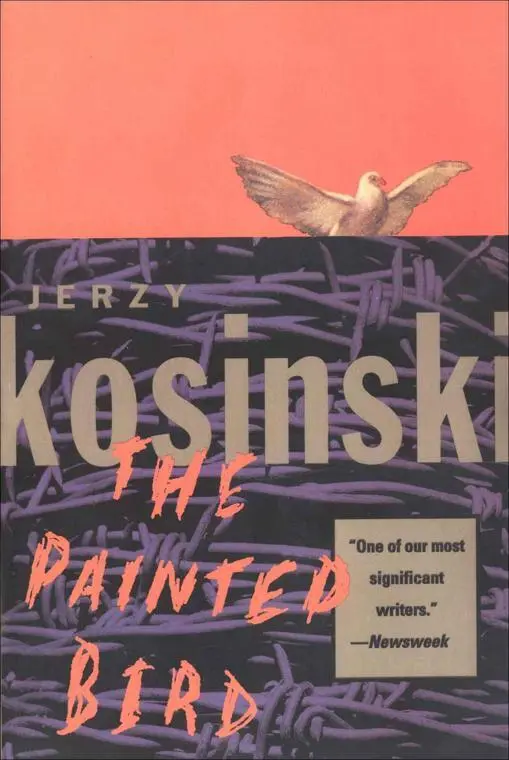
- Название:The Painted Bird
- Автор:
- Жанр:
- Год:1965
- ISBN:978-0-8021-9575-3
- Рейтинг книги:4 / 5. Голосов: 1
-
Избранное:Добавить в избранное
- Отзывы:
-
Ваша оценка:
The Painted Bird: краткое содержание, описание и аннотация
Предлагаем к чтению аннотацию, описание, краткое содержание или предисловие (зависит от того, что написал сам автор книги «The Painted Bird»). Если вы не нашли необходимую информацию о книге — напишите в комментариях, мы постараемся отыскать её.
The Painted Bird — читать онлайн бесплатно полную книгу (весь текст) целиком
Ниже представлен текст книги, разбитый по страницам. Система сохранения места последней прочитанной страницы, позволяет с удобством читать онлайн бесплатно книгу «The Painted Bird», без необходимости каждый раз заново искать на чём Вы остановились. Поставьте закладку, и сможете в любой момент перейти на страницу, на которой закончили чтение.
Интервал:
Закладка:
For several hours we rode on a well-traveled road bearing the recent tracks of trucks. Later we left the road and drove through the forest, startling birds and hares. The wounded man sagged listlessly. I was not sure if he was alive; I could only feel his inert body lashed by rope to the cart and me.
We halted twice. The two peasants offered some of their meal to the German, who in return doled out a cigarette and a yellow candy to each of them. The peasants thanked him servilely. They took long draughts from the bottles hidden under the box seat and then urinated in the bushes.
We were ignored. I was hungry and weak. A warm resin-scented breeze drifted from the forest. The wounded man moaned. The horses restlessly tossed their heads, their long tails lashing out against the flies.
We moved on. The German on the cart was breathing heavily, as though in sleep. He closed his gaping mouth only when a fly threatened to swoop into it.
Before sunset we rode into a small, densely built-up town. Here and there the houses had brick walls and chimneys. The fences were painted white or blue. Sleeping doves huddled together on the gutterpipes.
As we passed the first few buildings, children playing in the road noticed us. They surrounded our slow cart and stared at us. The soldier rubbed his eyes, stretched his arms, hitched up his trousers, jumped down, and walked alongside the cart, oblivious to his surroundings.
The troop of children increased; children jumped out of every house. Suddenly one of the older and taller boys struck the prisoner with a long birch twig. The wounded man shuddered and drew back. The children became excited and began pelting us with a barrage of rubbish and rocks. The wounded man drooped. I felt his shoulders, glued to mine, wet with sweat. A few stones hit me also; but I was a more elusive target, sitting between the wounded man and the drivers. The children were making great sport of us. We were being pelted with dried lumps of cow dung, rotten tomatoes, reeking little cadavers of birds. One of the young brutes began to concentrate on me. He walked alongside the cart and with a stick methodically hit selected parts of my body. I tried vainly to ball-up enough saliva to spit into his derisive face.
Adults joined the crowd around the cart. They shrieked, “Beat the Jews, beat the bastards,” and egged the children on to further attacks. The drivers, unwilling to expose themselves to accidental blows, jumped off the box seat and walked along beside the horses. The wounded man and I now provided excellent targets. A new hail of stones struck us. My cheek was cut, a broken tooth was dangling, and my lower lip was split. I spat blood into the faces of those nearest to me, but they leapt back adroitly to aim other blows.
Some fiend tore whole bundles of ivy and ferns growing along the roadway out by the root and lashed the wounded man and me. The pain burned at my body, the stones were striking me with more precision, and I dropped my chin on my breast, dreading that some stone might strike my eyes.
Suddenly a small, stout priest leapt out of an unprepossessing house as we were passing by. He wore a torn, faded cassock. Flushed with excitement, he burst into the crowd brandishing a cane, and he began to strike at them on the hands, faces, and heads. Panting, perspiring, trembling with exhaustion, he scattered the mob in all directions.
The priest now walked alongside the cart, slowly regaining his breath. With one hand he wiped his brow and with the other clasped mine. The wounded man had evidently fainted, for his shoulders grew cold as he swayed rhythmically like a puppet tied to a stick.
The cart entered the courtyard of the military police building. The priest had to remain outside. Two soldiers untied the rope, took the wounded man off the cart, and laid him down at the wall. I stood nearby.
Soon afterward a tall SS officer in a soot-black uniform sauntered into the courtyard. Never before had I seen such a striking uniform. At the proud peak of the cap glittered a death’s-head and crossbones, while lightninglike signs embellished the collar. A red badge bearing the bold sign of the swastika cut across his sleeve.
The officer received a report from one of the soldiers. Then his heels drummed against the flat concrete surface of the courtyard as he strode to the wounded man. With a deft movement of the tip of his shining jackboot he flipped the man’s face toward the light.
The man looked hideous—a mangled face with a rammed-in nose and a mouth hidden by torn skin. Shreds of ivy, lumps of earth, and cow dung were sticking to his eye socket. The officer squatted close to this amorphous head which was reflected in the smooth surface of his boot tops. He was questioning or saying something to the wounded man.
The bloody mass moved like a thousand-pound load. The thin, mutilated body pushed itself by its tied hands. The officer edged away. His face was in the sunshine now, and it had a sheer and compelling beauty, the skin almost waxlike, with flaxen hair as smooth as a baby’s. Once before, in a church, I had seen such a delicate face. It was painted on a wall, bathed in organ music, and touched only by light from the stained-glass windows.
The wounded man continued rising until he was nearly sitting. Silence lay over the courtyard like a heavy cloak. The other soldiers stood stiffly, gazing at the spectacle. The wounded man breathed hard. Straining to open his mouth, he swayed like a scarecrow in a gust of wind. Sensing the nearness of the officer he listed in his direction.
The officer, disgusted, was about to rise from his squatting position when suddenly the wounded man moved his mouth again, grunted, and then, extremely loudly, uttered a short word that sounded like “pig” and fell back, striking his head on the concrete.
On hearing this the soldiers quivered and looked at each other stupefied. The squatting officer rose and barked a command. The soldiers clicked their heels, cocked their rifles, approached the man, and pumped rapid shots into him. The shattered body shuddered and grew still. The soldiers reloaded and stood at attention.
Nonchalantly the officer approached me, beating a swagger stick against the seam of his freshly pressed breeches. The instant I saw him I could not tear my gaze from him. His entire person seemed to have something utterly superhuman about it. Against the background of bland colors he projected an unfadable blackness. In a world of men with harrowed faces, with smashed eyes, bloody, bruised and disfigured limbs, among the fetid, broken human bodies, he seemed an example of neat perfection that could not be sullied: the smooth, polished skin of his face, the bright golden hair showing under his peaked cap, his pure metal eyes. Every movement of his body seemed propelled by some tremendous internal force. The granite sound of his language was ideally suited to order the death of inferior, forlorn creatures. I was stung by a twinge of envy I had never experienced before, and I admired the glittering death’s-head and crossbones that embellished his tall cap. I thought how good it would be to have such a gleaming and hairless skull instead of my Gypsy face which was feared and disliked by decent people.
The officer surveyed me sharply. I felt like a squashed caterpillar oozing in the dust, a creature that could not harm anyone yet aroused loathing and disgust. In the presence of his resplendent being, armed in all the symbols of might and majesty, I was genuinely ashamed of my appearance. I had nothing against his killing me. I gazed at the ornate clasp of his officer’s belt that was exactly at the level of my eyes, and awaited his decision.
The courtyard was silent again. The soldiers stood about obediently waiting for what would happen next. I knew my fate was being decided in some manner, but it was a matter of indifference to me. I placed infinite confidence in the decision of the man facing me. I knew that he possessed powers unattainable by ordinary people.
Читать дальшеИнтервал:
Закладка:
Похожие книги на «The Painted Bird»
Представляем Вашему вниманию похожие книги на «The Painted Bird» списком для выбора. Мы отобрали схожую по названию и смыслу литературу в надежде предоставить читателям больше вариантов отыскать новые, интересные, ещё непрочитанные произведения.




Обсуждение, отзывы о книге «The Painted Bird» и просто собственные мнения читателей. Оставьте ваши комментарии, напишите, что Вы думаете о произведении, его смысле или главных героях. Укажите что конкретно понравилось, а что нет, и почему Вы так считаете.