Jerzy Kosiński - The Painted Bird
Здесь есть возможность читать онлайн «Jerzy Kosiński - The Painted Bird» весь текст электронной книги совершенно бесплатно (целиком полную версию без сокращений). В некоторых случаях можно слушать аудио, скачать через торрент в формате fb2 и присутствует краткое содержание. Год выпуска: 1965, ISBN: 1965, Жанр: Детская проза, на английском языке. Описание произведения, (предисловие) а так же отзывы посетителей доступны на портале библиотеки ЛибКат.
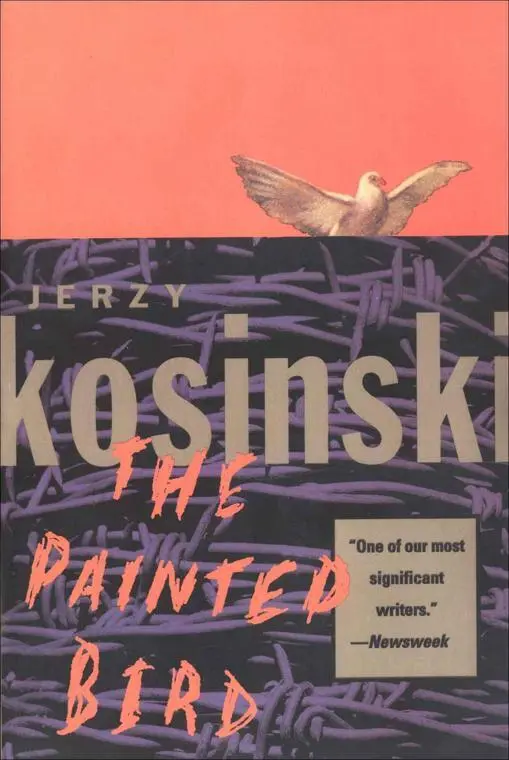
- Название:The Painted Bird
- Автор:
- Жанр:
- Год:1965
- ISBN:978-0-8021-9575-3
- Рейтинг книги:4 / 5. Голосов: 1
-
Избранное:Добавить в избранное
- Отзывы:
-
Ваша оценка:
The Painted Bird: краткое содержание, описание и аннотация
Предлагаем к чтению аннотацию, описание, краткое содержание или предисловие (зависит от того, что написал сам автор книги «The Painted Bird»). Если вы не нашли необходимую информацию о книге — напишите в комментариях, мы постараемся отыскать её.
The Painted Bird — читать онлайн бесплатно полную книгу (весь текст) целиком
Ниже представлен текст книги, разбитый по страницам. Система сохранения места последней прочитанной страницы, позволяет с удобством читать онлайн бесплатно книгу «The Painted Bird», без необходимости каждый раз заново искать на чём Вы остановились. Поставьте закладку, и сможете в любой момент перейти на страницу, на которой закончили чтение.
Интервал:
Закладка:
I had often seen the same thing happen to dogs. Sometimes when they coupled violently, starved for release, they could not break loose again. They struggled with the painful tie, turning more and more away from each other, finally joined only at their rear ends. They seemed to be one body with two heads, and two tails growing in the same place. From man’s friend they became nature’s freak. They howled, yelped, and shook all over. Their bloodshot eyes, begging for help, gaped with unspeakable agony at the people hitting them with rakes and sticks. Rolling in the dust and bleeding under the blows, they redoubled their efforts to break apart. People laughed, kicked the dogs, threw screeching cats and rocks at them. The animals tried to run away, but each headed in the opposite direction. They ran in circles. In mad rage they tried to bite each other. Finally they gave up and waited for human help.
Then village boys would throw them into a river or pond. The dogs tried desperately to swim, but each kept pulling away from the other. They were helpless, and their heads only emerged from time to time, frothing at the mouth, too weak to bark. As the current carried them away an amused crowd followed along the riverbank, shouting with joy, throwing stones at their heads as they bobbed out of the water.
On other occasions, people who did not intend to lose their dogs in this manner brutally cut them apart, which meant mutilation or slow death from bleeding for the male. Sometimes the animals managed to separate after wandering around for days, falling into ditches, getting caught in fences and brush.
Rainbow renewed his efforts. He appealed loudly to the Virgin Mary for help. He panted and puffed. He made another big heave, trying to tear himself away from the girl. She screamed and started to hit the bewildered man’s face with her fist, scratch him with her nails, bite his hands. Rainbow licked the blood off his lip, lifted himself on one arm, and dealt the girl a powerful blow with the other. Panic must have dimmed his brain, for he collapsed on top of her, biting her breasts, arms and neck. He hammered her thighs with his fists, then grabbed her flesh as if trying to tear it off. The girl screamed with a high-pitched steady cry that finally broke off when her throat dried up—and then it started again. Rainbow went on beating her until he was exhausted.
They lay, one on top of the other, motionless and silent. The flickering flame of the oil lamp was the only thing that moved.
Rainbow started crying for help. His shouts brought first a band of barking dogs, then some alarmed men with axes and knives. They opened the door of the barn and, uncomprehending, goggled at the couple on the floor. In a hoarse voice, Rainbow quickly explained the situation. They closed the door and, not letting anyone else enter, sent for a witch-midwife who knew about such things.
The old woman came, kneeled by the locked couple, and did something to them with the help of others. I could see nothing; I only heard the girl’s last piercing shriek. Then there was silence and Rainbow’s barn grew dark. At dawn I ran to the knothole. Sunshine was coming in through the slots between the boards, lighting up sparkling beams of grain dust. On the threshing floor, close to the wall, a human shape lay stretched out flat, covered from head to foot with a horse blanket.
I had to take the cows to pasture while the village was still asleep. When I returned at dusk I heard the peasants discussing the previous night’s events. Rainbow had taken the body back to the railroad track, where the patrol was due to pass in the morning.
For several weeks the village had a lively topic of conversation. Rainbow himself, when he had taken a few drinks, would tell people how the Jewess had sucked him in and wouldn’t let go of him.
Strange dreams haunted me at night. I heard moans and cries in the barn, an icy hand touched me, black strands of lank hair smelling of gasoline stroked my face. At dawn when I took the cattle to pasture I looked fearfully at the mists floating over the fields. Sometimes the wind would push along a tiny shred of soot, clearly heading in my direction. I shivered and cold sweat poured down my back. The bit of soot circled over my head, looking me straight in the eye, and then drifted high into heaven.
10
German detachments began to search for partisans in the surrounding forests and to enforce the compulsory deliveries. I knew that my stay in the village was reaching its end.
One night my farmer ordered me to flee at once to the forest. He had been informed of a coming raid. The Germans had learned that a Jew was hiding in one of the villages. He was said to have lived there since the outbreak of the war. The entire village knew him; his grandfather used to own a large tract of land and was greatly liked by the community. As they said, though a Jew, he was a decent enough fellow. I left late that evening. It was an overcast night, but the clouds began separating, stars sprang out, and the moon revealed itself in all its eminence. I hid in a bush.
When dawn came I moved toward the waving ears of grain, keeping far from the village. My toes were stinging from the thick scraping blades of grain, but I tried to reach the center of the field. I had to proceed carefully; I did not want to leave behind too many broken stalks that could betray my presence. Finally I found myself fairly deep in the grain. Shivering from the morning cold, I curled into a ball and tried to sleep.
I woke to hear rough voices coming from all directions. The Germans had surrounded the field. I clung to the earth. As the soldiers strode through the field, the crackling of broken stalks became loud.
They almost stepped on me. Startled, they aimed their rifles at me; when I rose, they readied them. There were two of them, young, in new green uniforms. The taller one grabbed me by the ear, and both laughed, exchanging remarks about me. I understood that they were asking whether I was a Gypsy or a Jew. I denied it. This amused them even more; they kept on joking. All three of us walked toward the village, I ahead and they, laughing, directly behind.
We entered the main road. Terrified peasants spied from behind the windows. When they recognized me they disappeared.
Two large brown trucks stood in the center of the village. Soldiers in unbuttoned uniforms squatted around them drinking from canteens. More soldiers were returning from the fields, stacking their rifles and sitting down.
A few of the soldiers surrounded me. They pointed at me, laughed or grew serious. One of them walked up close to me, leaned over, and smiled straight in my face with a warm, loving smile. I was going to smile back when he suddenly punched me very hard in the stomach. I lost my breath and fell, gasping and groaning. The soldiers burst into laughter.
From a nearby hut an officer emerged, noticed me, and approached. The soldiers snapped to attention. I also stood up, alone in the circle. The officer scrutinized me coldly and issued a command. Two soldiers grabbed me by the arms, dragged me to the hut, opened the door, and shoved me inside.
In the center of the room, in semi-darkness, a man lay. He was small, emaciated, dark. His snarled hair hung over his forehead, a bayonet wound split his entire face. His hands were tied behind him, and a deep wound gaped through the cut jacket sleeve.
I crouched in a corner. The man fixed me with shining black eyes. They seemed to look out from under his thick, overhanging eyebrows and come straight at me. They terrified me. I averted my gaze.
Outside engines were being started; boots, weapons, and canteens rattled. Commands rang out and the trucks departed with a roar.
The door opened and peasants and soldiers entered the hut. They dragged the wounded man out by his hands and dumped him on a seat in a cart. His broken knuckles hung limp as on a swaying dummy. We were seated back to back; I faced the shoulders of the drivers; he the rear of the cart and the receding road. A soldier sat with the two peasants who drove the cart. From the peasants’ conversation, I gathered that we were being taken to the police station in a nearby town.
Читать дальшеИнтервал:
Закладка:
Похожие книги на «The Painted Bird»
Представляем Вашему вниманию похожие книги на «The Painted Bird» списком для выбора. Мы отобрали схожую по названию и смыслу литературу в надежде предоставить читателям больше вариантов отыскать новые, интересные, ещё непрочитанные произведения.







Обсуждение, отзывы о книге «The Painted Bird» и просто собственные мнения читателей. Оставьте ваши комментарии, напишите, что Вы думаете о произведении, его смысле или главных героях. Укажите что конкретно понравилось, а что нет, и почему Вы так считаете.