Susan Hinton - The Outsiders
Здесь есть возможность читать онлайн «Susan Hinton - The Outsiders» весь текст электронной книги совершенно бесплатно (целиком полную версию без сокращений). В некоторых случаях можно слушать аудио, скачать через торрент в формате fb2 и присутствует краткое содержание. Год выпуска: 2006, ISBN: 2006, Издательство: Penguin Group US, Жанр: Проза, Современная проза, на английском языке. Описание произведения, (предисловие) а так же отзывы посетителей доступны на портале библиотеки ЛибКат.
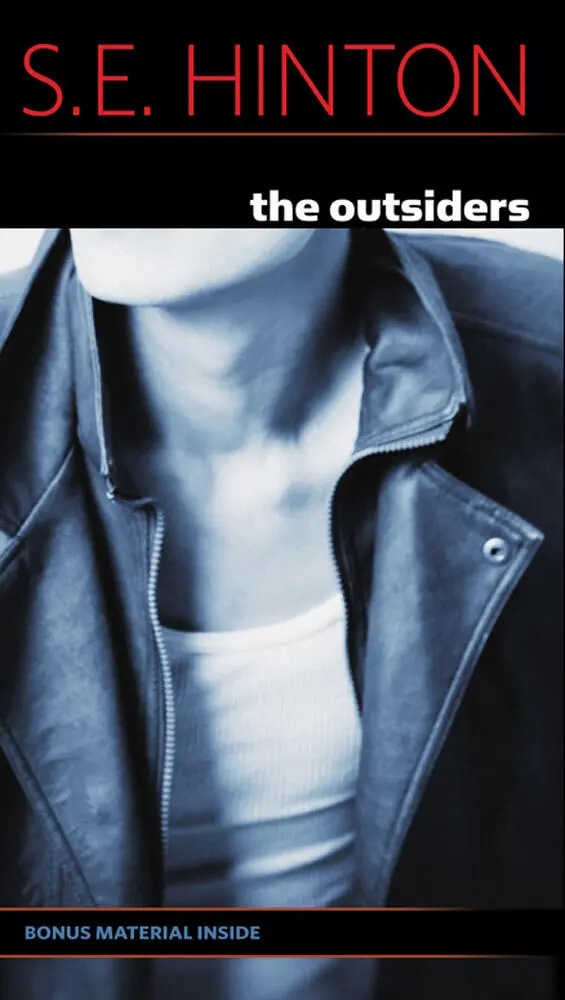
- Название:The Outsiders
- Автор:
- Издательство:Penguin Group US
- Жанр:
- Год:2006
- ISBN:9781101642610
- Рейтинг книги:3 / 5. Голосов: 6
-
Избранное:Добавить в избранное
- Отзывы:
-
Ваша оценка:
The Outsiders: краткое содержание, описание и аннотация
Предлагаем к чтению аннотацию, описание, краткое содержание или предисловие (зависит от того, что написал сам автор книги «The Outsiders»). Если вы не нашли необходимую информацию о книге — напишите в комментариях, мы постараемся отыскать её.
The Outsiders — читать онлайн бесплатно полную книгу (весь текст) целиком
Ниже представлен текст книги, разбитый по страницам. Система сохранения места последней прочитанной страницы, позволяет с удобством читать онлайн бесплатно книгу «The Outsiders», без необходимости каждый раз заново искать на чём Вы остановились. Поставьте закладку, и сможете в любой момент перейти на страницу, на которой закончили чтение.
Интервал:
Закладка:
“You should have gone out for football instead of track.”
“Where did you think you were going?” I lay flat on my back and looked at him. Darry came up and dropped down beside us.
Soda shrugged. “I don’t know. It’s just… I can’t stand to hear y’all fight. Sometimes… I just have to get out or… it’s like I’m the middleman in a tug o’ war and I’m being split in half. You dig?”
Darry gave me a startled look. Neither of us had realized what it was doing to Soda to hear us fight. I was sick and cold with shame. What he said was the truth. Darry and I did play tug of war with him, with never a thought to how much it was hurting him.
Soda was fiddling with some dead grass. “I mean, I can’t take sides. It’d be a lot easier if I could, but I see both sides. Darry yells too much and tries too hard and takes everything too serious, and Ponyboy, you don’t think enough, you don’t realize all Darry’s giving up just to give you a chance he missed out on. He could have stuck you in a home somewhere and worked his way through college. Ponyboy, I’m telling you the truth. I dropped out because I’m dumb. I really did try in school, but you saw my grades. Look, I’m happy working in a gas station with cars. You’d never be happy doing something like that. And Darry, you ought to try to understand him more, and quit bugging him about every little mistake he makes. He feels things differently than you do.” He gave us a pleading look. “Golly, you two, it’s bad enough having to listen to it, but when you start trying to get me to take sides…” Tears welled up in his eyes. “We’re all we’ve got left. We ought to be able to stick together against everything. If we don’t have each other, we don’t have anything. If you don’t have anything, you end up like Dallas… and I don’t mean dead, either. I mean like he was before. And that’s worse than dead. Please”—he wiped his eyes on his arm—“don’t fight anymore.”
Darry looked real worried. I suddenly realized that Darry was only twenty, that he wasn’t so much older that he couldn’t feel scared or hurt and as lost as the rest of us. I saw that I had expected Darry to do all the understanding without even trying to understand him. And he had given up a lot for Soda and me.
“Sure, little buddy,” Darry said softly. “We’re not going to fight anymore.”
“Hey, Ponyboy”—Soda gave me a tearful grin—“don’t you start crying, too. One bawl-baby in the family’s enough.”
“I’m not crying,” I said. Maybe I was. I don’t remember. Soda gave me a playful punch on the shoulder.
“No more fights. Okay, Ponyboy?” Darry said.
“Okay,” I said. And I meant it. Darry and I would probably still have misunderstandings — we were too different not to — but no more fights. We couldn’t do anything to hurt Soda. Sodapop would always be the middleman, but that didn’t mean he had to keep getting pulled apart. Instead of Darry and me pulling him apart, he’d be pulling us together.
“Well,” Soda said, “I’m cold. How about going home?”
“Race you,” I challenged, leaping up. It was a real nice night for a race. The air was clear and cold and so clean it almost sparkled. The moon wasn’t out but the stars lit up everything. It was quiet except for the sound of our feet on the cement and the dry, scraping sound of leaves blowing across the street. It was a real nice night. I guess I was still out of shape, because we all three tied. No. I guess we all just wanted to stay together.
I still didn’t want to do my homework that night, though. I hunted around for a book to read, but I’d read everything in the house about fifty million times, even Darry’s copy of The Carpetbaggers , though he’d told me I wasn’t old enough to read it. I thought so too after I finished it. Finally I picked up Gone with the Wind and looked at it for a long time. I knew Johnny was dead. I had known it all the time, even while I was sick and pretending he wasn’t. It was Johnny, not me, who had killed Bob — I knew that too. I had just thought that maybe if I played like Johnny wasn’t dead it wouldn’t hurt so much. The way Two-Bit, after the police had taken Dally’s body away, had griped because he had lost his switchblade when they searched Dallas.
“Is that all that’s bothering you, that switchblade?” a red-eyed Steve had snapped at him.
“No,” Two-Bit had said with a quivering sigh, “but that’s what I’m wishing was all that’s bothering me.”
But it still hurt anyway. You know a guy a long time, and I mean really know him, you don’t get used to the idea that he’s dead just overnight. Johnny was something more than a buddy to all of us. I guess he had listened to more beefs and more problems from more people than any of us. A guy that’ll really listen to you, listen and care about what you’re saying, is something rare. And I couldn’t forget him telling me that he hadn’t done enough, hadn’t been out of our neighborhood all his life — and then it was too late. I took a deep breath and opened the book. A slip of paper fell out on the floor and I picked it up.
Ponyboy, I asked the nurse to give you this book so you could finish it. It was Johnny’s handwriting. I went on reading, almost hearing Johnny’s quiet voice. The doctor came in a while ago but I knew anyway. I keep getting tireder and tireder. Listen, I don’t mind dying now. It’s worth it. It’s worth saving those kids. Their lives are worth more than mine, they have more to live for. Some of their parents came by to thank me and I know it was worth it. Tell Dally it’s worth it. I’m just going to miss you guys. I’ve been thinking about it, and that poem, that guy that wrote it, he meant you’re gold when you’re a kid, like green. When you’re a kid everything’s new, dawn. It’s just when you get used to everything that it’s day. Like the way you dig sunsets, Pony. That’s gold. Keep that way, it’s a good way to be. I want you to tell Dally to look at one. He’ll probably think you’re crazy, but ask for me. I don’t think he’s ever really seen a sunset. And don’t be so bugged over being a greaser. You still have a lot of time to make yourself be what you want. There’s still lots of good in the world. Tell Dally. I don’t think he knows. Your buddy, Johnny.
Tell Dally. It was too late to tell Dally. Would he have listened? I doubted it. Suddenly it wasn’t only a personal thing to me. I could picture hundreds and hundreds of boys living on the wrong sides of cities, boys with black eyes who jumped at their own shadows. Hundreds of boys who maybe watched sunsets and looked at stars and ached for something better. I could see boys going down under street lights because they were mean and tough and hated the world, and it was too late to tell them that there was still good in it, and they wouldn’t believe you if you did. It was too vast a problem to be just a personal thing. There should be some help, someone should tell them before it was too late. Someone should tell their side of the story, and maybe people would understand then and wouldn’t be so quick to judge a boy by the amount of hair oil he wore. It was important to me. I picked up the phone book and called my English teacher.
“Mr. Syme, this is Ponyboy. That theme — how long can it be?”
“Why, uh, not less than five pages.” He sounded a little surprised. I’d forgotten it was late at night.
“Can it be longer?”
“Certainly, Ponyboy, as long as you want it.”
“Thanks,” I said and hung up.
I sat down and picked up my pen and thought for a minute. Remembering. Remembering a handsome, dark boy with a reckless grin and a hot temper. A tough, towheaded boy with a cigarette in his mouth and a bitter grin on his hard face. Remembering — and this time it didn’t hurt — a quiet, defeated-looking sixteen-year-old whose hair needed cutting badly and who had black eyes with a frightened expression to them. One week had taken all three of them. And I decided I could tell people, beginning with my English teacher. I wondered for a long time how to start that theme, how to start writing about something that was important to me. And I finally began like this: When I stepped out into the bright sunlight from the darkness of the movie house, I had only two things on my mind: Paul Newman and a ride home…
Читать дальшеИнтервал:
Закладка:
Похожие книги на «The Outsiders»
Представляем Вашему вниманию похожие книги на «The Outsiders» списком для выбора. Мы отобрали схожую по названию и смыслу литературу в надежде предоставить читателям больше вариантов отыскать новые, интересные, ещё непрочитанные произведения.








Обсуждение, отзывы о книге «The Outsiders» и просто собственные мнения читателей. Оставьте ваши комментарии, напишите, что Вы думаете о произведении, его смысле или главных героях. Укажите что конкретно понравилось, а что нет, и почему Вы так считаете.