Kamila Shamsie - Kartography
Здесь есть возможность читать онлайн «Kamila Shamsie - Kartography» весь текст электронной книги совершенно бесплатно (целиком полную версию без сокращений). В некоторых случаях можно слушать аудио, скачать через торрент в формате fb2 и присутствует краткое содержание. Год выпуска: 2004, ISBN: 2004, Издательство: Houghton Mifflin Harcourt, Жанр: Проза, на английском языке. Описание произведения, (предисловие) а так же отзывы посетителей доступны на портале библиотеки ЛибКат.
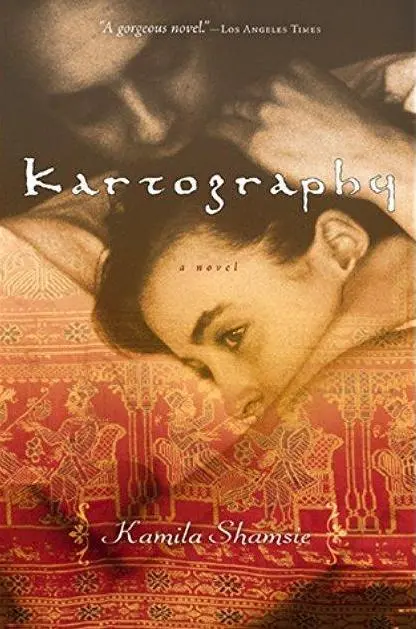
- Название:Kartography
- Автор:
- Издательство:Houghton Mifflin Harcourt
- Жанр:
- Год:2004
- ISBN:9780547541129
- Рейтинг книги:4 / 5. Голосов: 1
-
Избранное:Добавить в избранное
- Отзывы:
-
Ваша оценка:
Kartography: краткое содержание, описание и аннотация
Предлагаем к чтению аннотацию, описание, краткое содержание или предисловие (зависит от того, что написал сам автор книги «Kartography»). Если вы не нашли необходимую информацию о книге — напишите в комментариях, мы постараемся отыскать её.
A love story with a family mystery at its heart, Kartography is a dazzling novel by a young writer of astonishing maturity and exhilarating style. Shamsie transports us to a world we have not often seen in fiction-vibrant, dangerous, sensuous Pakistan. But even as she takes us far from the familiar, her story of passion and family secrets rings universally true.
Kartography — читать онлайн бесплатно полную книгу (весь текст) целиком
Ниже представлен текст книги, разбитый по страницам. Система сохранения места последней прочитанной страницы, позволяет с удобством читать онлайн бесплатно книгу «Kartography», без необходимости каждый раз заново искать на чём Вы остановились. Поставьте закладку, и сможете в любой момент перейти на страницу, на которой закончили чтение.
Интервал:
Закладка:
I wasn’t about to defend my father, or even point out how silly it was of him to attack my father and yet simultaneously assume he would have been the perfect husband. ‘I don’t know what this has to do with going back to Karachi. Karim, I don’t understand what we’re fighting about.’
‘You’re going to go back, aren’t you? After everything that’s happened you’re going to go back, because all you really want is to go on the way you’ve been going on. Like your father, who could so easily transfer his affections simply because it was easier to love someone who wasn’t Bengali, you arrange your life around everything that’s easy, even though it means wrapping yourself in a little cocoon and deciding that things that happen away from the street where you live don’t touch you. And then you pretend your street is the world.
‘And what happens tomorrow when you decide that being with me is too hard, what happens then, Raheen? How dispensable will I prove to be? As dispensable as I was when I left Karachi, and all you could do was write letters about how much fun you were having, and how foreign I was becoming day by day, and how you really weren’t interested in anything I had to say about how hard it was, how goddamn miserable it made me, to be away from Karachi, which meant being away from you.’
‘That’s not true, Karim.’ I was pulling a leaf apart between my fingers, the fleshy part separating easily and falling off the veins. ‘Go and read my letters again.’
‘I can’t. I cut them up, remember, and burnt what was left.’
‘Well, I remember what I wrote. I remember I used to tell you everything that was going on in school, every little detail, so that when you came back you wouldn’t have to feel like an outsider for even a second.’
‘You made me feel like the outsider. You told me what was happening without telling me it would be so much better if I were there.’
This was turning into some twisted nightmare. ‘I was only matching the tone you set in your letters, Karim. Your first letter to me, the first correspondence between either of us, started with you saying: Bet you’re boiling in that deadly summer sun, and here it’s cool enough for a sweater. Ha-ha!’ I repeated it again to emphasize the lightness of the letter’s tone. ‘Ha-ha!’
‘How could I use any other tone but “ha-ha!” when it was so obvious you didn’t want to hear anything from me that wasn’t a joke? Raheen, you used to see me crying, before I left Karachi, your best friend since we were born, you used to see me crying, because my parents were always yelling and my father was threatening to take me away and do you know how hard it is for a thirteen-year-old boy to cry in front of anyone? I cried in front of you, only in front of you, because I just needed you to ask what’s wrong and you couldn’t, you couldn’t, you didn’t even care enough to want to know. Go back to bloody Karachi. Go back and turn into Runty and see if I give a damn. Coming here was the stupidest thing I could have done.’
I caught hold of his sleeve. ‘Why did you come, then?’
‘I was going to take you to Boston with me. To see my mother. But I don’t want her to see you.’ He pulled away from me and headed out of the glen.
I threw the bits of leaf at him in frustration but they swirled and came back at me. I could hear his footsteps pick up and become a run, and I knew I’d never catch up with him.
If he’d stayed any longer he would have accused, you still haven’t called my mother. As though it was any easier calling her now I knew what she had suffered at the hands of both my parents. I remembered Aunty Maheen’s voice from that first aborted phone call— Darling, who is it? — and the sudden ache that made me hang up the phone because it wasn’t Uncle Ali she was speaking to. That was four years after the divorce. It made no sense, the strength of my reaction.
Yes, it did.
Yes, it did.
It seemed easier not to see her, that was the truth. It seemed easier not to have to see her and her husband and imagine how Karim must have felt — perhaps still felt — to see them together. Because if I had to imagine how Karim felt about the divorce, I’d have to face how I failed him. I used to walk around all day in those weeks after the divorce trying to shake off the suffocating feeling that came from imagining his hurt, and I felt that if I heard his voice, if I heard him weep, I would break into a million pieces. So instead I told him I didn’t know what to say; when he wrote back, I told myself that if he had my voice inside his head to speak to, that was enough. I never broached the subject again in any of my letters. In doing that, I drew a dividing line between us. I do not want your pain sitting on my heart, boy. Keep it away.
I leaned against the tree. I had done that, and both Karim and I knew it. When he told me I lived in tiny circles, that I didn’t want to acknowledge how I was connected to the outside world, he had been talking about the failure of my friendship to take part of his pain upon myself. Even if he didn’t know that’s what he had been talking about.
I veered off the path, and half-ran, half-slid, down to the river. I sat there a long time, watching the water flow past. Karim’s life after Karachi unfolded in front of me, and I did nothing to stop it, not even when I imagined Aunty Maheen telling him she was leaving. His loneliness then was complete. I stayed by the river long enough to push past tears, past hurt, until what remained was my shame. But I still didn’t leave. I stayed, allowing the shame to grow and grow, until finally there was a tiny exhalation, a release.
I stood up then and made my way back to the present. But when I neared my dorm, there were words etched into the soil near where he had fallen when he leapt from the tree: I’m sorry. I love you.
Or was that a soil-speck, not a full stop, between the first sentence and the second?
In Boston, summer was in full swing. Sunlight glinted off the John Hancock building, glinted off the Charles. A convertible sped past, leaving a smell of ice cream in the air. I glanced down at the directions Aunty Maheen had dictated over the phone.
‘At Storrow Drive get into the extreme right lane…’ It sounded simple enough, but no one had prepared me for the rush-hour traffic of Storrow Drive, the horror of being stuck in the extreme left lane with at least three lanes to traverse and not much time to do it. I emptied my mind of all the rule-bound small-town driving I’d been practising in the last few months, further emptied my mind of the thought that I was driving Zia’s beloved black Integra, and reminded myself that I was a Karachiite. Setting my jaw, I slammed on the horn, spun the wheel to the right and, with an utter disdain for the curses that were hurled in my direction, managed to make it over to the requisite lane well before the turn for Aunty Maheen’s flat.
When the concierge asked who I had come to see I realized I didn’t know Aunty Maheen’s last name any more, so I just said, ‘Maheen,’ and the concierge said, ‘Would that be Mrs Ahmed?’ which seemed a fair bet, so I nodded and was directed to the eleventh floor.
I thought I’d cured myself of the habit of fidgeting with my hair when nervous, but as I stood waiting for someone to answer her door bell I kept pulling the ends of my hair, conscious that it was much shorter than the last time she’d seen me. I hoped she was alone. When I had finally summoned up the courage to call her and say I needed to see her, I had been unable to think of a way to tell her I didn’t want to see the Interloper. Not yet. It had been a strange phone conversation, both of us too aware that I’d been in the US almost four years without calling, and that made unsayable all the truths going through my mind: I’ve missed you; it’s so good to hear your voice; I can’t wait to see you.
Читать дальшеИнтервал:
Закладка:
Похожие книги на «Kartography»
Представляем Вашему вниманию похожие книги на «Kartography» списком для выбора. Мы отобрали схожую по названию и смыслу литературу в надежде предоставить читателям больше вариантов отыскать новые, интересные, ещё непрочитанные произведения.








Обсуждение, отзывы о книге «Kartography» и просто собственные мнения читателей. Оставьте ваши комментарии, напишите, что Вы думаете о произведении, его смысле или главных героях. Укажите что конкретно понравилось, а что нет, и почему Вы так считаете.