Kamila Shamsie - Kartography
Здесь есть возможность читать онлайн «Kamila Shamsie - Kartography» весь текст электронной книги совершенно бесплатно (целиком полную версию без сокращений). В некоторых случаях можно слушать аудио, скачать через торрент в формате fb2 и присутствует краткое содержание. Год выпуска: 2004, ISBN: 2004, Издательство: Houghton Mifflin Harcourt, Жанр: Проза, на английском языке. Описание произведения, (предисловие) а так же отзывы посетителей доступны на портале библиотеки ЛибКат.
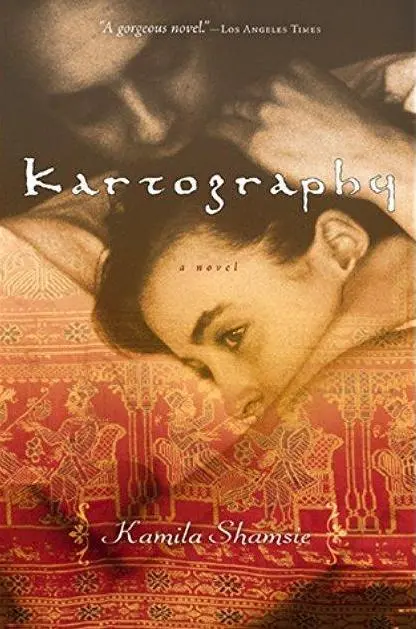
- Название:Kartography
- Автор:
- Издательство:Houghton Mifflin Harcourt
- Жанр:
- Год:2004
- ISBN:9780547541129
- Рейтинг книги:4 / 5. Голосов: 1
-
Избранное:Добавить в избранное
- Отзывы:
-
Ваша оценка:
Kartography: краткое содержание, описание и аннотация
Предлагаем к чтению аннотацию, описание, краткое содержание или предисловие (зависит от того, что написал сам автор книги «Kartography»). Если вы не нашли необходимую информацию о книге — напишите в комментариях, мы постараемся отыскать её.
A love story with a family mystery at its heart, Kartography is a dazzling novel by a young writer of astonishing maturity and exhilarating style. Shamsie transports us to a world we have not often seen in fiction-vibrant, dangerous, sensuous Pakistan. But even as she takes us far from the familiar, her story of passion and family secrets rings universally true.
Kartography — читать онлайн бесплатно полную книгу (весь текст) целиком
Ниже представлен текст книги, разбитый по страницам. Система сохранения места последней прочитанной страницы, позволяет с удобством читать онлайн бесплатно книгу «Kartography», без необходимости каждый раз заново искать на чём Вы остановились. Поставьте закладку, и сможете в любой момент перейти на страницу, на которой закончили чтение.
Интервал:
Закладка:
I put my arm around Sonia, wanting only to erase all the misery that her bent head and sagging shoulders conveyed. ‘At least it’s over now. And you don’t want to marry someone who’s so fickle. There’ll be others, tons of proposals, all better than Adel Rana.’
She pulled away from me. ‘It’s not over. Things like this are never over.’
Karim stood up, pushing back the wooden bench. ‘I can’t stay here. I don’t understand this place. I don’t want to.’ He looked at me sadly, almost apologetically. He turned to Sonia. ‘I’m going to fly out tomorrow. But I want your permission to see your father first, Sonia.’
‘My father?’
‘Her father?’
‘Karimazov, don’t do this.’
‘I’d like to ask his permission to marry you.’
A boy selling balloons moved towards us. The beggar girl knocked him to the ground. One balloon burst; another slipped out of his grasp and flew up, a white oval against the moon-empty sky. Karim and Zia rushed to separate the beggar and boy. I stayed seated on the wooden bench, and watched the balloon. It rose higher and higher and disappeared into a constellation.
‘What’s going on?’ Sonia said. ‘Will someone tell me what’s going on?’
I could see Karim turning to say something to Zia, and Zia shaking his arm off. Sonia was saying, ‘I thought you and Karim…’ and I wanted to yell at her, ‘He wants perfection, so he’s choosing you.’
That was when it hit me for the first time: I had lost him.
Not to Sonia and not to maps. I had lost him to the past, and there was no changing that. Mine was still the hand he reached for under the table when the world turned awful, but that only made the loss more unbearable. It was as though our instincts to turn to each other, to want each other, remained as strong as ever, but when instinct stopped and thought took over we pulled away, each time with a little more disgust than the time before.
‘Are you angry with me?’ Sonia asked. ‘I’m not going to marry him, you know that, don’t you? He’s yours, even if both of you don’t see it.’
‘You’re a better woman than I am, Sonia. You’re a better woman than my mother was.’
Karim and Zia had finally stopped the beggar girl and the balloon boy from striking out at each other. They started to walk towards us.
‘I don’t want to talk to Zia,’ Sonia said.
‘I don’t want to talk to Karim.’
We turned, ran towards my car, despite the stares and exclamations of the men around us, and drove off. In my rear-view mirror I saw the boys watch us go. Neither of them attempted to stop us.
There are two kinds of blessed moments to which we can awake: the first, that moment of realizing a nightmare was unhinged from reality, no place in our lives for it save for those places in which we store memories that make us shudder even though they aren’t true memories at all; the second, more elusive — for we don’t fully recognize the peace of mind it brings until it’s gone — is the moment of believing reality was a nightmare, nothing more. But the morning after Kharadar, covered in sweat despite the December breeze, I awoke to memory.
I looked at the clock. Early. Forty-eight hours ago, at this time, I was standing at the airport, waiting for Karim. I picked myself off the mattress quietly so as not to disturb Sonia, who was fast asleep in bed, just inches away from me.
I brushed my teeth using my finger as a toothbrush and changed from Sonia’s T-shirt back into the clothes I had been wearing the night before. They were stiff with sea salt. I took them off again, and borrowed a shalwar-kameez from Sonia’s wardrobe. I was unable to imagine how I would make my way through the coming day. Karim was leaving in a few hours. He had called Sonia’s house last night to say he had used Uncle Asif’s contacts at PIA to get himself a seat on today’s flight to London. While he was speaking, Sonia had tried to hand the phone to me, but I refused to take it. He had clearly said something to her about coming to see her father, and Sonia said, ‘Please, don’t. Our friendship will be over if you do.’
Sonia and I spent the rest of the night watching tear-jerkers: Beaches, Dead Poets Society, The Outsiders, a tissue box placed between us.
‘C. Thomas Howell,’ Sonia said, pointing at the screen as the credits rolled for The Outsiders. ‘He must have thought he was going to be such a big star. What happened to him?’
‘Playing Ponyboy was the zenith of his career,’ I replied, and then we both had to laugh at how much that made us cry.
Halfway through Beaches, my mother had called looking for me. Sonia said I’d be spending the night at her place. She was too embarrassed to say I refused to talk to my mother so she told her I was already asleep.
I pushed the mattress under Sonia’s bed and sat down at her desk. Now what? At some point I’d have to go home. What happens when you spend your life creating yourself in someone else’s image and that image festers overnight? How can you point a finger without it turning right round and stabbing you in the throat? I pressed a fingernail against my gullet, ran to the bathroom and threw up all the chai and paratha and sandwiches and pakoras from the evening before.
Afterwards I lay on the bathroom tiles, concentrating on the expansion and deflation of my chest cavity as I breathed in and out. At length, I reached over for Sonia’s make-up basket, took out her eyeliner, tore a length of loo paper off a roll and wrote:
(1) Why did Zafar make that remark about Bengalis?
(2) Why did Yasmin and Ali’s engagement break off?
(3) How did they all remain friends?
(4) Who felt what for whom, and when?
I tore off another square and wrote:
(1) What does 1971 have to do with now?
The blank whiteness of the loo paper below that question faced me like an accusation. I pressed the nib of the eyeliner against the paper, and a tiny prick of black spread into a wider and wider circle. I pulled the entire roll of paper off its holder, placed a magazine beneath it, and wrote:
Days away from 1995, we are nearly forty-eight years old as a nation, young enough that there are people alive who have lived through our entire history and more, but too old to put our worries down to teething problems. Between our birth in 1947 and 1995, dead bang between our beginning and our present, is 1971, of which I know next to nothing except that there was a war and East Pakistan became Bangladesh, and what terrible things we must have done then to remain so silent about it. Is it shame at losing the war, or guilt about what we did to try to win that mutes us?
I put the eyeliner down, looked at the furious scribbling, much of which had torn through the paper and left black squiggles on the Prime Minister’s face. Time to find my father.
When I walked into our house, he was pacing the hallway. He clearly hadn’t slept all night. I didn’t know what I was feeling as we looked at each other, but it wasn’t anything I’d ever felt before.
‘Come on,’ he said to me.
I followed him outside, but when he got into his car, I hesitated.
‘We’re going for a drive,’ he said.
‘I think I might feel claustrophobic.’
‘So open the window.’
‘I don’t really think you’re in a position to tell me what to do.’
He started the engine without responding to that.
I opened the gate so that he could drive out. Our street was just beginning to awaken. The retired army officer down the road was taking his two German Shepherd dogs for a walk; the jamadaar was hosing down the driveway next door, sending bougainvillaea flowers flowing under the gate and on to the street in rivulets of oily water; the newspaperwallah was driving slowly along on his motorbike, tossing papers into houses — but on arriving at the house of the American chairman of some multinational, he had to veer his bike all the way to one side of the street in order to achieve a trajectory that would allow the paper to clear the absurdly high wall. When he reached the house next door, the paperwallah wavered, conscious of the wet driveway; then, seeing me looking at him, he smiled a huge smile and tossed the paper over the wall. The jamadaar stormed out, waving the wet newspaper over his head, and demanding a dry copy. The paperwallah said, ‘Blow on it, it’ll dry. If you can water a driveway, you can do that,’ and zipped down the street on his motorbike.
Читать дальшеИнтервал:
Закладка:
Похожие книги на «Kartography»
Представляем Вашему вниманию похожие книги на «Kartography» списком для выбора. Мы отобрали схожую по названию и смыслу литературу в надежде предоставить читателям больше вариантов отыскать новые, интересные, ещё непрочитанные произведения.





Обсуждение, отзывы о книге «Kartography» и просто собственные мнения читателей. Оставьте ваши комментарии, напишите, что Вы думаете о произведении, его смысле или главных героях. Укажите что конкретно понравилось, а что нет, и почему Вы так считаете.