Джеймс Хилтон - Morning Journey
Здесь есть возможность читать онлайн «Джеймс Хилтон - Morning Journey» весь текст электронной книги совершенно бесплатно (целиком полную версию без сокращений). В некоторых случаях можно слушать аудио, скачать через торрент в формате fb2 и присутствует краткое содержание. Год выпуска: 1951, Жанр: Проза, на английском языке. Описание произведения, (предисловие) а так же отзывы посетителей доступны на портале библиотеки ЛибКат.
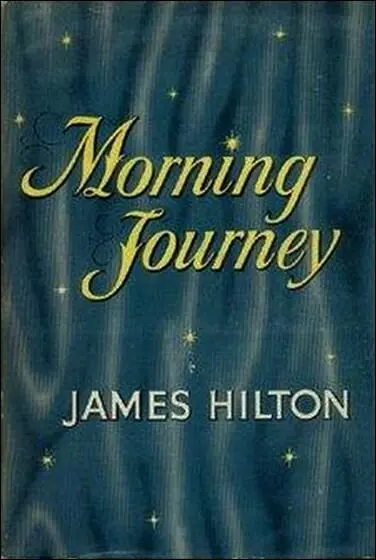
- Название:Morning Journey
- Автор:
- Жанр:
- Год:1951
- ISBN:нет данных
- Рейтинг книги:4 / 5. Голосов: 1
-
Избранное:Добавить в избранное
- Отзывы:
-
Ваша оценка:
Morning Journey: краткое содержание, описание и аннотация
Предлагаем к чтению аннотацию, описание, краткое содержание или предисловие (зависит от того, что написал сам автор книги «Morning Journey»). Если вы не нашли необходимую информацию о книге — напишите в комментариях, мы постараемся отыскать её.
Morning Journey — читать онлайн бесплатно полную книгу (весь текст) целиком
Ниже представлен текст книги, разбитый по страницам. Система сохранения места последней прочитанной страницы, позволяет с удобством читать онлайн бесплатно книгу «Morning Journey», без необходимости каждый раз заново искать на чём Вы остановились. Поставьте закладку, и сможете в любой момент перейти на страницу, на которой закончили чтение.
Интервал:
Закладка:
“I know what I’d like to do. You’ll probably think it crazy, but to me it doesn’t look crazier than most other things these days. I’d like to go to medical school and later take up tropical medicine. My best friend— the one who took the girl who was killed to the dance—he was in the Pacific during the first years of the war—he told me plenty about it. They need resident doctors on all those Pacific islands. The natives have everything from leprosy to measles. Now the war’s over the Government’s beginning to realize how much medical work will have to be done in so-called peacetime, though I admit it’s a bit illogical to improve the health of a few ex-cannibals when we’re all going to be atom-bombed. Perhaps that’s why it appeals to me—because it’s illogical. When the radio-active manna begins to fall on the world I’d rather be discovered in some relatively pointless occupation such as treating a Polynesian scalp for ringworm… instead of sitting in a bank office doing fabulous things with a comptometer.” He laughed nervously. “Well, what do you think of the idea? You’re very silent.”
She said: “I’m just wondering why you haven’t already started.”
“Started what?”
“The medical thing, if it’s what you want.”
“Carey, you’re rather wonderful. I have started. I’ve written to Columbia asking about entrance requirements.”
She saw and heard the bridge game ending across the room and the sudden burst of talk as the score was added up. She had time to say: “I’m glad, Norris, I’m very glad,” and then to add quietly: “I think your father’s won —he looks so pleased with himself.”
Austen came towards them smiling. “Eleven dollars and thirty cents,” he remarked, with a satisfaction which, from him, could only be considered charming.
That night, because again she found sleep difficult, she began Paul’s manuscript. She had had it in her possession for over a week, during which there had been several chances for private reading, but she had felt no urgency; Paul’s life story was like Paul himself in her life—close or distant beyond computation in miles or days. But she had promised to give her opinion, and, once she began, it was certainly no effort to form one.
The opening chapters were interesting, without a doubt. She could also (though she was no real judge of this) imagine that some publisher might take a chance on the whole book, if only for its general liveliness and gossip value. But what struck her, amusingly at first, and then appallingly as she went on, was the picture it presented of Paul himself—an absurd picture on the surface, yet beneath the absurdity so ruefully revealing. For he was his own complete hero from the first sentence. Nothing had ever happened but added a mosaic to the finished pattern of the man who was always right (and whose enemies and friends alike were always wrong), a man infinitely wise and desperately victimized, a man who had never done a foolish or a selfish or an unjustifiable thing, but whom the world had treated with constant unawareness of the paragon living in its midst. The picture was flawless (Carey realized) because it was constructed with the awful sincerity of self-hypnosis. Errors, even of simple fact, were numerous and monumental. Poor old Foy, for instance, appeared as a philistine who had cut short the run of Othello when it was still making money but not enough to satisfy his avarice, and various other theatrical figures whom Paul had quarrelled with in London and New York were hardly recognizable in their completely satanic guise. For the passage of the years was to Paul no softener into greys, but rather a lens through which the blacks were blacker, and his own white whiter than snow. It was demonology, not autobiography. And all this in depicting the comparatively minor rancours of those early years. (There was, of course, no reference at all to that obliterated year in Hollywood.) What would happen, Carey wondered, when he came to his film-making experiences in Germany (the Everyman affair), and the war-time ordeal of the internment camp?
She read with greater misgivings as she proceeded, and with the greatest of all when she turned back to re-read passages here and there. She was sure, by then, that for Paul to publish it (even supposing it were free from technical libel) would be disastrous. Not that it was badly written (it had some of the glibness that had made him, in his youth, a promising journalist of sorts), but there was no quality in it to offset its own angle of distortion, and its sole perfection was for this reason non-literary, clinical, and ludicrous. If he had wished to give the world the documented confession of an egomaniac, this was it, and of value, doubtless, in a psychiatrist’s library; but among the informed public those who did not sue would probably laugh their heads off. The whole thing was too true by being not true at all.
And then she suddenly realized, as never before, that Paul’s infallible world, the world in which his greatness was real, the world of Erste Freundschaft, had nothing to do with either his actual behaviour in life or with his own ridiculous self-portrait. It was as if, indeed, words were a medium that, despite his skill with them, set him far off the tracks of truth. He posed in every sentence, and she remembered that his first success in journalism had been the exploitation of a pose that he himself had scorned. Perhaps that early experience had probed and explored a weakness, so that words were never afterwards to be his authentic weapon. And perhaps that was why, of every craft connected with the stage, he had always got along worst with writers; and perhaps that was also why, when he took to the camera, it was a release from chains, for in all his films there was none of this brawling self-love, but an integrity, a vision of life, and the sweetness of a ripe apple… All this came to her mind as she read the manuscript, and when she had finished it she wondered, not what to tell him, but how. The problem took such precedence, even over others she had, that she felt she must act quickly; she could not endure the thought of him sitting there in that dreary little room, happily engaged upon a task so inept. She drove to see him the next morning, climbing the eight half-flights with the resoluteness of one who intends at all costs to be frank. The real trouble, she expected, would not be to break the news gently but to make any impression at all on his own conviction that he could do no wrong.
“So you’ve read it already?” he exclaimed, when he saw the manuscript under her arm. “That’s GREAT! You just couldn’t stop, I suppose, once you tried a page or two?” He smiled indulgently as he pulled a chair for her. From the look of things he had been working hard at the continuation, and he saw her glance take in the typewriter and the littered table. “I think I have another couple of chapters for you,” he added proudly. “Now tell me all about it.”
“Paul… let me get my breath…”
“Yes, I know. Those stairs… But isn’t it good stuff? How did you like the part about our first meeting? That walk in Phoenix Park and my promise to direct you in a play—”
“That wasn’t our first meeting, Paul, and you didn’t promise to direct me… but it’s a fair sample of what’s wrong with the whole thing.”
“WRONG?”
“Yes, because it isn’t true. You’ve just made yourself a hero in everything—which wouldn’t matter so much except that you’re wasting your time doing this sort of thing at all. You’re not a writer. You’re a picture-maker. Your mind’s eye has no words.”
And now, she thought, regarding him dispassionately, let the heavens fall. He seemed preoccupied for a moment, as if holding some answer of his own in abeyance; then all he did was to take a cigar from his pocket and slowly light it—not at all the movement of an angry man. Presently he remarked: “Not bad, not bad. My mind’s eye has no words. I like that. Carve it on my tombstone. You know, Carey, I have an idea some time to make a picture without words at all. The old silents were almost an art when this horrible mess of verbiage dragged them down to the level of mere photographed stage plays. You’re pretty smart to perceive that.”
Читать дальшеИнтервал:
Закладка:
Похожие книги на «Morning Journey»
Представляем Вашему вниманию похожие книги на «Morning Journey» списком для выбора. Мы отобрали схожую по названию и смыслу литературу в надежде предоставить читателям больше вариантов отыскать новые, интересные, ещё непрочитанные произведения.



Обсуждение, отзывы о книге «Morning Journey» и просто собственные мнения читателей. Оставьте ваши комментарии, напишите, что Вы думаете о произведении, его смысле или главных героях. Укажите что конкретно понравилось, а что нет, и почему Вы так считаете.