Джеймс Хилтон - So Well Remembered
Здесь есть возможность читать онлайн «Джеймс Хилтон - So Well Remembered» весь текст электронной книги совершенно бесплатно (целиком полную версию без сокращений). В некоторых случаях можно слушать аудио, скачать через торрент в формате fb2 и присутствует краткое содержание. Год выпуска: 1945, Жанр: Проза, на английском языке. Описание произведения, (предисловие) а так же отзывы посетителей доступны на портале библиотеки ЛибКат.
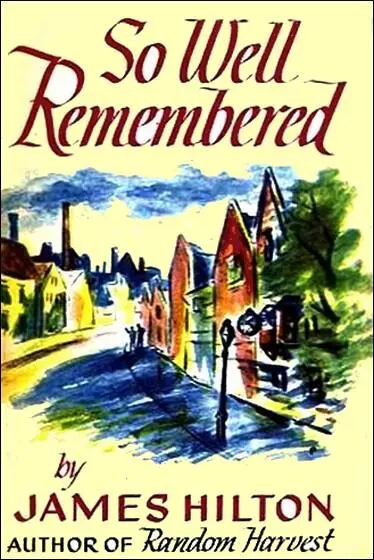
- Название:So Well Remembered
- Автор:
- Жанр:
- Год:1945
- ISBN:нет данных
- Рейтинг книги:5 / 5. Голосов: 1
-
Избранное:Добавить в избранное
- Отзывы:
-
Ваша оценка:
So Well Remembered: краткое содержание, описание и аннотация
Предлагаем к чтению аннотацию, описание, краткое содержание или предисловие (зависит от того, что написал сам автор книги «So Well Remembered»). Если вы не нашли необходимую информацию о книге — напишите в комментариях, мы постараемся отыскать её.
So Well Remembered — читать онлайн бесплатно полную книгу (весь текст) целиком
Ниже представлен текст книги, разбитый по страницам. Система сохранения места последней прочитанной страницы, позволяет с удобством читать онлайн бесплатно книгу «So Well Remembered», без необходимости каждый раз заново искать на чём Вы остановились. Поставьте закладку, и сможете в любой момент перейти на страницу, на которой закончили чтение.
Интервал:
Закладка:
Just before dawn one morning he dozed off in the chair and dreamed of his own boyhood, a dream he had had recurrently before, though never with such clarity. It was about his Uncle Joe, whom he had gone to live with when he was seven years old, and of whom he had had more fear (on one occasion only) than ever before or since of anything or anyone. What had happened actually, though not always in the dream, was that uncle and nephew had met for the first time at the house in Mill Street, when no one else was there. This was a few months after his father had died, a week after the funeral of his mother, and a few hours after the door had closed on his elder brother Harry, his elder sister Jane, and the furniture-removers.
George had been the youngest of a family of six, with a gap so wide between himself and the rest that at the time he was left parentless all the others were grown-up and some of them married. Their bickerings about who should take care of him (each one having a completely plausible alibi) had made them jump at an unexpected offer from their mother’s brother, despite the fact that he and their father had quarrelled years before over some point of behaviour which (according to the latter) “just shows what a wicked man Joe is”. Nobody ever told George more than that; all Harry would add was an especially sinister: “You’ll find out soon enough, Georgie.” And when the Mill Street household was broken up, Jane and Harry watched the last of the furniture stowed away in the van, then looked at George as if it were somehow disobliging of him to be alive. Finally Jane whispered: “We might as well go now, Harry—George’ll be all right by himself till Uncle Joe comes —he said he’d be along as soon as he closed the shop.”
Which made an excellent excuse to go about their respective affairs and leave a boy of seven alone in an empty house in which both his parents had recently died, there to await (with no lights and dusk approaching) the arrival of a man he had never seen before, and who, from mysterious hints and rumours he had heard, must surely be some kind of monster.
And about nine o’clock this legendary Uncle Joe, having paused longer than he intended at the Liberal Club, came striding along Mill Street to knock at Number Twenty-Four. George could not, at that moment of panic, decide whether he were more frightened of the darkness or of his uncle; he could only crouch under the stairs until the knock was repeated. Then he decided that the unknown peril was worse and that he would not open the door at all. But in the meantime Uncle Joe had gone round to the back of the house and found a door there unlocked, so that he simply walked in, stumbling and making a great commotion in the dark while he struck matches and called for George.
George saw his face first of all in the light of the quick-spurting flame —not, perhaps, the most reassuring way for anyone bordering on hysteria to encounter a feared stranger. He saw a big reddish face, with bristling moustaches, tufts of hair sticking out of the nose and ears, and eyebrows which, owing to the shadow, seemed to reach across the entire forehead.
The result of all this was that by the time Uncle Joe, groping after a series of wild screams that jumped alarmingly from room to room, finally traced them to the corner of an upstairs cupboard, George had fainted and the old man had used up all his matches.
The only thing he could think of was to carry the boy downstairs in his arms and thence out of the house into the street. They had reached the corner before George came-to, whereupon Uncle Joe, panting for breath, gladly set him down on the edge of the kerb with a lamp-post to lean against. Then, being a man of much kindness but little imagination, he could think of nothing further but to relight his pipe while the boy ‘got over it’, whatever ‘it’ was.
Presently George looked up from the kerb, saw the big man bending over him, and despite the now less terrifying eyebrows, would have raced away in renewed flight had there been any power left in his legs. But there seemed not to be, so he sat there helpless, resigned to the worst as he heard his captor fumbling around and muttering huskily: “Bugger it! No more matches —wasted ‘em all looking for you, young shaver!”
Suddenly then, by a sort of miracle, the heartening message came through —that everything was ALL RIGHT; but only years afterwards was George able to reflect that in that same first kindly breath there had been the two things that had made his father call Uncle Joe a wicked man—namely, a ‘swear’ and the smell of whisky.
All this was what REALLY happened… but in the dream it did not always end like that; sometimes the fear of the stranger’s footsteps in the empty house lasted till the crisis of waking.
And now, years later, while his son lay desperately ill in the room above, George dreamed of this fear again, and was wakened by the doctor’s hand. “Sorry, George… but I think you’d best go up.”
“Is it—is it—bad?”
“Pretty bad… this time.”
George went upstairs, still with the agony of the dream pulsating in his veins; and then, from the bedroom doorway, he saw Livia’s face. There was no fear in it as she glanced not to him, but to the doctor.
The doctor walked over to the bed, stooped for a moment, then looked up and slowly nodded.
One thing was now settled more definitely than ever: George would not leave Browdley, and if she should ever ask him again he would answer from a core of bitterness in his heart. But she did not even mention the matter. She seemed not to care where they lived any more, and if an absence of argument were the only test, then they were at peace during the days that followed. But George knew differently, and he knew that Livia knew also. It was no peace, but an armistice on terms, and one only tolerable so long as both parties fenced off large parts of their lives as individual territory.
They both grieved over Martin, and comforted each other up to the boundary line, but that was fixed, and beyond it lay inflexibility. When, for instance, she said a week or so later: “Tom Whaley telephoned while you were out to say that the Council reconvenes on the seventeenth,” George simply nodded, and went to his study.
She followed him, adding: “He wanted to know if you’d be there.” She waited for him to reply, then said: “ I don’t mind you going, George. I don’t mind being left alone in the evenings.”
He answered: “Aye, I shall go.”
“Perhaps you’d better let him know then—”
“Don’t worry—I met him in the street after he telephoned you. I told him I’d be going.”
And there was finality in that.
He went to the meeting, and found there an atmosphere not only of warm personal sympathy, but of eagerness to accept him as a prophet; so that he scored, almost without opposition, the biggest personal triumph of his career. The housing scheme he had urged for years went through the first stage of its acceptance that very night; even his bitterest antagonists gave way, while to his friends he became manifestly the leader of a cause no longer lost. There was irony (unknown to any but himself) that, at such a moment of easy victory, he had never felt grimmer in spirit. When he reached home late that night Livia was in bed, and he would not disturb her, for the news he had did not seem enough excuse; she could read about it if she wished (and there was irony there too) in the pages of the next Guardian. But the excitements of the evening had made him sleepless, so he sat up in his study till daylight, reading and writing and thinking and working out in his mind the terms of the unspoken armistice.
One afternoon he found her with Fred, the messenger boy from the printing works, busily engaged in clearing up the yard behind the office that had always (as far back as anyone could remember) been a dumping-ground for old papers, cardboard boxes, tin cans, etc. It was such a small area, enclosed on two sides by buildings and on the remaining ones by high brick walls, that nobody had ever thought of any other use for it. But now, when she saw his curiosity, she asked if he would mind her turning it into a garden.
Читать дальшеИнтервал:
Закладка:
Похожие книги на «So Well Remembered»
Представляем Вашему вниманию похожие книги на «So Well Remembered» списком для выбора. Мы отобрали схожую по названию и смыслу литературу в надежде предоставить читателям больше вариантов отыскать новые, интересные, ещё непрочитанные произведения.




Обсуждение, отзывы о книге «So Well Remembered» и просто собственные мнения читателей. Оставьте ваши комментарии, напишите, что Вы думаете о произведении, его смысле или главных героях. Укажите что конкретно понравилось, а что нет, и почему Вы так считаете.