Patrick Bishop - Bomber Boys
Здесь есть возможность читать онлайн «Patrick Bishop - Bomber Boys» — ознакомительный отрывок электронной книги совершенно бесплатно, а после прочтения отрывка купить полную версию. В некоторых случаях можно слушать аудио, скачать через торрент в формате fb2 и присутствует краткое содержание. ISBN: , Жанр: unrecognised, на английском языке. Описание произведения, (предисловие) а так же отзывы посетителей доступны на портале библиотеки ЛибКат.
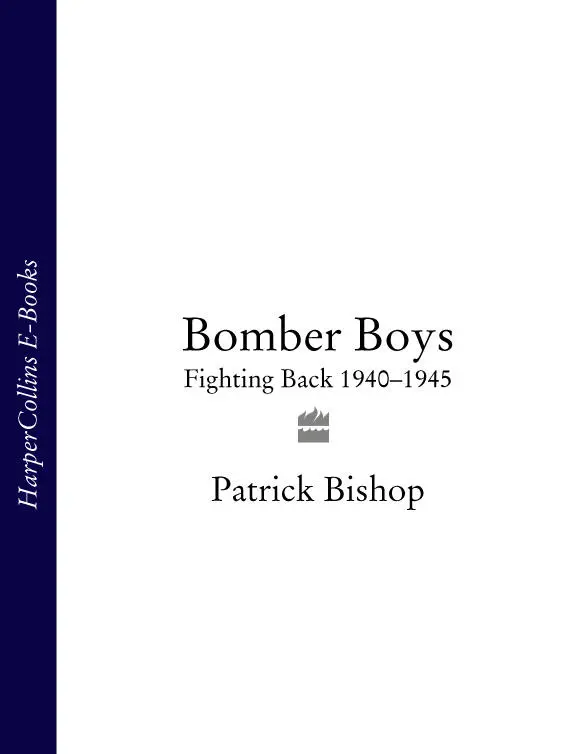
- Название:Bomber Boys
- Автор:
- Жанр:
- Год:неизвестен
- ISBN:978-0-00-728013-1
- Рейтинг книги:3 / 5. Голосов: 1
-
Избранное:Добавить в избранное
- Отзывы:
-
Ваша оценка:
Bomber Boys: краткое содержание, описание и аннотация
Предлагаем к чтению аннотацию, описание, краткое содержание или предисловие (зависит от того, что написал сам автор книги «Bomber Boys»). Если вы не нашли необходимую информацию о книге — напишите в комментариях, мы постараемся отыскать её.
Bomber Boys — читать онлайн ознакомительный отрывок
Ниже представлен текст книги, разбитый по страницам. Система сохранения места последней прочитанной страницы, позволяет с удобством читать онлайн бесплатно книгу «Bomber Boys», без необходимости каждый раз заново искать на чём Вы остановились. Поставьте закладку, и сможете в любой момент перейти на страницу, на которой закончили чтение.
Интервал:
Закладка:
These figures, if true, were shocking and at Bomber Command, Sir Richard Peirse and his senior officers tried to dispute them. Churchill, however, had been persuaded. He was in no mood then, to give a positive reception to another plan based on the unverifiable. His view was summed up in a pessimistic minute of 27 September that contradicted everything he had previously said as prime minister on the subject of bombing. ‘It is very disputable whether bombing by itself will be a decisive factor in the present war. On the contrary, all that we have learnt since the war shows that its effects, both physical and moral, are greatly exaggerated.’
These words caused great anxiety to Portal and his men. Churchill appeared to be saying that he had no confidence in their approach to the air war. Portal took several days thinking about his response. His reply, when it came, was robust. He told the prime minister that it was too soon to come to such a definite conclusion as a serious bombing campaign had yet to begin. It was difficult to believe that any country could withstand indefinitely the scale of attack contemplated in the new plan. German air raids in the previous year caused death or serious injury to 93,000 British civilians. This result had been achieved with a small fraction of the bomb load Bomber Command hoped to employ in 1943. He repeated what had now become an article of faith. ‘The consensus of informed opinion,’ he declared, ‘is that German morale is much more vulnerable to bombing than our own.’
Portal was calling Churchill’s bluff. The prime minister’s doubts had come very late in the day. The whole bomber programme, aircraft production, aircrew training and technical developments were based on the understanding articulated by the Chiefs of Staff back on 31 July that bombing on an unprecedented scale was the weapon Britain had to depend on to bring victory. He pointed out that if Churchill had ‘ceased to believe in the efficacy of the bomber as a war-winning weapon’ then a new plan would have to be produced. This would mean a complete reshaping of the RAF’s main effort and remove it from the battlefield for many months to come. Britain would be denied its only means of waging war on the enemy’s own territory.
Churchill had no real choice but to back down and he did so, but not before sounding a sour cautionary note. ‘I deprecate,’ he wrote on 7 October, ‘placing unbounded confidence in this means of attack and still more in expressing that confidence in terms of arithmetic.’ In the end, he concluded, ‘the only plan is to persevere’.
This period marked the lowest point in Bomber Command’s war, a demoralizing period of costly experimentation. In its short life, aerial warfare had gained enormous importance in the minds of politicians, soldiers and the public. But no one yet understood exactly what it was for. Defending the failures of the early years Slessor reminded a post-war audience that ‘this was the first air war (his emphasis.) … we had embarked upon it, not only with totally inadequate weapons and woefully incomplete intelligence about our enemy but with virtually no experience whatever to guide us.’ 9Operations had never achieved a consistent tempo as the emphasis shifted from target to target and even, as the Battle of the Atlantic broke out, from land to sea with squadrons being transferred temporarily or permanently to Coastal Command. Throughout the year preconceived expansion plans had to give way to the constant diversion of aircraft and crew to other theatres.
During 1941, 1,341 aircraft were lost on operations, meaning that the average first-line strength had been destroyed roughly two and a half times over. These great sacrifices failed to make any significant impression on Germany. The ports of Hamburg, Kiel and Bremen had suffered some damage, but the Ruhr, the heart of Germany’s war industry, remained almost completely intact. Bomber Command’s main achievement had been to give heart to the Blitz-battered British people. As it did so, its own morale was beginning to fray. In 106 Squadron, where Michael Wood was piloting a Hampden, ‘there was a story going around that the accounts related by one of our crews were suspect and did not tie up with the accounts of the target area put forward by the rest of the squadron. The CO became suspicious and arranged to plot the course of the aircraft in question. From the information gathered, it transpired that the aircraft was flying up and down the North Sea dropping their bombs in the drink and, after the necessary time lapse, flying back to base.’ Wood never verified the story. But the fact that it was doing the rounds was indicative of the low mood.
One pilot from 144 Squadron was court-martialled for a similar-sounding incident. Sergeant W, a married man with two young children who had been a grocer in civilian life before joining the RAF in 1938, was accused of ‘failing to use his utmost exertions’ to carry out orders. He had been detailed to attack Frankfurt on the night of 22/23 July 1941. On his return, he reported that the mission had been successful. A few days later, the navigator on the trip informed a senior officer that they had never reached Germany at all. The pilot maintained that the navigator, who had been borrowed for the operation, was incompetent and had failed to provide the correct headings to reach the target, resulting in them flying around the North Sea for nearly seven hours. The navigator maintained that the skipper was ‘windy’ and had never intended to carry out the attack. Sergeant W was backed up by three other members of his crew. He was an experienced pilot who had spent seven months on the squadron and whose conduct had until then satisfied his CO. Had he reported the failure to complete the mission it was unlikely that matters would have developed as drastically as they did. As it was, he told the court-martial, ‘after landing and thinking back over the trip, I decided to say nothing about getting lost. In consequence the personal experience report was made out as for a successful trip.’ The worst interpretation was put on his actions. He was found guilty and sentenced to be reduced to the ranks, imprisoned with hard labour for two years and discharged with ignominy from the service. The sentence was cut to six months on appeal. 10
For all the institutional belief in British resilience, no one in authority was going to tell anyone, civilian or airman, how little the campaign was really achieving. ‘Fortunately,’ wrote Slessor, ‘I think the crews were for the most part sustained by the belief that they were hitting the enemy harder than they actually were.’ 11
The futility of the effort was starkly revealed on the night of 7/8 November. The weather forecast was abysmal, with thick cloud, storms, ice and hail predicted. Sir Richard Peirse nonetheless ordered 392 aircraft, a record number, into attacks on Berlin, Cologne and Mannheim, as well as smaller operations against Boulogne and Ostend. The weather was particularly atrocious along the North Sea routes leading to Berlin. Of the 169 bombers sent to Berlin, less than half got anywhere near it. Those that did, barely scratched the city. The official survey reported damage to one industrial building, two railway premises, a gasometer, two administrative buildings, thirty houses (fourteen of which were destroyed), sixteen garden sheds and one farm building. Eleven people were killed and fourteen injured. Bomber Command however lost twenty-one aircraft, 12.4 per cent of those dispatched. Eighty-eight airmen died; eight for every German killed by their bombs. All together thirty-seven aircraft were lost, 9.7 per cent of the force. This loss was double what had been suffered in any previous night operation. Peirse had gone ahead despite protests, notably from Slessor who had been allowed to withdraw his 5 Group aircraft from the force and send them instead to Cologne. His refusal to cancel the operation seems to have been driven by a desperate desire to achieve results when faith in his leadership was dwindling. It was a gamble rather than a calculated risk and it was taken with the lives of men whose fate he held in trust.
Читать дальшеИнтервал:
Закладка:
Похожие книги на «Bomber Boys»
Представляем Вашему вниманию похожие книги на «Bomber Boys» списком для выбора. Мы отобрали схожую по названию и смыслу литературу в надежде предоставить читателям больше вариантов отыскать новые, интересные, ещё непрочитанные произведения.









Обсуждение, отзывы о книге «Bomber Boys» и просто собственные мнения читателей. Оставьте ваши комментарии, напишите, что Вы думаете о произведении, его смысле или главных героях. Укажите что конкретно понравилось, а что нет, и почему Вы так считаете.