Lucy Hughes-Hallett - The Pike - Gabriele d’Annunzio, Poet, Seducer and Preacher of War
Здесь есть возможность читать онлайн «Lucy Hughes-Hallett - The Pike - Gabriele d’Annunzio, Poet, Seducer and Preacher of War» — ознакомительный отрывок электронной книги совершенно бесплатно, а после прочтения отрывка купить полную версию. В некоторых случаях можно слушать аудио, скачать через торрент в формате fb2 и присутствует краткое содержание. Жанр: unrecognised, на английском языке. Описание произведения, (предисловие) а так же отзывы посетителей доступны на портале библиотеки ЛибКат.
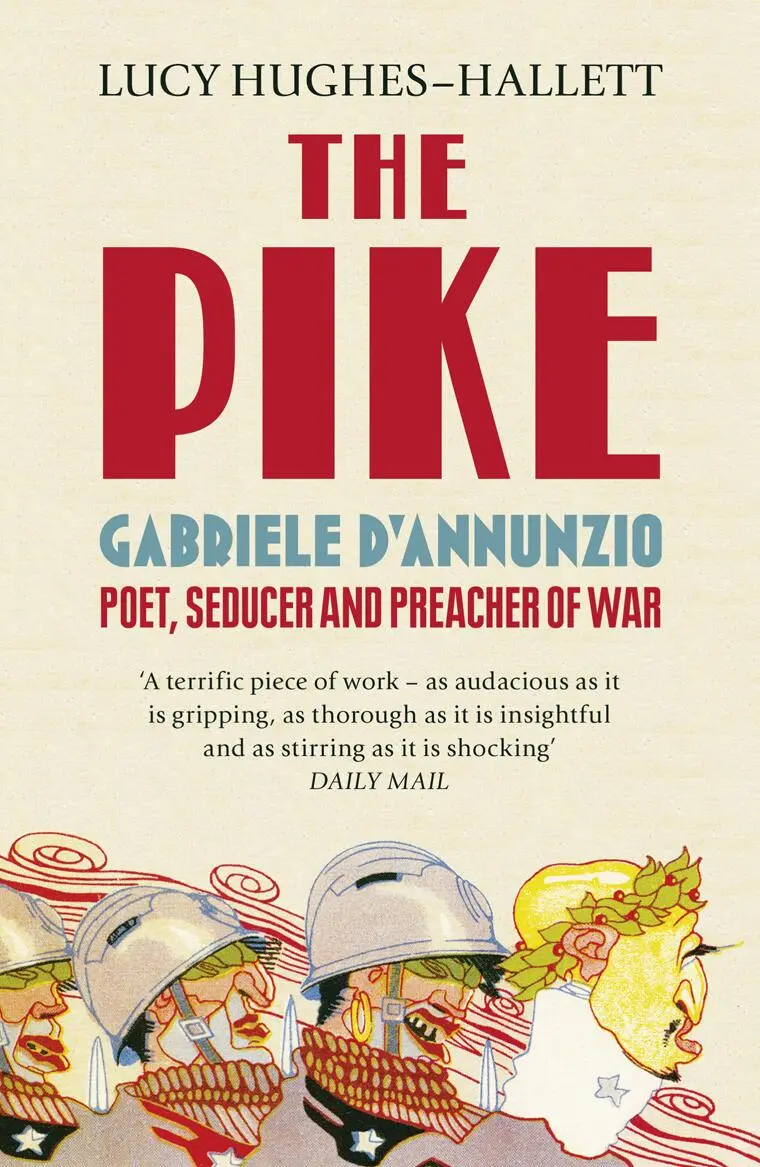
- Название:The Pike: Gabriele d’Annunzio, Poet, Seducer and Preacher of War
- Автор:
- Жанр:
- Год:неизвестен
- ISBN:нет данных
- Рейтинг книги:5 / 5. Голосов: 1
-
Избранное:Добавить в избранное
- Отзывы:
-
Ваша оценка:
The Pike: Gabriele d’Annunzio, Poet, Seducer and Preacher of War: краткое содержание, описание и аннотация
Предлагаем к чтению аннотацию, описание, краткое содержание или предисловие (зависит от того, что написал сам автор книги «The Pike: Gabriele d’Annunzio, Poet, Seducer and Preacher of War»). Если вы не нашли необходимую информацию о книге — напишите в комментариях, мы постараемся отыскать её.
The Pike: Gabriele d’Annunzio, Poet, Seducer and Preacher of War — читать онлайн ознакомительный отрывок
Ниже представлен текст книги, разбитый по страницам. Система сохранения места последней прочитанной страницы, позволяет с удобством читать онлайн бесплатно книгу «The Pike: Gabriele d’Annunzio, Poet, Seducer and Preacher of War», без необходимости каждый раз заново искать на чём Вы остановились. Поставьте закладку, и сможете в любой момент перейти на страницу, на которой закончили чтение.
Интервал:
Закладка:
When he was five or six years old, one of d’Annunzio’s sisters beckoned him aside and, opening her childish fist, showed him her treasure, an artificial pearl. At once he was seized by a craving for something similarly rounded and lustrous. There were swallows’ nests beneath the house’s eaves. He would steal an egg. He ran up to a top-floor room and out onto the narrow balcony, but he was too small to reach a nest. Going back indoors he found a bench and, struggling doggedly, dragged it out. Women at a window of the opposite house called out to him. He took no notice. He scrambled up onto the bench and thence onto the wrought-iron railing three storeys above the paved street below. Clinging to the slatted shutters, he groped upwards. The women called more loudly. Down in the street passers-by stopped. Shopkeepers came out to see what was going on, craning their heads upward. The little boy could hear a growing hubbub beneath him. He struggled to haul himself up, but his arms weren’t strong enough. Agitated swallows beat around his head.
Suddenly he was being gripped around the waist and dragged down. His parents were there, his mother trembling, his father pale and threatening to beat him. He was lifted back through the window and laid, faint and shaking, on a bed. In retrospect he saw them – mother, father, child – as a secular trinity. His aunts hung over him weeping, as the sorrowing Marys wept over the dead Christ. But the family’s communion was interrupted. The crowd now gathered in the street, believing the child to be dead, began on the chilling ululations customary at funerals. Gabriele’s father picked him up, and carried him, limp and white-faced, back out onto the balcony. The keening turned to shouts of joy.
Describing the incident in old age, d’Annunzio made of this, his first balcony appearance, a portent. He was marked out from childhood, so he asserted, for a public life. More pertinently, it demonstrates how religious imagery pervaded his imagination. One of his school reports describes him as ‘very unbelieving’. At sixteen he was enthusiastic about Paradise Lost and Byron’s Cain, both poems whose heroes defy God. He admired Darwin. He shocked his teachers (most of them priests) by ‘gross heresies’, suggesting that if the deity existed at all he was a ‘villain or an imbecile’ who has ‘created mankind to amuse himself by watching us suffer’. But, for all that, it came naturally to him to see himself as Christ, and his parents as Mary and Joseph. The public life of the people among whom he spent his childhood, their faith, their songs and prayers, their spells and festivals, became part of the furnishings of his mind.

GLORY
TOWARDS THE END OF EACH AFTERNOON, when d’Annunzio was a child in Pescara, the paranze, the Abruzzese fishing boats with their wide sails the colours of oranges, or saffron or terracotta, would appear at the mouth of the river. One day when he was nine years old, Gabriele ran down to the quay to greet them. He had a friend on one of the boats who used to bring him gifts of cockles. Having received his offering, he carried it off to a niche in the dilapidated ramparts of Pescara’s fort, settled himself astride a rusty old cannon and began forcing open the shells with his pocket knife. It was hard. The knife slipped. He cut himself badly. Blood poured over his hand and down the cannon. He began to feel dizzy. His handkerchief was too small to use as a tourniquet. He cut off a sleeve of his shirt to bind up the wound. At once the bandage was soaked with blood.
The place was lonely and night was coming on. A goat’s head appeared over the ancient wall above him, regarding him with its mad, devilish eyes. He remembered that the vaults of the old arsenal were infested with spiders and that the local women used their webs to staunch bleeding. Trembling now, he made his way into the dark and ruinous chambers, yelling to scare off the horrid scampering things, cut down a web with his knife, and wrapped it around his bloody hand before staggering home half-fainting.
When, in middle age, he wrote his account of this escapade, d’Annunzio placed it in a splendid setting of distant mountains and fiery-coloured clouds. He cherished the scar on his thumb as ‘the indelible sign of my innate difference’. The essay in which he described the incident is entitled ‘The First Sign of a High Destiny’.
The images and stories of heroes surrounded d’Annunzio as he grew up. The main salon in the d’Annunzio family’s house in Pescara is decorated with a painting of Aeneas. In the background, Troy burns. Aeneas, undismayed, looks stagily outwards to the future, as he sets off to fulfil the great destiny his father Anchises has foreseen for him. So d’Annunzio was to be launched out into the world to fulfil his father’s ambitions.
He was growing up in an heroic age for Italy. The Abruzzi had been a part of the Kingdom of the Two Sicilies, ruled through the middle years of the nineteenth century from Naples by a Bourbon monarchy. Three years before Gabriele’s birth, Garibaldi led his thousand volunteers to Sicily and drove the Bourbon troops, who outnumbered them twenty-six to one, off the island. The King was nervous and vacillating. His officers were hopelessly demoralised. As Garibaldi swept on up through Calabria to Naples, the armies of the teetering monarchy changed sides, or stripped off their uniforms and ran for home. In one of his stories d’Annunzio recreates the scene, which he must have heard repeatedly described, of the day when the fort at Pescara was evacuated and ‘the troops scattered, throwing their weapons and equipment into the river’.
King Victor Emmanuel of Savoy came south at the head of his army to annex the regions Garibaldi had conquered. Francesco Paolo d’Annunzio was one of the delegation who travelled to his camp at Ancona to invite him to bring his troops into Pescara. When they did so, the King himself (shortly to assume the title of King of All Italy) passed a night under the d’Annunzio family’s roof. In their small way the family had assisted in the making of the Italian nation state.
It was the first age of mass reproduction. Prints of Garibaldi and Victor Emmanuel adorned the walls of houses all over the peninsula, revered much as sacred paintings were revered. In d’Annunzio’s home they were juxtaposed with depictions of the exploits of classical heroes: it was as though the time for glorious deeds had come again. When Gabriele was seven years old the French withdrew their support for the Pope’s temporal power, and Victor Emmanuel’s troops marched into Rome. The state of Italy, independent and united, was complete. Years later d’Annunzio was to recall being wakened, after going to bed that September evening, by people parading though the streets with lighted torches, by raucous songs, fanfares of trumpets and cries of ‘Rome!’
When he was eleven, d’Annunzio was sent to a boarding school, the Royal College of the Cicognini at Prato, which was considered to be the finest in Italy. Francesco Paolo wanted him to be ‘Tuscanised’. The Tuscan dialect, the language of Dante and Machiavelli and Lorenzo the Magnificent, was to be the language of the new Italy’s elite.
The Cicognini is grand but grim. Behind its eighteenth-century façade lie long corridors, with vaulted ceilings and wrought-iron lanterns. There is a chapel and an elegant little theatre, but there is little to make a boy feel at home. Gabriele felt the misery of boarding-school children everywhere. In writing his recollections of his years there, he describes the college as his ‘prison’. He recalls the gloom with which he walked back through its ‘sad portal’ after the daily walk and the relief, on his few exeats, of escaping from its atmosphere of confinement and prohibition. He was not allowed back to Pescara, even for the long summer holidays, for four whole years.
Читать дальшеИнтервал:
Закладка:
Похожие книги на «The Pike: Gabriele d’Annunzio, Poet, Seducer and Preacher of War»
Представляем Вашему вниманию похожие книги на «The Pike: Gabriele d’Annunzio, Poet, Seducer and Preacher of War» списком для выбора. Мы отобрали схожую по названию и смыслу литературу в надежде предоставить читателям больше вариантов отыскать новые, интересные, ещё непрочитанные произведения.







Обсуждение, отзывы о книге «The Pike: Gabriele d’Annunzio, Poet, Seducer and Preacher of War» и просто собственные мнения читателей. Оставьте ваши комментарии, напишите, что Вы думаете о произведении, его смысле или главных героях. Укажите что конкретно понравилось, а что нет, и почему Вы так считаете.