Lucy Hughes-Hallett - The Pike - Gabriele d’Annunzio, Poet, Seducer and Preacher of War
Здесь есть возможность читать онлайн «Lucy Hughes-Hallett - The Pike - Gabriele d’Annunzio, Poet, Seducer and Preacher of War» — ознакомительный отрывок электронной книги совершенно бесплатно, а после прочтения отрывка купить полную версию. В некоторых случаях можно слушать аудио, скачать через торрент в формате fb2 и присутствует краткое содержание. Жанр: unrecognised, на английском языке. Описание произведения, (предисловие) а так же отзывы посетителей доступны на портале библиотеки ЛибКат.
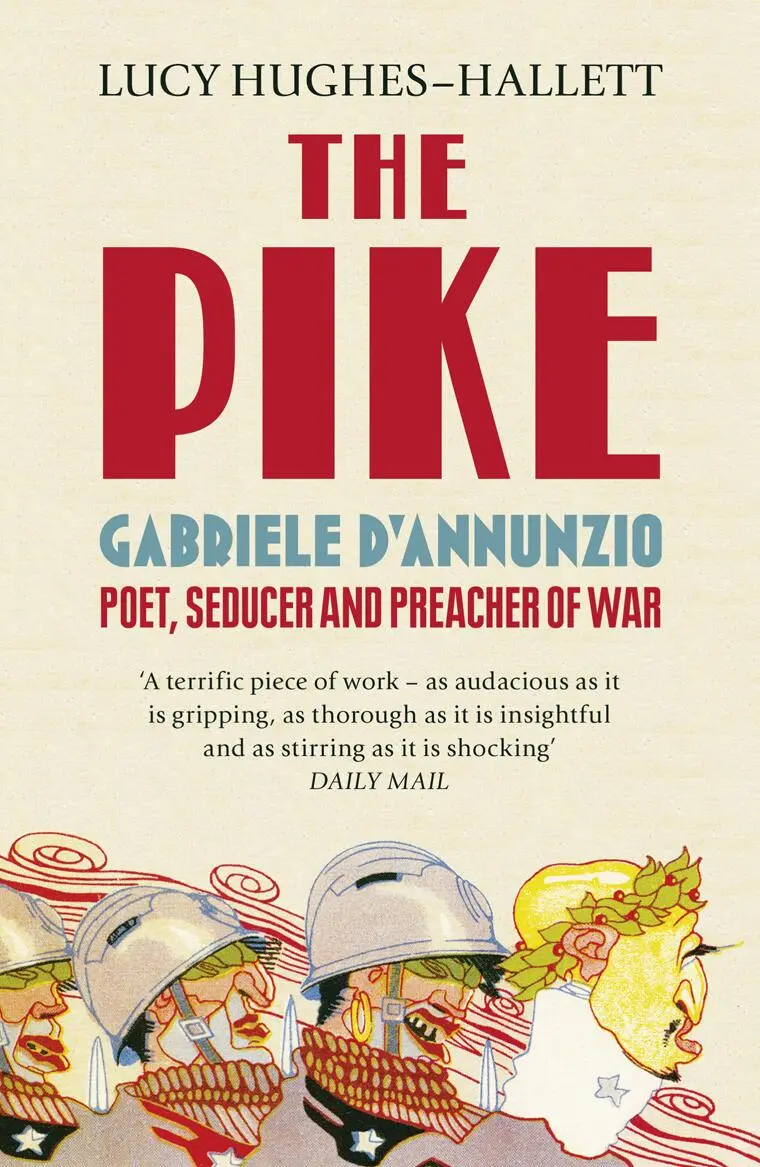
- Название:The Pike: Gabriele d’Annunzio, Poet, Seducer and Preacher of War
- Автор:
- Жанр:
- Год:неизвестен
- ISBN:нет данных
- Рейтинг книги:5 / 5. Голосов: 1
-
Избранное:Добавить в избранное
- Отзывы:
-
Ваша оценка:
The Pike: Gabriele d’Annunzio, Poet, Seducer and Preacher of War: краткое содержание, описание и аннотация
Предлагаем к чтению аннотацию, описание, краткое содержание или предисловие (зависит от того, что написал сам автор книги «The Pike: Gabriele d’Annunzio, Poet, Seducer and Preacher of War»). Если вы не нашли необходимую информацию о книге — напишите в комментариях, мы постараемся отыскать её.
The Pike: Gabriele d’Annunzio, Poet, Seducer and Preacher of War — читать онлайн ознакомительный отрывок
Ниже представлен текст книги, разбитый по страницам. Система сохранения места последней прочитанной страницы, позволяет с удобством читать онлайн бесплатно книгу «The Pike: Gabriele d’Annunzio, Poet, Seducer and Preacher of War», без необходимости каждый раз заново искать на чём Вы остановились. Поставьте закладку, и сможете в любой момент перейти на страницу, на которой закончили чтение.
Интервал:
Закладка:
There were swallows on the Capitol that day, a numerous flock of them squabbling noisily as they swooped around the green-bronze equestrian statue of Marcus Aurelius. We know it, because d’Annunzio made a note about them. Surrounded by an ecstatic crowd whose excitement he himself was orchestrating, he was yet sufficiently detached to observe birds and flowers (the masses of red carnations in the Teatro Costanzi on the night he spoke there) or the feel of a horse’s rump under his hand.
He was fast developing a brilliantly manipulative oratorical technique. He allowed his public no break in his contrivance of their hysteria. He played on them with rhetorical tricks borrowed from religious liturgy or from classical drama. ‘Hear me!’ he cried ‘Listen to me!’ ‘Understand me!’ The crowd was urged to join him, howling out responses to his insistent ‘Evvivas!’ These were not speeches to be rationally appraised but acts of collective self-hypnosis. D’Annunzio’s works as a dramatist had frequently been grandiose in conception, spectacular in their staging and appalling for the violence of their sentiments, but never before had he produced anything like the shows he put on during that ‘radiant May’.
He had found his métier. Romain Rolland, recoiling, likened him to Marat. He had become the figurehead of a mass movement. When he drove away from the Capitol, ‘dishevelled boys, their faces crazy, dripping with sweat as though after a fight’, threw themselves at the car, nearly lifting it off the ground. ‘The battle is won. The great bell has sounded. The whole sky is on fire. I am drunk with the joy of war.’
Quite how much political effect this extraordinary sequence of public demonstrations had is a matter of dispute. The Treaty of London had been ratified already, before d’Annunzio returned from France, but it is conceivable that without his intervention Salandra and his cabinet might have failed to carry the electorate (the majority of whom dreaded war) with them. But, whatever the extent of his actual influence, it certainly appeared to the public that d’Annunzio – a private individual without any constitutional authority – had imposed his will on the elected government, and that he was the man who had taken them to war. He had done it by directing a stream of virulent abuse against representatives of Italy’s democratic institutions, and by urging the crowds that gathered around him to begin what might have amounted to a civil war. If anyone in Rome in those frenzied days was an enemy of the state it was surely not Giolitti, but d’Annunzio himself.
Nietzsche defined the state as ‘a remorseless machine of oppression’, a ‘herd of blond beasts of prey’. D’Annunzio – who fancied himself (in some moods) to be a Nietzschean Übermensch (superman), unshackled by social conscience or civic duty – had no respect for the electorate, and no compunction about undermining the authority of democratic institutions. A decade later Mussolini would refer to the events of May 1915 as a ‘revolution’ and boast that in that glorious month the Italian people, incited by d’Annunzio ‘the first Duce’, had risen up against their corrupt and lily-livered rulers, clamouring for the right to prove their honour and gain glory, and that those rulers had ignominiously surrendered. The truth is otherwise. But the spectacle of a government apparently harangued into action by a demagogue with no respect for the rule of law was ominous for constitutional democracy.
Immediately after the fierce excitement of his appearance on the Capitol, d’Annunzio withdrew and walked, alone and quiet, on the Aventine Hill. The lovers in his novel Pleasure had ridden the same way, ‘with ever before their eyes the great vision of the imperial palaces set alight by the sunset, flame-red between the blackening cypresses, and through it drifting a golden dust’. So had d’Annunzio himself with Elvira Fraternali, the great love of his Roman years. He thought about her that evening (although he was to leave the letter she wrote him that month unanswered: he did not like to see what age did to women he had once doted on). He brooded over the five years of his ‘exile’ in France. To return to the city where he had made his name, and married, and several times fallen in love, and been young (he wrote that year that he would give anything, even Halcyon, his finest poem-sequence, to be twenty-seven years old again) moved him deeply. By the gate of the Priorato of Malta, with its famous view through a keyhole of the dome of St Peter’s, he saw what looked like a tiny star hovering at the level of his eyebrows. It was a glow-worm, the first he had seen since he left Italy in 1910.
In his notebook, in his letters, in his memoir Notturno, the glow-worm is accorded almost as much space as the preceding oration. D’Annunzio’s case has always puzzled those simple-minded enough to believe that artistic talent and refined sensibility are incompatible with political extremism and an appetite for violence. Only hours after he had been raving against his political opponents and urging a mob on to murder, he was strolling – pensive and nostalgic – through the jasmine-scented Roman night, his appreciation of Rome’s multi-layered beauty that of a man of deep erudition; his response to a minuscule natural wonder that of a poet.
On the day Italy declared war on Austria-Hungary, d’Annunzio dined with some of his supporters. Very late, as dawn was breaking, he spoke to them. This address makes a quiet, gravely ominous coda to the stridency of the public speeches. He looked forward to the ensuing carnage without compunction for his part in involving his country in it. He referred blasphemously to his days of non-stop oratory as ‘the Passion Week’. This was his night in the Garden of Gethsemane, the moment when he allowed himself and his hearers to feel the horror of what was to come. ‘All those people who yesterday were tumultuous in the streets and squares, who yesterday with a great voice demanded war, are full of veins, are full of blood.’ He had exulted in the idea of arriving at Quarto with a legion of sacrificial victims, ‘young blood to be spilt’. Now he looked forward to making the oblation of countless others’ lives to his ‘tenth muse, Energy’, who ‘loves not measured words but abundant blood’ and who was about to get her fill of it. He concluded with a muted prayer: ‘God grant that we find each other again, living or dead, in a place of light.’
Show over, d’Annunzio relaxed. In the summer of 1915, between his prodigious feats of oratory in May and his setting out for the front in July, he sank, according to his secretary Tom Antongini, into ‘the most abject state of frivolity’. He summoned Aélis from Paris to join him (Nathalie was pointedly not invited) and went, so Antongini tells us, ‘from a reception to a dinner and from an intimate tea to an even more intimate night’. As the forger of Italy’s new martial destiny he was the man of the hour: women found him less resistible than ever. D’Annunzio’s son Mario reports that a rich Argentinian lady took a room in the hotel expressly to be near him. (He accepted the flowers with which she presented him, but rejected their donor – ‘too thin,’ he said.) Isadora Duncan was there too, and perhaps more fortunate. His philandering did nothing to decrease his popularity with the public. His militancy added to his sexual allure; his sexual conquests enhanced his virile, iron-clad image.
He was not writing. Now he was a hero he was more marketable than ever, and the people he had hurried into war looked to him to compose their battle hymns. But no words came. ‘I have a horror of sedentary work,’ he wrote that summer. ‘Of the pen, of the ink, of paper, of all those things now become so futile. A feverish desire for action devours me.’
Читать дальшеИнтервал:
Закладка:
Похожие книги на «The Pike: Gabriele d’Annunzio, Poet, Seducer and Preacher of War»
Представляем Вашему вниманию похожие книги на «The Pike: Gabriele d’Annunzio, Poet, Seducer and Preacher of War» списком для выбора. Мы отобрали схожую по названию и смыслу литературу в надежде предоставить читателям больше вариантов отыскать новые, интересные, ещё непрочитанные произведения.






Обсуждение, отзывы о книге «The Pike: Gabriele d’Annunzio, Poet, Seducer and Preacher of War» и просто собственные мнения читателей. Оставьте ваши комментарии, напишите, что Вы думаете о произведении, его смысле или главных героях. Укажите что конкретно понравилось, а что нет, и почему Вы так считаете.