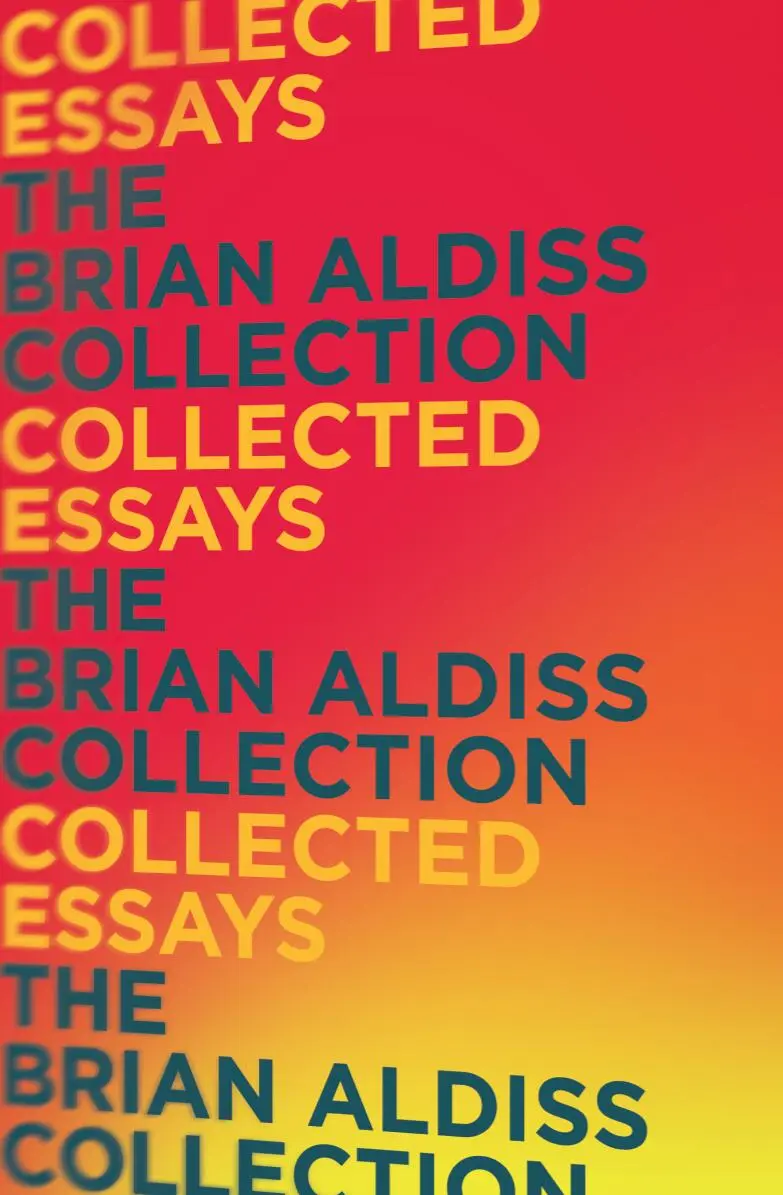
Brian Aldiss - Collected Essays
Здесь есть возможность читать онлайн «Brian Aldiss - Collected Essays» — ознакомительный отрывок электронной книги совершенно бесплатно, а после прочтения отрывка купить полную версию. В некоторых случаях можно слушать аудио, скачать через торрент в формате fb2 и присутствует краткое содержание. Жанр: unrecognised, на английском языке. Описание произведения, (предисловие) а так же отзывы посетителей доступны на портале библиотеки ЛибКат.
- Название:Collected Essays
- Автор:
- Жанр:
- Год:неизвестен
- ISBN:нет данных
- Рейтинг книги:3 / 5. Голосов: 1
-
Избранное:Добавить в избранное
- Отзывы:
-
Ваша оценка:
Collected Essays: краткое содержание, описание и аннотация
Предлагаем к чтению аннотацию, описание, краткое содержание или предисловие (зависит от того, что написал сам автор книги «Collected Essays»). Если вы не нашли необходимую информацию о книге — напишите в комментариях, мы постараемся отыскать её.
Collected Essays — читать онлайн ознакомительный отрывок
Ниже представлен текст книги, разбитый по страницам. Система сохранения места последней прочитанной страницы, позволяет с удобством читать онлайн бесплатно книгу «Collected Essays», без необходимости каждый раз заново искать на чём Вы остановились. Поставьте закладку, и сможете в любой момент перейти на страницу, на которой закончили чтение.
Интервал:
Закладка:
An audience is somehow raked up to attend the great event. The music recital is moderately successful. It includes works by ‘Dowland, Purcell, Sullivan, Elgar, the composer of “Ta-ra-ra-boom-de-ay’’, Noel Coward, Duke Ellington (taken to have been an English nobleman of some sort), Britten and John Lennon.’ But with Romeo and Juliet it is different.
Alexander has a drink at the Marshal Stalin in St John’s Street before attending the theatre. The play about the death of innocence—although it has been cut to an hour in order not to tax people’s patience too greatly—is a disaster. There is a near riot, the theatre is set on fire, and Alexander decides not to rescue the girl playing Juliet.
In scenes of ghastly comedy, Shakespeare’s island race rejects its old culture and religion when they are offered. It prefers to queue quietly for food—a typical meal being cabbage soup, belly of pork with boiled beets (since there’s now a third fresh-meat day in a week), and stewed windfalls. Or it will booze at the Marshall Grechko (to become The Jolly Englishman under the New Cultural Policy).
Once a culture ceases to be common coinage, it has gone forever. It is a grim warning, one which elevates the novel far above the jingoistic military warning, Be Prepared! Sadness rather than jingoism is the imprint of these pages.
Alternative histories and worlds represent curious byways of science fiction, seeming usually to have more affinity with history than science. Such is the case with the novels cited here. Often this is because their authors stand rather apart from the mainstream of science fiction. Such can be said of Robert Harris, for instance, author of Fatherland, in which Nazi Germany, having won World War II, is about to celebrate Hitler’s seventieth birthday.
The exceptions to this rule are, of course, Philip Dick and Harry Harrison, both life-long practitioners of the art. Amis is not an exception. Despite his life-long interest in SF, and his anthologies, his reputation lies elsewhere, as a major comic novelist. There is almost a sense in which alternative histories are prolonged pokerfaced jokes—as is the case with the classic Bring the Jubilee, by Ward Moore, in which an accident changes the history of the United States.
Like Ward Moore’s novel, Russian Hide-and-Seek presents us with military or militaristic situations. No joke is intended, just as its serious and unusual cultural theme is no cause for laughter.
Fittingly, the usual Amis humour is, in Russian Hide-and-Seek, suffused into a permeating irony. Detail is piled on disconcerting detail—each unexpected but just—like the young English woman girlishly longing to get to Moscow (an echo of Chekhov here), until the whole disastrous tapestry of a lost England hangs before us.
All that we value has been swept away. Culture is irrelevant. Nihilism prevails.
Those who know Amis, or perhaps have read only his Memoirs, will recognize his powers as an anecdotalist. One of his stories well illustrates the theme of his novels.
Amis was invited in the early 1980s to dine with the Prime Minister, together with other illuminati at 10 Downing Street. It happened to be the very day on which Hutchinson published Russian Hide-and-Seek, so Amis took along a copy of the novel, inscribed to Mrs Thatcher. She asked him what it was about.
Amis replied, ‘Well, in a way it’s about a future Britain under Russian occupation’. It was a typically modest Amis answer. And what was Margaret Thatcher’s response?
‘Huh! Can’t you do any better than that? Get yourself another crystal ball.’ As Amis says in his memoirs, an answer both unfair and unanswerable.
Now we know what those with power over us think about SF. They share an uninquiring ignorance of intellectual literary circles. And they know as much about culture as the occupying Russians.
WELLS AND THE LEOPARD LADY WELLS AND THE LEOPARD LADY Lecture delivered at the International Wells Symposium THE ADJECTIVES OF ERICH ZANN A Tale of Horror JEKYLL ONE HUMP OR TWO Lecture given at the IAFA Conference of the Fantastic KAFKA’S SISTER CAMPBELL’S SOUP SOME EARLY MEN IN THE MOON KALIYUGA, OR UTOPIA AT A BAD TIME Talk given at the Annual MENSA meeting in Cambridge UTOPIA: DREAM OR PIPE DREAM? THE ATHEIST’S TRAGEDY REVISITED THE PALE SHADOW OF SCIENCE Address to the British Association for the Advancement of Science DECADENCE AND DEVELOPMENT THE VEILED WORLD A Lecture given to the Oxford Psychotherapy Society A PERSONAL PARABOLA Speech delivered at the Natwest Fundación, Madrid Copyright
Lecture delivered at the International Wells Symposium Lecture delivered at the International Wells Symposium THE ADJECTIVES OF ERICH ZANN A Tale of Horror JEKYLL ONE HUMP OR TWO Lecture given at the IAFA Conference of the Fantastic KAFKA’S SISTER CAMPBELL’S SOUP SOME EARLY MEN IN THE MOON KALIYUGA, OR UTOPIA AT A BAD TIME Talk given at the Annual MENSA meeting in Cambridge UTOPIA: DREAM OR PIPE DREAM? THE ATHEIST’S TRAGEDY REVISITED THE PALE SHADOW OF SCIENCE Address to the British Association for the Advancement of Science DECADENCE AND DEVELOPMENT THE VEILED WORLD A Lecture given to the Oxford Psychotherapy Society A PERSONAL PARABOLA Speech delivered at the Natwest Fundación, Madrid Copyright
H. G. Wells’s Men Like Gods begins with Mr Barnstaple driving along what Wells calls ‘the Wonderful Road’, and entering Utopia. Barnstaple and his party meet with a leopard which is benevolently inclined. By this symbol, Wells shows us the nature of an earthly paradise; the lion lying down with the lamb, etc. Dante on his journey to the Inferno first meets a leopard as a sign of great mysterious change ahead.
Large cats, leopards, cheetahs, panthers, and other furry carnivores, play a fairly active role in the Wellsian pantheon, generally linked with Wells’s perennial impulse to escape from the mundane world. While presenting these carnivores as tame and amiable, he also depicts himself, as he often says, as a carnivore. This policy of reversal operates in many of his books, including one or two of the neglected ones I mean to discuss.
But the theme of my talk is really the strangest reversal of all: the fact that despite his enormous success, which it would be impossible for any author nowadays to rival, there was a part of Wells, and a vital part, which no amount of success could ever appease, and which he was continually trying to suffocate under more work.
If our opinion of Wells is to be revised, then it is first necessary to confront the Himalaya of Wells studies: that long career punctuated so conspicuously by the ascent of literary heights and the decline into political shallows. The Wells, in other words, with that marvellous sense of fun, the Great General of Dreamland, to use his own description, who became the hollow apostle of world order, who exchanged the cloak of imagination for the tin helmet of instruction—as the Chinese say. Wells was a dear and honest man; he would not mind, I hope, our looking into this puzzling question. For he has become, rather unexpectedly, not the great prophet whom earlier generations saw, but the brilliant if eccentric writer who—almost by his own decision—went off the gold standard.
Wells had a career problem. He rose from the unprivileged classes to a position of great privilege where he was free to travel round the world talking to Stalin and Franklin D. Roosevelt. This rise—this escape—one of Wells’s numerous wonderful escapes—challenged his early identification with ‘the little man’. The Food of the Gods (1903) is almost a parable of this dilemma. The novel starts on the side of the little men and ends up on the side of the big, the Gods. Such reversals manifest themselves in numerous ways in Wells’s life and thought.
Читать дальшеИнтервал:
Закладка:
Похожие книги на «Collected Essays»
Представляем Вашему вниманию похожие книги на «Collected Essays» списком для выбора. Мы отобрали схожую по названию и смыслу литературу в надежде предоставить читателям больше вариантов отыскать новые, интересные, ещё непрочитанные произведения.





Обсуждение, отзывы о книге «Collected Essays» и просто собственные мнения читателей. Оставьте ваши комментарии, напишите, что Вы думаете о произведении, его смысле или главных героях. Укажите что конкретно понравилось, а что нет, и почему Вы так считаете.