Brian Aldiss - Collected Essays
Здесь есть возможность читать онлайн «Brian Aldiss - Collected Essays» — ознакомительный отрывок электронной книги совершенно бесплатно, а после прочтения отрывка купить полную версию. В некоторых случаях можно слушать аудио, скачать через торрент в формате fb2 и присутствует краткое содержание. Жанр: unrecognised, на английском языке. Описание произведения, (предисловие) а так же отзывы посетителей доступны на портале библиотеки ЛибКат.
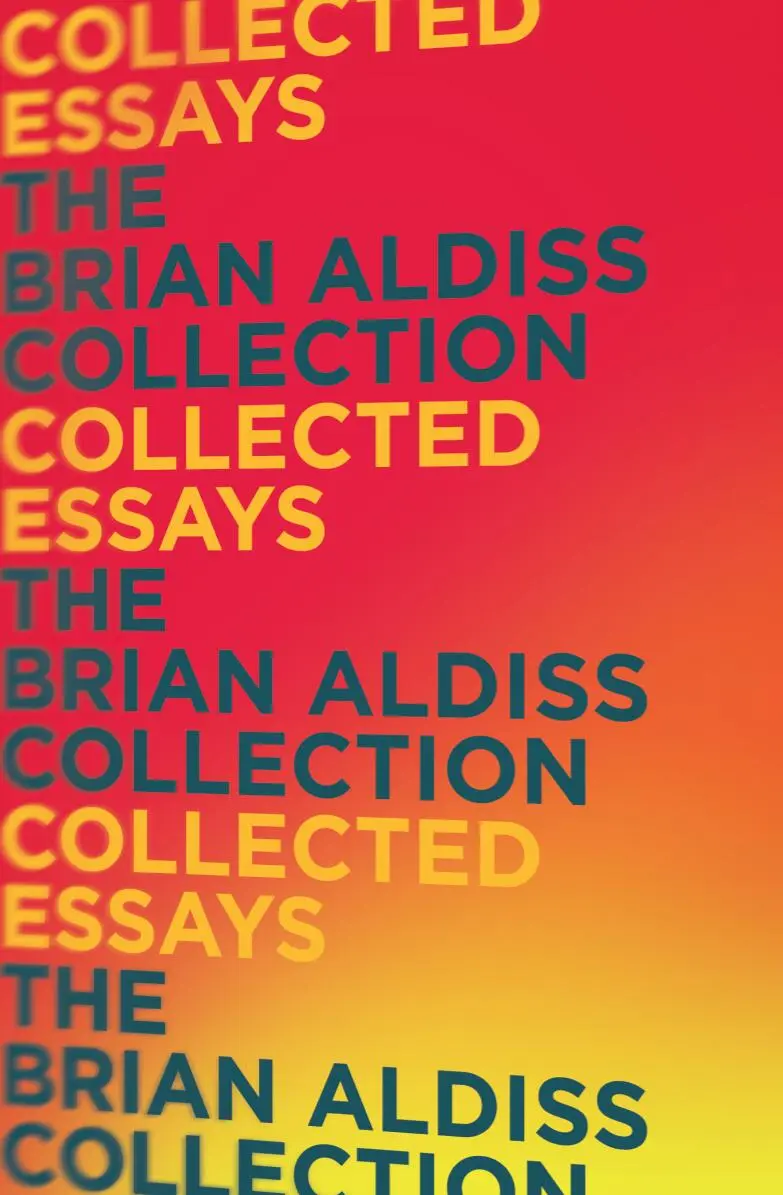
- Название:Collected Essays
- Автор:
- Жанр:
- Год:неизвестен
- ISBN:нет данных
- Рейтинг книги:3 / 5. Голосов: 1
-
Избранное:Добавить в избранное
- Отзывы:
-
Ваша оценка:
Collected Essays: краткое содержание, описание и аннотация
Предлагаем к чтению аннотацию, описание, краткое содержание или предисловие (зависит от того, что написал сам автор книги «Collected Essays»). Если вы не нашли необходимую информацию о книге — напишите в комментариях, мы постараемся отыскать её.
Collected Essays — читать онлайн ознакомительный отрывок
Ниже представлен текст книги, разбитый по страницам. Система сохранения места последней прочитанной страницы, позволяет с удобством читать онлайн бесплатно книгу «Collected Essays», без необходимости каждый раз заново искать на чём Вы остановились. Поставьте закладку, и сможете в любой момент перейти на страницу, на которой закончили чтение.
Интервал:
Закладка:
Humanities departments are under threat in times of recession, in a way that science departments—though themselves not without difficulties—are not. In self-defence, academics in humanities posts write their papers in a form of language which imitates the jargon of their colleagues in the harder sciences. The result is frequently an inviolable form of gobbledegook. An example of what I mean is taken almost randomly from a respected critical journal:
The most serious difficulty with the genre concept comes from the fact that the existence of a particular genre structure (variant) in a given epoch is usually accompanied by literary consciousness of writers, critics, and readers who recognize this structure as different from the synchronic structures of other genres. This intersubjective recognition, depending as it does on the general level of education and culture, on the familiarity of the reading public with traditional and modern literatures, and on the state of criticism in the epoch, is of course, often arbitrary.
While not entirely resisting attempts at divination, these two sentences seem to say little, and say it in an ugly way remote from the graces of our language as she is spoken. A defence mechanism is in operation. To speak plainly is to risk being taken for a fool. Difficulty must be seen to operate in the texts, or else there may be difficulty with grants in the future. SF criticism, being new, is particularly vulnerable to the administrative chopper.
Beneath the tortured language, what is said rarely carries malice. At least not openly. Our boat is still new and not properly tested: it must not be rocked. Thus criticism and its object have come full circle since the eighteenth century. Then, judgements were expressed with clarity and style, and were often designed to wound:
Cibber, write all your verses upon glasses;
So that we may not use them for our——.
1. One thinks here of the scene after Shelley’s death, when Trelawny caused his corpse to be burnt on the shore, Byron and Leigh Hunt also being present. At the last possible moment, Trelawny ran forward and snatched Shelley’s heart from the body.
2. Leonard Woolf, The Annotated Frankenstein, New York, Clarkson N. Potter Inc, 1977.
3. Julian Symons, Bloody Murder, London, Faber and Faber, 1972 (Harmondsworth, Penguin, 1974).
4. Christopher Small, Ariel Like a Harpy, London, Gollancz, 1972.
5. In Literary Women, London, W. H. Allen, 1972.
6. Muriel Spark, Child of Light: A Reassessment of Mary Wollstonecraft Shelley, Hadleigh Bridge, Essex, Tower Bridge Publications, 1951 (revised and published as Mary Shelley, London, Constable, 1988).
7. W. Warren Wagar, Terminal Visions, Bloomington, IN, Indiana University Press, 1982.
8. Percy G. Adams, Travel Literature and the Evolution of the Novel, Lexington, KY, University of Kentucky Press, 1984.
9. William Walling, Mary Shelley, Boston, MA, Twayne, 1972.
10. Mark Adlard, ‘A Labour of Love’, Foundation, 6.
11. Lester del Rey, The World of Science Fiction, New York, Garland Publishing, 1980.
12. An instance is ‘The story’, a scatty review of BYS in Robert Conquest’s The Abomination of Moab, London, Maurice Temple Smith, 1979.
13. Rosemary Jackson, Fantasy: The Literature of Subversion, London, Routledge Chapman and Hall, 1981 (Routledge paperback 1990).
14. Darko Suvin, The Metamorphoses of Science Fiction: On the Poetics and History of a Literary Genre, New Haven, CT, Yale University Press, 1979.
15. In Astounding: John W. Campbell Memorial Anthology, ed. Harry Harrison, New York, Random House, 1973
16. Leonard Woolf, ed., The Annotated Frankenstein, New York, Clarkson N. Potter Inc., 1977.
17. David Ketterer, Frankenstein’s Creation: The Book, The Monster, and Human Reality, Victoria, BC, University of Victoria, 1979.
18. David Ketterer, ‘Frankenstein in Wolf’s Clothing’, in Science Fiction Studies, 18, July 1979.
19. For an impressive and up-to-date confirmation of Mary Shelley’s interest in science, see the long introduction by Marilyn Butler to her edition of Frankenstein, The 1818 Text, London, Pickering and Chatto, 1993.
20. Studies by these three authors are: Christopher Small, Ariel Like a Harpy: Shelley, Mary and Frankenstein, London, Gollancz, 1972; William Veeder, Mary Shelley and Frankenstein: The Fate of Androgyny, Chicago, Chicago University Press, 1986; and Mary K. Patterson Thornburg, The Monster in the Mirror: Gender and the Sentimental/Gothic Myth in Frankenstein, Ann Arbor, MI, UMI Research Publications, 1987
21. Discussed in ‘Since the Enlightenment’, in Brian Aldiss, This World and Nearer Ones, London, Weidenfeld & Nicolson, 1979.
22. In Marshall Tymn, ed., The Science Fiction Reference Book, San Bernardino, CA, Borgo Press, 1981.
23. James Gunn, Alternate Worlds, Englewood Cliffs, NJ, Prentice Hall, 1975
24. James Gunn, The Road to Science Fiction, 4 volumes, New York, New English Library, Mentor, 1977-81.
25. Robert Scholes and Eric S. Rabkin, Science Fiction: History, Science, Vision, London, Oxford University Press, 1977.
26. New York, Bowker, 1976, Fourth Edition, 1995.
27. London, Orbit, Second Edition, 1993. Editors, John Clute & Peter Nicholls.
28. Samuel JR. Delany, ‘Reflections on Historical Models of Modem English Language Science Fiction’, Science Fiction Studies, Vol. 7, Pt. 2, July 1980, reprinted in Starboard Wine, 1984.
Bibliography
Betty T. Bennett, ed., The Letters of Mary Wollstonecraft Shelley, Baltimore, MD, Johns Hopkins Press, 3 vols, 1980–1988.
Betty T. Bennett & Charles E. Robinson, eds., The Mary Shelley Reader, Baltimore, MD, Johns Hopkins Press (Softshell Books), 1990.
Paula R. Feldman & Diana Scott-Kilvert, eds., The Journals of Mary Shelley 1814–1844, Oxford, Oxford University Press, 2 vols, 1987.
Robert Gittings & Jo Manton, Claire Clairmont and the Shelleys 1798–1879, Oxford, Oxford University Press, 1992.
George Levine & U. C. Knoepflmacher, eds., The Endurance of ‘Frankenstein’. Essays on Mary Shelley’s Novel, Berkeley, CA, University of California Press, 1979.
Charles E. Robinson, ed., Mary Shelley: Collected Tales and Stories, Baltimore, MD, Johns Hopkins Press (Softshell Books), 1990.
Mary Shelley, New Introduction by Brian Aldiss, The Last Man, London, The Hogarth Press, 1985.
William St Clair , The Godwins and the Shelleys . The Biography of a Family , New York, W. W. Norton and Co., 1989.
Mary Wollstonecraft, Letters Written during a Short Residence in Sweden , Norway and Denmark , Fontwell, Centaur Press, 1970. Or as A Short Residence in Sweden, Norway & Denmark , Harmondsworth, Penguin Classics, 1987.
Mary Wollstonecraft Shelley, edited with introduction and notes by Marilyn Butler, Frankenstein: or. The Modern Prometheus. The 1818 Text, London, William Pickering, 1993.
STURGEON: THE CRUELTY OF THE GODS STURGEON: THE CRUELTY OF THE GODS THE DOWNWARD JOURNEY Orwell’s 1984 PEEP CULTURE Is it Worth Losing Your Balls For? WELLS AND THE LEOPARD LADY Lecture delivered at the International Wells Symposium THE ADJECTIVES OF ERICH ZANN A Tale of Horror JEKYLL ONE HUMP OR TWO Lecture given at the IAFA Conference of the Fantastic KAFKA’S SISTER CAMPBELL’S SOUP SOME EARLY MEN IN THE MOON KALIYUGA, OR UTOPIA AT A BAD TIME Talk given at the Annual MENSA meeting in Cambridge UTOPIA: DREAM OR PIPE DREAM? THE ATHEIST’S TRAGEDY REVISITED THE PALE SHADOW OF SCIENCE Address to the British Association for the Advancement of Science DECADENCE AND DEVELOPMENT THE VEILED WORLD A Lecture given to the Oxford Psychotherapy Society A PERSONAL PARABOLA Speech delivered at the Natwest Fundación, Madrid Copyright
Интервал:
Закладка:
Похожие книги на «Collected Essays»
Представляем Вашему вниманию похожие книги на «Collected Essays» списком для выбора. Мы отобрали схожую по названию и смыслу литературу в надежде предоставить читателям больше вариантов отыскать новые, интересные, ещё непрочитанные произведения.

Обсуждение, отзывы о книге «Collected Essays» и просто собственные мнения читателей. Оставьте ваши комментарии, напишите, что Вы думаете о произведении, его смысле или главных героях. Укажите что конкретно понравилось, а что нет, и почему Вы так считаете.