Brian Aldiss - Collected Essays
Здесь есть возможность читать онлайн «Brian Aldiss - Collected Essays» — ознакомительный отрывок электронной книги совершенно бесплатно, а после прочтения отрывка купить полную версию. В некоторых случаях можно слушать аудио, скачать через торрент в формате fb2 и присутствует краткое содержание. Жанр: unrecognised, на английском языке. Описание произведения, (предисловие) а так же отзывы посетителей доступны на портале библиотеки ЛибКат.
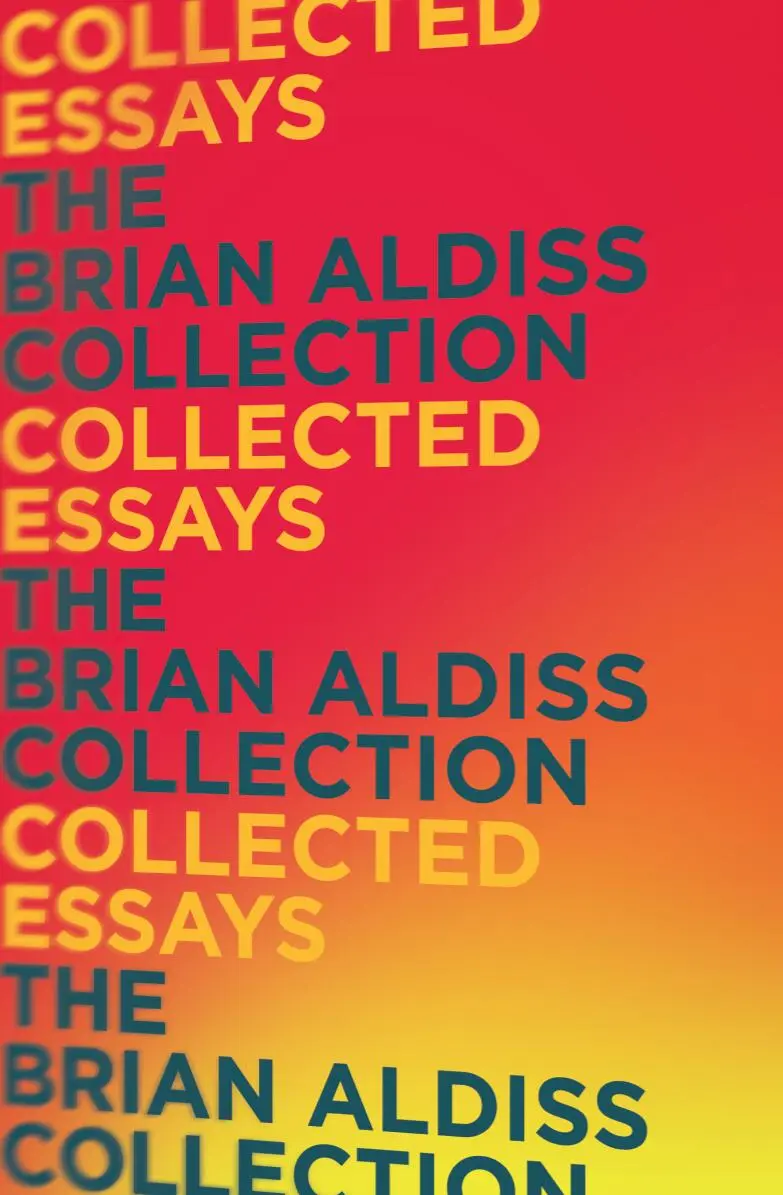
- Название:Collected Essays
- Автор:
- Жанр:
- Год:неизвестен
- ISBN:нет данных
- Рейтинг книги:3 / 5. Голосов: 1
-
Избранное:Добавить в избранное
- Отзывы:
-
Ваша оценка:
Collected Essays: краткое содержание, описание и аннотация
Предлагаем к чтению аннотацию, описание, краткое содержание или предисловие (зависит от того, что написал сам автор книги «Collected Essays»). Если вы не нашли необходимую информацию о книге — напишите в комментариях, мы постараемся отыскать её.
Collected Essays — читать онлайн ознакомительный отрывок
Ниже представлен текст книги, разбитый по страницам. Система сохранения места последней прочитанной страницы, позволяет с удобством читать онлайн бесплатно книгу «Collected Essays», без необходимости каждый раз заново искать на чём Вы остановились. Поставьте закладку, и сможете в любой момент перейти на страницу, на которой закончили чтение.
Интервал:
Закладка:
The 1970s yield two remarkable novels in which the protagonists strive for reality, in one case finding and in one case failing to find it: Flow My Tears, The Policeman Said and A Scanner Darkly. The ‘explanation’ of Flow My Tears, whereby a group of people move into transposed reality because of another person’s, Jason Taverner’s, failings, makes no scientific and even worse theological sense, though for all that it is a sombrely glittering novel, the real hero being a corrupt police chief who does not enter until half-way through the book. But A Scanner Darkly is all too terrifyingly plausible, on both scientific and theological grounds, with the terrible drug, Death, which splits the corpus callosum, rendering the victim dissociated from himself. This, it seems to me, is the grandest, darkest, of all Dick’s hells.
Dick at one time came to some kind of perilous treaty with various drugs, just as Anna Kavan did with heroin. Kavan never came off heroin; it was her doppelganger, her bright destroyer, killingly necessary to her. Dick’s renunciation of drugs brought forth the 1980s group of novels, again a trio, Valis, The Divine Invasion and The Transmigration of Timothy Archer. It’s too early to judge this group. The last novel is set in what for Dick is a curiously sunny Southern California, and opens on the day John Lennon is shot. It thrills with intimations of death—but when I said that to someone he replied, ‘What Dick novel doesn’t?’
I have to say, ungratefully, that I so vastly enjoyed Dick giving me bad news, opening up whole new cans of worms at every turn, that I become peevish when a can opens and angels come winging out. That the narrator of Timothy Archer is a lady called Angel hardly helps matters. Despite these reservations, it is a complex and interesting novel, fairly light and sunny in tone. It bears the hallmark of Dick, a hallmark discernible even in the minor novels, genuine grief that things are as bad as they are. That’s a rare quality in SF.
So Dick began as a smart imitator of van Vogt and ended up as a wizard. Most careers in the SF field flow the other way about. Maybe it’s the Hobart effect.
Dick said that it was not the possibilities of SF that appealed to him but the wild possibilities. Not just, ‘What would happen if …’ but ‘My God, what would happen if …’.
This is partly why we like him. But ultimately the affection he inspires is beyond analysis. He had a way of dramatizing his inner fears which made you laugh. His novels are full of gadgets, sentient hardware and awesome entities, but nevertheless they are inward novels. He constantly invents new means of doom and destruction, but nevertheless a sense of gusto bounces up from the page. In some peculiar sense he was a world-league novelist, yet he meekly burnt two mainstream novels when Don Wollheim told him they were no good. There’s the paradox. If it wasn’t for Don Wollheim at Ace, we’d possibly never have seen any Dick novels ever, and the universe would have been different. And our inner lives, ditto.
Dick’s first American readers appear only to have found Dick depressing. Was he too wild? Did they not dig his humour? Were there too many worms in his can? It was in Britain that he first found a more realistic and welcoming appraisal. Accustomed by national temperament to sailing through seas of bad news without turning a vibrissa, we appreciated Dick’s ingenuity, inventiveness, and metaphysical wit. We taught the Americans to see what a giant they had in their midst, just as they taught us to admire Tolkien. If we do admire Tolkien.
The tide has turned. Hollywood made an over-heated, over produced, and over immoral film from a lovely book, and called it by an old Alan Nourse title, Blade Runner. (Then there was Total Recall. The rebarbative Stanislaw Lem said that Dick fought trash with trash. It looks like trash could win!)
Meanwhile, the SF world rallies round, aware that some awful grey shagged-out thing on Mars has now got Dick by the short hairs. I’ve never liked the SF community more. A real spirit of affection is in evidence. Hence this meeting.
The SF newspaper, Locus, put out an excellent Dick memorial number just after he disappeared, with tributes and memories from many hands. Perhaps I may quote here a paragraph from what I said then, writing in New York:
Dick was never out of sight since his first appearances in those great glad early days of the fifties, when the cognoscenti among us scoured the magazines on the bookstalls for names that had suddenly acquired a talismanic quality: J. G. Ballard, William Tenn, Philip K. Dick. Now he’s gone, the old bear, the old sage and jester, the old destroyer, the sole writer among us who, in Pushkin’s mighty phrase, ‘laid waste the hearts of men’.
The above was written in 1982. Some of us knew Dick was a towering writer long before that date. We did not foresee that he would be canonized after death, that even his rejected non-SF would be published to acclaim. Looked at detachedly, the blossoming Dick industry has its sad side. A writer needs appreciation in his lifetime; praise goes unheard when you’re six feet under.
For the purposes of this volume, I hoped to update the above, but cannot see how. Dick is in a process of being deified. Total Recall (1990) was a brutal and unscientific mess of a movie, which certainly made it look as if trash had won. On the other hand, we have had some excellent productions of Dick material. These certainly include an elegant Selected Letters of Philip K. Dick 1974 (1991), edited by the energetic Paul Williams, who has done so much to tend Dick’s reputation, and Lawrence Sutin’s brilliant and truthful biography, Divine Invasions: A Life of Philip K. Dick, and, towards the rave end of the spectrum, In Pursuit of Valis: Selections from the ‘Exegesis’ (1991), edited by Lawrence Sutin.
Dick remains irreplaceable. One can name at least six of his novels which are startlingly good, witty and dark, in which even what is monstrous is treated with human sympathy: The Three Stigmata of Palmer Eldrich, Martian Time-Slip, The Man in the High Castle, A Scanner Darkly, Flow My Tears, The Policeman Said, and Valis. While they are interesting, the non-SF novels are thinner; Dick needed the bitter lemon of futurity in his potion.
With Martian Time-Slip in particular I have a rather long relationship. After protracted dealings, I secured for this beautiful complex novel its first hardcover edition. That was in 1976. In the same year, I was in contact with Stanley Kubrick, and suggested to him that Dick’s novel would make an excellent film. Nothing came of the suggestion.
In the 1980s, having founded the small company of Avernus Ltd with Frank Hatherley, I started negotiations with those at the top of Paramount UK for a movie. The heads were keen: then the heads started to roll. But I had opened protracted negotiations for an option on film and TV rights in the book. These I eventually bought. We’re talking now about the 1990s.
As a bit of agitprop, or agit-pop some might say, I wrote the imaginary conversation, Kindred Blood in Kensington Gore, which Avernus published as a pamplet in 1992. This represents Dick in the Afterlife. I have performed this surreal piece several times on stage, with two gallant actresses playing the multiple roles of Dick’s father, his sister, and VALIS itself. The ladies are Petronilla Whitfield in England and Colleen Ferro in the USA.
By this time, we had the TV Drama department of the BBC interested. More than interested, enthusiastic and involved, once they clearly understood this was not just a tacky length of sci-fi. Martian Time-Slip was to be a five-part mini-series produced with serious resources behind it. Given 250 minutes or so of air time, one can serve up more than one plot; characters and backgrounds get a chance to emerge. Not only were the BBC thoroughly behind it, but we managed to secure a considerable investment from Europe.
Читать дальшеИнтервал:
Закладка:
Похожие книги на «Collected Essays»
Представляем Вашему вниманию похожие книги на «Collected Essays» списком для выбора. Мы отобрали схожую по названию и смыслу литературу в надежде предоставить читателям больше вариантов отыскать новые, интересные, ещё непрочитанные произведения.







Обсуждение, отзывы о книге «Collected Essays» и просто собственные мнения читателей. Оставьте ваши комментарии, напишите, что Вы думаете о произведении, его смысле или главных героях. Укажите что конкретно понравилось, а что нет, и почему Вы так считаете.