Dr. Daniel - The Cancer Directory
Здесь есть возможность читать онлайн «Dr. Daniel - The Cancer Directory» — ознакомительный отрывок электронной книги совершенно бесплатно, а после прочтения отрывка купить полную версию. В некоторых случаях можно слушать аудио, скачать через торрент в формате fb2 и присутствует краткое содержание. Жанр: unrecognised, на английском языке. Описание произведения, (предисловие) а так же отзывы посетителей доступны на портале библиотеки ЛибКат.
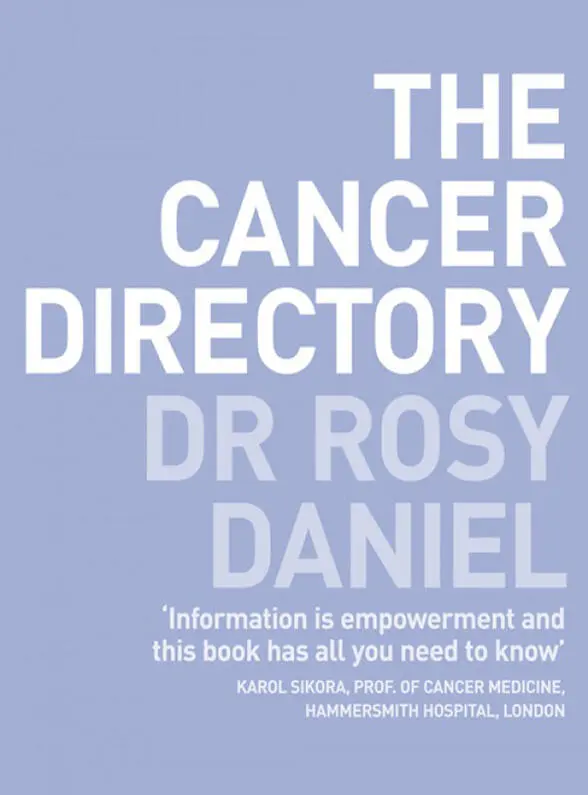
- Название:The Cancer Directory
- Автор:
- Жанр:
- Год:неизвестен
- ISBN:нет данных
- Рейтинг книги:3 / 5. Голосов: 1
-
Избранное:Добавить в избранное
- Отзывы:
-
Ваша оценка:
The Cancer Directory: краткое содержание, описание и аннотация
Предлагаем к чтению аннотацию, описание, краткое содержание или предисловие (зависит от того, что написал сам автор книги «The Cancer Directory»). Если вы не нашли необходимую информацию о книге — напишите в комментариях, мы постараемся отыскать её.
The Cancer Directory — читать онлайн ознакомительный отрывок
Ниже представлен текст книги, разбитый по страницам. Система сохранения места последней прочитанной страницы, позволяет с удобством читать онлайн бесплатно книгу «The Cancer Directory», без необходимости каждый раз заново искать на чём Вы остановились. Поставьте закладку, и сможете в любой момент перейти на страницу, на которой закончили чтение.
Интервал:
Закладка:
To get a clear picture of what you are dealing with, you need to find out:
• the typeof cancer you have or its histology
• the stageof the cancer or how far it has spread
• the gradeof the tumour or how aggressive it is
• the markersof your tumour by which the effectiveness of treatment or progress of the disease can be measured
• if the tumour is hormone-positive.
Once you have this information, you will then be armed, if you so choose, to go away and read about the cancer you have and discover the possible treatment options for your cancer type, stage and grade.
The exception is in the case of tumours of the blood cells. These are the leukaemias,in which there is no solid tumour because the cell that has grown out of control is one of the various types of white blood cells. The way this sort of tumour is diagnosed is by performing blood counts or looking at bone marrow. These tests might reveal that one cell type is growing very fast at the expense of other blood cells, the levels of which may be lower than normal. With leukaemias, classification is in terms of whether the illness is chronic(slow-growing) or acute(fast-growing).
Depending on how much information you wish to be given, you might ask your doctor for answers to some or all of the following questions:
IF YOU DO NOT WANT TO KNOW THE ANSWERS TO THESE QUESTIONS, TELL THE CONSULTANT AND GP WHAT YOU DO and DO NOT WANT TO KNOW.
• What type of primary cancer do I have (or what is the histology of the tumour)?
• How large is the primary site?
• Has it spread to the lymph nodes draining the site from which it has arisen?
• Has it spread elsewhere in the body, and what is its stage (1, 2, 3 or 4) (or how far has the tumour spread)?
• What is the ‘grade’ or degree of aggressiveness of the tumour?
• Are there other prognostic indications from the pathologist?
• Is the cancer hormone-receptor-positive? If so, to what hormones is the tumour sensitive?
• Are there any blood markers by which the growth or shrinkage of the tumour can be measured?
• To which parts of my body might this type of tumour spread?
• Would it be advisable for me to be screened thoroughly for secondary cancer?
• If secondary cancers were found on screening, how would this affect the choice of treatment I am being offered?
• In the case of leukaemia, is it acute or chronic?
• Left untreated, what is the usual course of events with this type of cancer?
• What is the prognosis (or average survival time) with this cancer if medically treated?
Finding out more about your cancer
When you have found out the type, stage and grade of your cancer from your consultant or GP, you may wish to gather more information before making any decisions about medical, complementary and alternative medicine approaches to treatment.
It is best to think a bit about how and where you should look before you embark on this process. Information about cancer is divided into two main categories – what has been written for people with cancer; and what has been written for doctors, nurses or other healthcare professionals.
In the former, the medical and scientific jargon will have been translated into plain English and (hopefully) it will have been written with consideration of your feelings. In contrast, the latter information will have been written for those with an understanding of science who only need to know the facts – and is likely to be very blunt.
It is important now that you do not become overwhelmed with information and, even more essential, that you do not become overly depressed by what you read. Your approach will therefore depend on your personality, and how much information you can take and in what form. A helpful source of information on cancer for those who have cancer is CancerBACUP. As well as a full range of informative leaflets about every type of cancer, they also have a nurse ‘phone-in’ service to answer your specific questions about your situation. For medical and scientific information, there is the Internet and medical libraries. However, people often complain that the Internet can lead to information overload, and that the information gleaned from medical libraries is often non-user friendly.
Other sources of information are the big cancer-research institutes such as:
• Cancer Research UK
• National Cancer Institute USA
• The American Cancer Society
• The Royal Marsden Hospital, London
• Memorial Sloane-Kettering Cancer Hospital, New York
• University of Texas MD Anderson Cancer Center, Houston.
Going to the Frontier with the Internet
Useful websites for more information about orthodox cancer medicine include:
www.cancerbacup.org.uk: The best UK information site on all aspects of cancer with good links to other sites
www.cancer.gov:The largest cancer website in the world, belonging to the US National Cancer Institute in Washington
www.oncolink.org:The excellent site of the University of Pennsylvania Cancer Center with good links to other US sites
www.oncology.com: The website of the American Society of Clinical Oncology, where treatment protocols and drugs are well explained
www.cancerhelp.org.uk:Smaller, manageable site from the University of Birmingham
www.cancerresearchuk.org.uk:Britain’s cancer research charities site
www.macmillan.org.uk:Site of the Macmillan Fund, with useful contacts especially for support groups and palliative care
www.cancereurope.com:The European School of Oncology site, with good links to other cancer sites in the EU.
Look in Chapter 4 for more cancer-treatment information, and in Part 2 of this Directory for useful websites and contact details of those offering helpful cancer information.
If you would like to speak to a doctor in more detail about your cancer, you may be able to get help from the pathology department of the hospital that diagnosed your tissue samples. Pathology departments have doctors called ‘pathologists’, whose job it is to understand the course that specific diseases tend to follow. Because pathologists do not see many patients, they usually have quite a lot of patience. You may find that one of these doctors is willing to come to the phone, if you ring the pathology department, and tell you in detail about the nature of your tumour and its likely behaviour in the future. Of course, it is possible that all this information will simply raise more questions than it answers, so it is perfectly appropriate that, having gathered your information, you go back to your consultant and/or GP to ask your next round of questions.
If you would like a broader integrated medicine perspective, this may also be the time to seek the advice and help of an integrated medicine doctor (see the Resources Directory).
Knowing when to stop
It is important to know when to stop with this process of seeking information about your cancer so that you do not become overly preoccupied with reading more and more about your condition. As soon as you feel satisfied that you have a reasonable grasp of the situation, it is time to move on to making your treatment decisions.
Understanding the medical approach to cancer
Once you know about your cancer and have assessed your situation and the level of risk, you can consider the treatment options.
Читать дальшеИнтервал:
Закладка:
Похожие книги на «The Cancer Directory»
Представляем Вашему вниманию похожие книги на «The Cancer Directory» списком для выбора. Мы отобрали схожую по названию и смыслу литературу в надежде предоставить читателям больше вариантов отыскать новые, интересные, ещё непрочитанные произведения.









Обсуждение, отзывы о книге «The Cancer Directory» и просто собственные мнения читателей. Оставьте ваши комментарии, напишите, что Вы думаете о произведении, его смысле или главных героях. Укажите что конкретно понравилось, а что нет, и почему Вы так считаете.