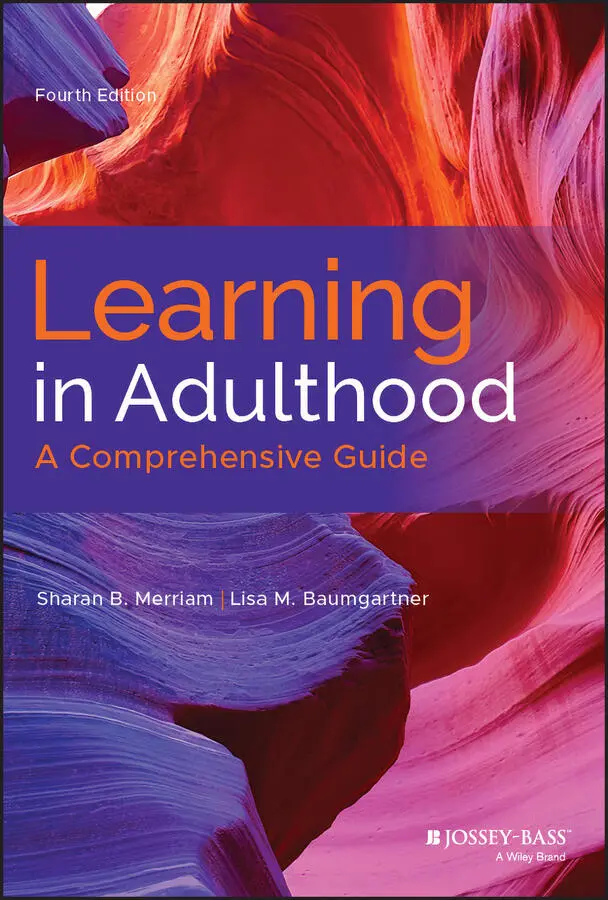
Sharan B. Merriam - Learning in Adulthood
Здесь есть возможность читать онлайн «Sharan B. Merriam - Learning in Adulthood» — ознакомительный отрывок электронной книги совершенно бесплатно, а после прочтения отрывка купить полную версию. В некоторых случаях можно слушать аудио, скачать через торрент в формате fb2 и присутствует краткое содержание. Жанр: unrecognised, на английском языке. Описание произведения, (предисловие) а так же отзывы посетителей доступны на портале библиотеки ЛибКат.
- Название:Learning in Adulthood
- Автор:
- Жанр:
- Год:неизвестен
- ISBN:нет данных
- Рейтинг книги:4 / 5. Голосов: 1
-
Избранное:Добавить в избранное
- Отзывы:
-
Ваша оценка:
Learning in Adulthood: краткое содержание, описание и аннотация
Предлагаем к чтению аннотацию, описание, краткое содержание или предисловие (зависит от того, что написал сам автор книги «Learning in Adulthood»). Если вы не нашли необходимую информацию о книге — напишите в комментариях, мы постараемся отыскать её.
has been the definitive guide in the field of adult education. Now in its fourth edition, this comprehensive volume is fully revised to reflect the latest developments in theory, research, and practice. The authors integrate foundational research and current knowledge to present fresh, original perspectives on teaching and learning in adulthood. Written by internationally-recognized experts, this market-leading guide draws from work in sociology, philosophy, critical social theory, psychology, and education to provide an inclusive overview of adult learning.
Designed primarily for educators of adults, this book is accessible for readers new to adult education, yet suitably rigorous for those more familiar with the subject. Content is organized into four practical parts, covering topics such as the social context of adult learning, self-directed and transformational learning, postmodern and feminist perspectives, cognitive development in adulthood, and more. Offering the most comprehensive single-volume treatment of adult learning available, this landmark text:
Offers a wide-ranging perspective on adult learning Synthesizes the latest thinking and work in the field Includes coverage of the sociocultural perspectives of adult learning Explores the broader social implications of adult education
is an indispensable resource for educators and administrators involved in teaching adults, as well as faculty and students in graduate programs in adult education.
Learning in Adulthood — читать онлайн ознакомительный отрывок
Ниже представлен текст книги, разбитый по страницам. Система сохранения места последней прочитанной страницы, позволяет с удобством читать онлайн бесплатно книгу «Learning in Adulthood», без необходимости каждый раз заново искать на чём Вы остановились. Поставьте закладку, и сможете в любой момент перейти на страницу, на которой закончили чтение.
Интервал:
Закладка:
In addition to the creation and elimination of jobs, technological changes are affecting workers in other ways, such as where work is done. We check our e-mails and take calls on our commutes prior to arriving at the office, use videoconferencing instead of traveling, and virtual assistants are increasingly part of our workday to help us remember appointments, take notes, or launch video meetings (Barker, 2018). Working remotely or working from home has become increasingly popular. Approximately 3.9 million Americans report working from home at least half of the week, which is a 115% increase since 2005 (Guta, 2019). The average telecommuter is 46 years old, almost equally likely to be a man as a woman, and has at least a bachelor's degree (Guta, 2019).
Yet others have cautioned against the unquestioning adoption of technology in the workplace, for information technologies have created something of a paradox. Designed to get work done more efficiently by fewer employees, information technologies have instead offered more ways to communicate, increased the demand for information, and raised the level of expectations regarding the print and graphic presentation of material. Think of the volume of mail one now handles through e-mail; this technology seems to have increased our workload and expectations of timely responses.
Technology's pros and cons are also evident in life beyond work. Respondents to a Pew Research survey noted that advantages of the living in the information age include having knowledge at your fingertips to live a better life in addition to having access to an array of services at the click of a mouse (Anderson & Rainie, 2018). Those who see the digital world as potentially dangerous to our well-being cite information overload as resulting in stress, anxiety, and depression. They state this information overload can negatively affect individuals' analytical thinking and memory (Anderson & Rainie, 2018).
Clearly, technology and the information age that it spawned are changing the nature of adult learning. Professionals' knowledge becomes outdated in a few years. Older adults must learn new ways to communicate with their grandchildren whether it be via FaceTime, texting, or through a virtual assistant such as Alexa. We must be able to function in a fast-changing society, and this necessitates continued learning. Technology is not only making learning mandatory, it is providing many of the mechanisms for it to occur. Learners can teleconference, attain information through an intelligent tutoring system that presents materials based on learner responses, or receive training through virtual worlds that ask learners to participate in a scenario via computer (Quinn, 2015). For example, those in counseling courses may pick an avatar and take the role of a counselor or client in a computer-simulated counseling session.
Simultaneous with the development of technologically sophisticated delivery systems is the development of new roles for educators and trainers. Although the “digital divide” has referred to those who can and cannot access technology, it can also refer to those who cannot use technologies effectively (Wei & Hindman, 2011). With smartphone use growing, more individuals can access the Internet, but possessing digital literacy skills such as knowing how to effectively search for and evaluate information or send effective e-mails, texts, and video images is also necessary in the twenty-first century (Rosen & Vanek, 2017).
A Pew Research team surveyed 2,752 Americans age 18 or older in all 50 states and the District of Columbia to uncover their “digital readiness” for personal learning (Horrigan, 2016, p. 7). Digital readiness included individuals' self-reported skills at using technology, including their familiarity with technology terms such as MOOCs, distance learning, or digital badges. Researchers assessed learners' trust of technology with survey questions such as: “I find it difficult to know whether information I find online is trustworthy” (p. 9). Respondents needed to indicate whether these statements described them “very well,” “somewhat well,” “not too well,” or “not at all well” (p. 9). A last indicator of readiness was how much respondents used technology. There were five groups along the spectrum of digital readiness. “The Unprepared” comprised 14% of respondents and were more likely to be women age 50 and older who came from lower income households and possessed lower levels of education. They do not adopt technology very readily, and “need help setting up tech devices and are not familiar with ‘ed tech’ terms” (p. 3). They were not confident about their computers skills or their ability to judge online information as trustworthy. Five percent of respondents were classified as “traditional learners” (p. 3). They were more likely to be women, minorities, and have lower levels of education and income. They are active learners, but they don't use the Internet to pursue learning and have concerns about their ability to judge online information. “The Reluctant” made up 33% of respondents and were more likely to be men age 50 and older who had lower incomes and education. “The Reluctant” had higher digital skills than those who were “Unprepared,” but they did not know new educational technology terms and did not use the Internet for learning. Group four, the “Cautious Clickers,” owned more technology and had higher levels of confidence in their ability to separate truth from fiction on the Internet (p. 3). They were not as familiar with online learning and technology terms as the “Digitally Ready.” They came from higher income households and typically had some college experience and were in their 30s and 40s. The “Digitally Ready,” 17%, loved to learn for personal enrichment and were very confident about their online skills and knew the most about online learning resources (Horrigan, 2016).
Part of becoming “Digitally Ready” is the ability to evaluate information online, and critical thinking skills are necessary. Critical thinking “involves people using a systematic approach to evaluate information, develop viable solutions, and test them as they seek to solve many different types of structured and ill-structured problems” (King, 2017, p. 115). The elements of critical thinking include “generating purposes, raising questions, using information, using concepts, making inferences, making assumptions, generating implications and embodying a point of view” (King, 2017, p. 115). To evaluate information, we need to examine its “clarity, accuracy, precision, relevance, depth, breadth, logic, and fairness” (Elder & Paul, 2010, as cited in King, 2017, p. 115).
Technology is here to stay and teachers may need to learn new ways of interacting with students in an online or hybrid learning environment. Consulting with an instructional design specialist or attending professional development workshops on effectively integrating distance learning tools may be necessary for some instructors while others may pick these skills up on their own. Some higher education institutions offer distance education certificates for faculty. Course topics may include how to design an online course, best practices in facilitating an online course, exploring online learning communities, learning assessment tools, and copyright issues (Online Learning Consortium, 2018).
In other areas, such as adult basic skills education, ABE educators face challenges in using technology. These challenges are more evident in ABE than other areas of education due to persistent underfunding (Rosen & Vanek, 2017). Educators need “professional development, coaching, and technical assistance” to integrate technology into their classrooms and they need to know how to “evaluate hardware and software” that can be used in the classroom (p. 56). Although both the Arizona Department of Education's Adult Education Services and the Adult Education and Literacy Department of the Texas Workforce Commission provide a wide range of professional development programs, including webinars and self-paced learning for ABE instructors, these types of opportunities are needed nationwide (Rosen & Vanek, 2017). Unfortunately, federal funding has not increased for ABE, and most state funding has not increased either, so the integration of technology into ABE is a challenge (Rosen & Vanek, 2017).
Читать дальшеИнтервал:
Закладка:
Похожие книги на «Learning in Adulthood»
Представляем Вашему вниманию похожие книги на «Learning in Adulthood» списком для выбора. Мы отобрали схожую по названию и смыслу литературу в надежде предоставить читателям больше вариантов отыскать новые, интересные, ещё непрочитанные произведения.












Обсуждение, отзывы о книге «Learning in Adulthood» и просто собственные мнения читателей. Оставьте ваши комментарии, напишите, что Вы думаете о произведении, его смысле или главных героях. Укажите что конкретно понравилось, а что нет, и почему Вы так считаете.