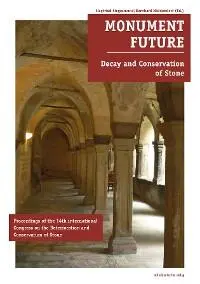
Siegfried Siegesmund - Monument Future
Здесь есть возможность читать онлайн «Siegfried Siegesmund - Monument Future» — ознакомительный отрывок электронной книги совершенно бесплатно, а после прочтения отрывка купить полную версию. В некоторых случаях можно слушать аудио, скачать через торрент в формате fb2 и присутствует краткое содержание. Жанр: unrecognised, на немецком языке. Описание произведения, (предисловие) а так же отзывы посетителей доступны на портале библиотеки ЛибКат.
- Название:Monument Future
- Автор:
- Жанр:
- Год:неизвестен
- ISBN:нет данных
- Рейтинг книги:4 / 5. Голосов: 1
-
Избранное:Добавить в избранное
- Отзывы:
-
Ваша оценка:
Monument Future: краткое содержание, описание и аннотация
Предлагаем к чтению аннотацию, описание, краткое содержание или предисловие (зависит от того, что написал сам автор книги «Monument Future»). Если вы не нашли необходимую информацию о книге — напишите в комментариях, мы постараемся отыскать её.
Alle vier Jahre treffen sich auf einer internationalen Tagung Experten, die sich mit den entsprechenden Sachfragen beschäftigen. Der „14th International Congress on the Deterioration and Conservation of Stone“ findet im September 2020 in Göttingen statt. Er ist die wichtigste Veranstaltung zur Verbreitung des Wissens von Praktikern und Forschern, die im Bereich der Steinkonservierung zur Erhaltung des baulichen Kulturerbes arbeiten: Geowissenschaftler, Architekten, Bauspezialisten, Ingenieure, Restauratoren, Denkmalpfleger und Bauherren.
Der Tagungsband mit über 150 wissenschaftlichen Beiträgen repräsentiert und erfasst den neuesten Stand der Technik auf diesem Gebiet.
Themen sind:
– Charakterisierung von Schadensphänomenen von Steinen und verwandten Baumaterialien (Stuck, Putz, Mörtel usw.)
– Methoden zur Untersuchung des Steinverfalls in situ und zerstörungsfreie Prüfung
– Langzeitüberwachung von Steindenkmälern und Gebäuden
– Simulation und Modellierung des Zerfalls
– Technologien und Entwicklung verbesserter Bearbeitung und Verwendung von Stein in Neubauten
– Bewertung der Langzeitwirkung von Bearbeitungstechniken
– Auswirkungen des Klimawandels auf die Steinverwitterung des Kulturerbes
– Berichte zur Steinkonservierung: Fallstudien und Projekte
– Digitalisierung und Dokumentation von Steinkonservierung
–
The 14th International Congress on the Deterioration and Conservation of Stone, entitled MONUMENT FUTURE: DECAY AND CONSERVATION OF STONE is a quadrennial event that brings together a world-wide community of geoscientists, architects, building specialists, engineers, conservators, restorators, monument curators and building owners who are concerned about the conservation of cultural stone structures and objects. Since antiquity, the weathering and deterioration of historical buildings, masonry, monuments, sculptures etc. using natural stones has been a very well-known problem.
This conference is the main gathering for the dissemination of knowledge in the field of stone deterioration issues. It represents and captures the state-of-the-art in the field of stone conservation and cultural heritage conservation with regards to the following topics:
– Characterisation of damage phenomena of stone and related building materials (plaster, rendering, mortar etc.)
– Methods for the investigation of stone decay; in-situ and non-destructive testing
– Long-term monitoring of stone monuments and buildings
– Simulation and modelling of decay
– Technology and development of improved treatments and use of stone in new buildings
– Assessment of long-term effects of treatments
– Impact of climate change on stone decay of Cultural Heritage
– Reports about stone conservation: case studies and projects
– Digitalization and documentation in stone conservation
Monument Future — читать онлайн ознакомительный отрывок
Ниже представлен текст книги, разбитый по страницам. Система сохранения места последней прочитанной страницы, позволяет с удобством читать онлайн бесплатно книгу «Monument Future», без необходимости каждый раз заново искать на чём Вы остановились. Поставьте закладку, и сможете в любой момент перейти на страницу, на которой закончили чтение.
Интервал:
Закладка:
Verde Alpi
Metamorpihc rock (ophicalcite). Colour: dark green colour with several light green elements and a large grid of white calcitic veins. Minerals: serpentine, calcite and magnetite. Decay morphologies: roughening, chromatic alteration. Geology: “Unità Ofiolitiche dello Chenaillet” (Jurassic). Quarry: near Cesana Torinese in the valle di Susa, near the French border (Torino province). Use: mainly polished slabs for flooring (Casa Wassermann).
Other ophicalcites (Verde Champ de Praz, Verde Issorie), with similar texture and composition and quarried in the eastern part of Valle d’Aosta (Chatillon), were also largely employed for flooring in the 20th century architecture.
Rosso di Lèvanto
Metamorphic rock (ophicalcite). Colour: dark red ground with very irregular white calcitic veins (a variety shows a dark green ground instead of red). Minerals: serpentine, calcite. Decay morphologies: roughening, chromatic alteration. Geology: “Ofioliti liguri”, a group including serpentinite, serpentinized peridotite, gabbro euphotide, diabase and ophicalcite (Upper Jurassic – Lower Cretaceous). Quarry: spread along the coast of Eastern Liguria (Lévanto, Bonassola etc. La Spezia province). Use: mainly polished slabs for cladding, moulded elements were also employed as jambs and lintel in portals and doors (Palazzo di Giustizia, flooring).
Verde Roja
Metamorphic rock (clayey schist, easily divisible into slabs). Colour: green with darker silicate veins. Minerals: quartz, mica, chlorite. 45Decay morphologies: scaling. Geology: “Scisti gneiss-sici” formation (Permian). Quarry: upper valley of the river Roja (Colle di Tenda) a former Italian territory assigned to France (dép. Alpes Maritimes) after the WWII. Use: mainly unpolished slabs for cladding or flooring (Casa Fiocchi, cladding, M. Fiocchi 1925 and Stazione Centrale, flooring together with other coloured stones, Milan).
Marmo di Valle Strona
Regional metamorphic rock (marble, coarse grain-size). Colour: grey with darker veins. Minerals: calcite, muscovite. Decay morpho-logies: disaggregation, sulphate skin formation. Geology: lenses in the “Dioritico-kinzigitica” formation of the “Ivrea-Verbano Zone”, spread from Valle Strona (Piedmont) to Canton Ticino (Switzerland). Quarry: near the village of Sambughetto (valle Strona, Verbano province). Use: mainly polished slabs for cladding (Palazzo di Giustizia, façades totally coated with this marble). It is worth to note the use of this marble in Naples, very far from the quarry site: Palazzo delle Poste (cladding of the curved façade, G. Vaccaro 1936); Banco di Napoli (cladding of the main hall, M. Piacentini 1940).
Marmo di Lasa
Regional metamorphic rock (marble, medium to fine grain-size). Colour: white with bands of various colours (grey to black due to graphite; green to chlorite; pink to zoisite); sometimes groups of little elongate black spots with shaded rims are present and an appropriate cut may produce a particular graphic effect (called Fantastico). Minerals: calcite; graphite, chlorite and zoisite. Decay morphologies: surface erosion, sulphate skin formation. Geology: Laas Unit (micaschist, banded paragneiss and marble) of Ortles-Campo Nappe, Austro-Alpine System (Pre-Permian metamorphic Basement). Quarry: above the village of Lasa-Laas (val Venosta-Vinschgau, Bolzano-Bozen province), the most important one (Weisswasser) was located at an altitude of 1,600 metres and the marble came down the hill using a incline railway. Use: mainly polished slabs for cladding; in some cases, the slabs are disposed in “open book style” (Casa Rustici, G. Terragni 1935, Milan; Torre Rasini, E. Lancia and G. Ponti 1934, Milan).
Fior di pesco carnico
Low grade metamorphosed crystalline limestone (marble, fine grain-size). Colour: light grey ground sometimes with pinkish or purplish spots and coarse grained veins. Mineral: calcite, opaque. Decay morphologies: surface erosion, sulphate skin formation. Geology: limestone of organic origin (Devonian) of the “Paleozoico carnico”. Quarry: near Pierabec, north of Forni Avoltri (Udine province). Use: mainly polished slabs for cladding (Palazzo della Provincia, atrium, G. Muzio 1942, Milan). Other building stones, coming from the same area in the north-western corner of this province, were also used in the 20th century architecture (Rosso Porfirico, upper Jurassic of Verzegnis or Persichino, upper Devonian of Timau).
Calacata and Cipollino
Regional metamorphic rock (calcite marble, very fine grain-size). Different varieties of marble are distinguished, mainly for colour and arrangement of the veins. Colour: white ground with gold-yellowish irregular veins (Calacata), green or white ground with undulating bands of light to dark green (Cipollino). Mineral: calcite. Decay morphologies: disaggregation, cracking, sulphate skin formation. Geology: “Autoctono toscano metamorfico” made of different epimetamorphic formations from Carboniferous to Paleogene; in particular these marbles are referred to “Cipollini” (lower Cretaceous – Oligocene). Quarry: different sites of Apuanian Alps according to the varieties. Calacata: Carrara district; Cipollino: Versilia – Lucca province, Cardoso and Arni districts.
Use: mainly polished slabs for façade cladding (Cipollino: former Palazzo della Montecatini, G. Ponti and A. Fornaroli 1936, Milan) of for interior cladding and for flooring (Calacata: Casa Wassermann).
Conclusion
The increase of the use of natural stones and marbles in the Thirties of 20th century, after two decades 46of “artificial stone”, was led by architects of the milanese school (Lancia, Muzio, Ponti, Portaluppi etc.). The use of natural stone was in agreement with the policy focused to improve the utilization of products of the Italian territory; this policy brought the opening of new quarries, but also brought the exploitation of ancient ones using up-to-date methods. The architects mainly paid attention to employ each stone for a specific purpose (cladding, floor, upright structural member, decoration etc.) according to its features (origin, mineralogy, texture, workability, resistance). The combined use of different stones in a single building was the obvious consequence of this option. In addition, the orientation of the cut of veined or brecciated blocks was accurately chosen in order to obtain slabs where the disposition of veins and colours was improved. Finally, in some cases, the stone elements were designed and manufactured to be exactly set only in one particular position of the whole building.
References
Biondelli D., Bugini R., Folli L., Saltari V. 2004a. I materiali del liberty a Milano. In: Biscontin G, Driussi G (eds) Architettura e materiali del Novecento. Arcadia, pp 27–36.
Biondelli D., Bugini R., Folli L., Saltari V. 2004b. I materiali di Piero Portaluppi. In: Biscontin G, Driussi G (eds.) Architettura e materiali del Novecento. Arcadia, pp 37–48.
Gramigna G., Mazza S. 2001. Milano – Un secolo di architettura milanese. Hoepli, p. 597.
Grandi M., Pracchi A. 1980. Milano – Guida all’architettura moderna. Zanichelli, p. 421.
ISPRA Istituto Superiore Protezione e Ricerca Ambientale 2012. Cartografia Geologica d’Italia scala 1:50000. http://www.ispra.it.
ISPRA Istituto Superiore Protezione e Ricerca Ambientale 1976. Cartografia Geologica d’Italia scala 1:100000. http://www.ispra.it.
Peverelli G. (ed.) 1939. Atti Convegno Nazionale presso Mostra Autarchica del Minerale Italiano. Il marmo, p. 127.
Читать дальшеИнтервал:
Закладка:
Похожие книги на «Monument Future»
Представляем Вашему вниманию похожие книги на «Monument Future» списком для выбора. Мы отобрали схожую по названию и смыслу литературу в надежде предоставить читателям больше вариантов отыскать новые, интересные, ещё непрочитанные произведения.








Обсуждение, отзывы о книге «Monument Future» и просто собственные мнения читателей. Оставьте ваши комментарии, напишите, что Вы думаете о произведении, его смысле или главных героях. Укажите что конкретно понравилось, а что нет, и почему Вы так считаете.