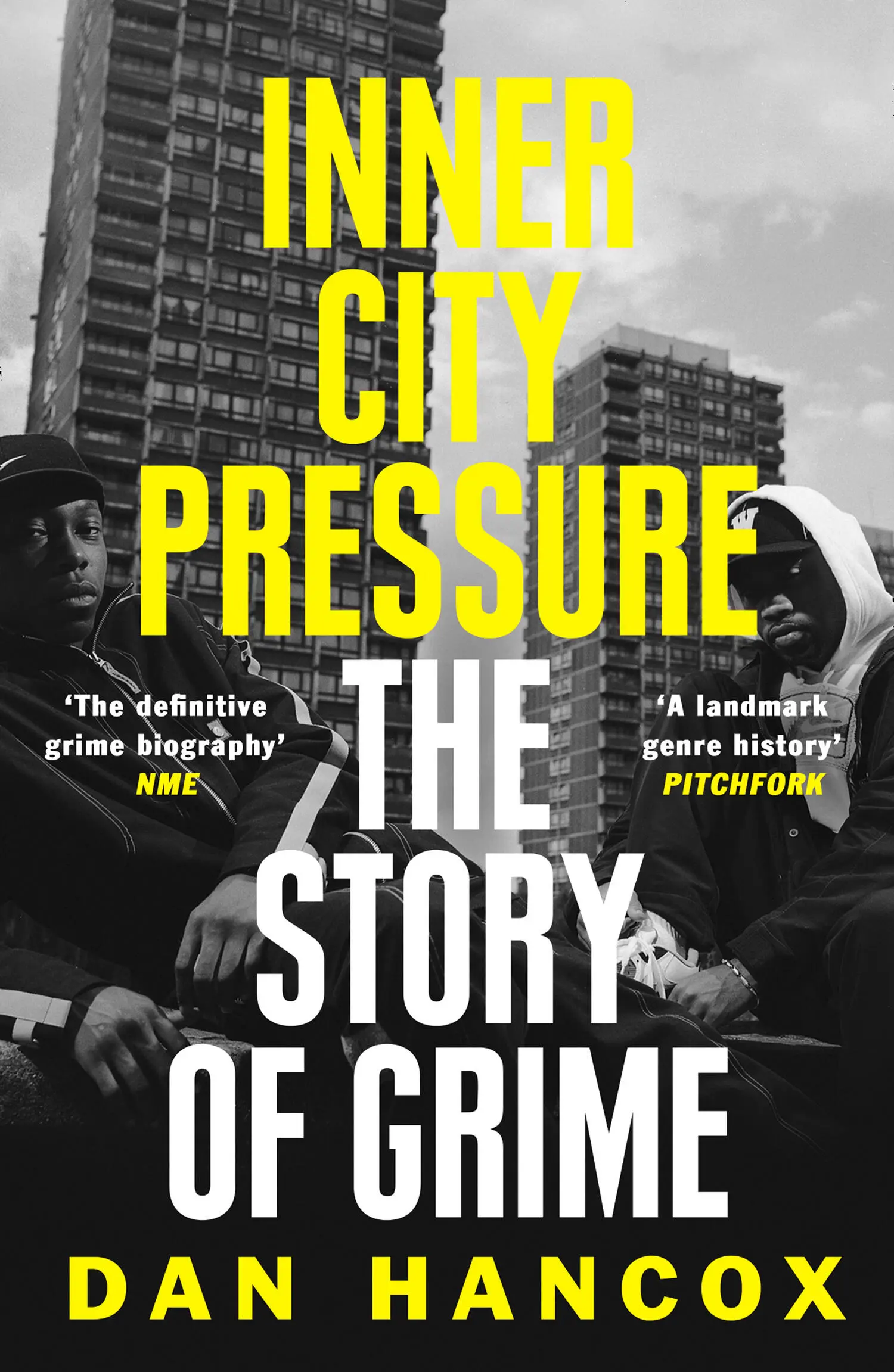
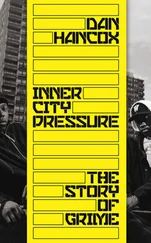
Dan Hancox - Inner City Pressure
Здесь есть возможность читать онлайн «Dan Hancox - Inner City Pressure» — ознакомительный отрывок электронной книги совершенно бесплатно, а после прочтения отрывка купить полную версию. В некоторых случаях можно слушать аудио, скачать через торрент в формате fb2 и присутствует краткое содержание. Жанр: unrecognised, на английском языке. Описание произведения, (предисловие) а так же отзывы посетителей доступны на портале библиотеки ЛибКат.
- Название:Inner City Pressure
- Автор:
- Жанр:
- Год:неизвестен
- ISBN:нет данных
- Рейтинг книги:5 / 5. Голосов: 1
-
Избранное:Добавить в избранное
- Отзывы:
-
Ваша оценка:
Inner City Pressure: краткое содержание, описание и аннотация
Предлагаем к чтению аннотацию, описание, краткое содержание или предисловие (зависит от того, что написал сам автор книги «Inner City Pressure»). Если вы не нашли необходимую информацию о книге — напишите в комментариях, мы постараемся отыскать её.
Inner City Pressure — читать онлайн ознакомительный отрывок
Ниже представлен текст книги, разбитый по страницам. Система сохранения места последней прочитанной страницы, позволяет с удобством читать онлайн бесплатно книгу «Inner City Pressure», без необходимости каждый раз заново искать на чём Вы остановились. Поставьте закладку, и сможете в любой момент перейти на страницу, на которой закончили чтение.
Интервал:
Закладка:
‘What’s different? Our accents, our lifestyle, our culture. When we was in America we’d say “Where are you from?” and they’d say “America”. But over here if someone said where are you from you might say “Jamaica”, or “Africa” or something else – maybe “British” and adding something else. We bring different cultures to our music, and different slang, a different way of doing things. And there’s different-sounding beats: in their clubs there’s a lot of just hip-hop, in our clubs you’ll have house, dance, Afrobeats, bashment, you’ve got a blend of styles.’
Jungle was the teenage apprenticeship for the pioneers of grime. They snuck into the raves while still underage just to hear it, persuaded mums and dads to let them go with older brothers or sisters, obsessed about it on pirate radio (usually Hackney’s Kool FM, the leading jungle station), made tapes in their bedrooms and swapped them at school and college, and through that shared community forged friendships that would last into the end of the nineties, to the evolution of 2-step garage and later their own sound. The family tree is robust enough that many of grime’s first wave of MCs started out in music spitting over jungle – it was their first experiences in writing rhymes, performing in a dance. D Double E started out MCing at jungle raves aged only 14. Wiley did too, and Riko Dan. There are recordings now on YouTube of the three of them spitting at jungle’s frenetic tempo – these items themselves a beautiful low-fidelity chronology of the last 20 years of technology and urban music: an illegal and unofficial pirate-radio broadcast, recorded onto a tape cassette, stored in an attic somewhere presumably, and then years later linked up via a cable to a computer, the audio converted to mp3, then uploaded to YouTube. Many of the personnel playing jungle at house parties, raves and on radio in SS (Silver Storm) Crew – the likes of Wiley, Maxwell D and Target – would go on to form seminal garage-into-grime crew Pay As U Go Cartel.
I remember listening to a Ruff Sqwad show on Rinse FM a few years later, in 2005, in which, for the first hour and 45 minutes of their two-hour set, they followed their usual formula: DJ Scholar beginning with a few US R&B and hip-hop (vocal) tracks, followed by half an hour of the biggest grime vocal tracks of the day, and then around the hour mark, switching to brand new grime dubplates and instrumentals, for the gathered MCs to spit their bars over. And then, for the final 15 minutes, the MCs, still only around the age of 20, MCs who would have been about ten when jungle was in its prime, switched up the pace for a final, hectic flurry of junglist ske-be-de-bi spitting. The overwhelming sensation you get from listening to them passing the mic to have a go is just sheer, infectious joy, as they fall about laughing.
The affection most of grime’s foundational figures have for jungle, then and now, is something to behold. Grime may have come directly from UK garage, and have mutated from it, but its creators speak of jungle like a first love, or a first high, an experience that will be refined, but in some wistful sense, never bettered. ‘Jungle,’ Wiley sighed fondly, when I interviewed him for the fifth time, in 2016. ‘That’s my favourite. You know jungle, it’s the only genre that didn’t get exploited? Because the people weren’t dumb – they just didn’t care! A few went to labels, got money, and realised, “You know what? Majors are a waste of time – I was earning more money on the white label.” They learned that trick, very early. But then it wasn’t an MC-led thing, from the point of the business. It is in the rave, but when it came to the records it wasn’t MC-led; it was more producer-controlled. So that’s why they wasn’t gassed [carried away].’ The implication is that the purity and community of the underground scene were never sullied by the ego of MCs-turned-superstars – never capitalised on unduly by the suits from the industry, or the biggest names from the scene.
For Skepta, his musical youth had been primarily ‘reggae in abundance’ – the likes of Barrington Levy, Gregory Isaacs and Half Pint – and that was followed by an instinctive and deep-rooted sense of connection, or ownership, to the frenetic ragga jungle playing out of cars and pirate radio stations in nineties Tottenham. ‘When I first heard jungle, I understood it immediately,’ he recalled in 2015, as we sat parked in his car in Palmers Green, his eyes glazing over with stoned awe. ‘To make something this bless sound this hype was just sick. I think it resonated with me because of the reggae basslines, but also because I’m British and I’m around dancey music – in Europe our ears are set towards like, high synthy sounds and fast speeds. We’re accustomed to that.’
It’s not a controversial point that deep in its spirit, jungle is grime’s true antecedent. Its aesthetics – a hard, scowling, dark side that is counterpointed by ludic, transcendent expressions of joy – were essential to the mutation of UK garage as it became grime. ‘Coming from jungle, you’re always going to be a little more into the darker stuff,’ recalled Troy ‘A Plus’ Miller, describing the garage days as a kind of stylistic interregnum. ‘Even though you like the light and the happy – you and your crew out in a rave, all the girls are here, we’re all having a nice time – you’re still going to lean towards things that are a bit darker.’
A Plus’s friend and founder of Rinse FM, Geeneus, is unequivocal about the power of that junglist passion; that passion would lead them to a collective mistake that would help change the course of British music. He told a podcast in 2016 about the influential UK garage instrumental ‘Cape Fear’, a welcome (re)turn to the dark side, which the Pay As U Go MCs could spit over with the speed and aggression of jungle lyricism. It wasn’t the way things were done in UK garage. ‘I was the last person to get involved in [UK garage], because I loved jungle so much,’ he recalled. ‘We started getting involved in it, but we was bringing along what we learned from jungle into the garage. But we got it completely wrong. And because we got it completely wrong, we ended up with grime. We thought we was making garage: getting garage beats like Cape Fear, and putting MCs on them, and they were spitting their heart out.’ On other occasions, to fit the Bow boys’ lingering passion for super-fast jungle with the contemporary 140bpm sound of 2-step, Slimzee would play Mampi Swift’s jungle track ‘Jaws’ at the wrong speed, at 33 instead of 45rpm, and the MCs would spit on it.
They had, Geeneus continued, ‘railroaded’ the UK garage scene ‘into something completely different. Where they’re bubbling along having a nice time in the party, looking nice, we’ve come in with tracksuits on, spitting lyrics everywhere, MCs everywhere, me and Slimzee just DJing for the MCs really.’11
As summaries of UK garage go, ‘bubbling along having a nice time in the party’ is pretty spot-on. The subject matter of the tunes – love, sex and relationships – narrated in smooth, soulful vocals from an even balance of male and female singers, reflected a much more grown-up, stylish swagger and refinement than had been seen in the wild days of British rave music previously, from acid house through jungle and drum ’n’ bass. It was as if, with the nineties drawing to a close, rave itself was moving beyond adolescent zeal and striving for a kind of adulthood. Garage as a form did not begin in the UK, but the US, and as Simon Reynolds records in Energy Flash , to begin with, in the mid-nineties, garage in the UK had ‘slavishly’ followed US production style. Then the junglists ‘entered the fray’, and created a ‘distinctly British hybrid strain that merged house’s slinky panache with jungle’s rude-bwoy exuberance’. The UK underground brought that edge, even as it was swapping a tracksuit for smart shoes and an ironed shirt.
Читать дальшеИнтервал:
Закладка:
Похожие книги на «Inner City Pressure»
Представляем Вашему вниманию похожие книги на «Inner City Pressure» списком для выбора. Мы отобрали схожую по названию и смыслу литературу в надежде предоставить читателям больше вариантов отыскать новые, интересные, ещё непрочитанные произведения.






Обсуждение, отзывы о книге «Inner City Pressure» и просто собственные мнения читателей. Оставьте ваши комментарии, напишите, что Вы думаете о произведении, его смысле или главных героях. Укажите что конкретно понравилось, а что нет, и почему Вы так считаете.