Lucy Mayblin - Migration Studies and Colonialism
Здесь есть возможность читать онлайн «Lucy Mayblin - Migration Studies and Colonialism» — ознакомительный отрывок электронной книги совершенно бесплатно, а после прочтения отрывка купить полную версию. В некоторых случаях можно слушать аудио, скачать через торрент в формате fb2 и присутствует краткое содержание. Жанр: unrecognised, на английском языке. Описание произведения, (предисловие) а так же отзывы посетителей доступны на портале библиотеки ЛибКат.
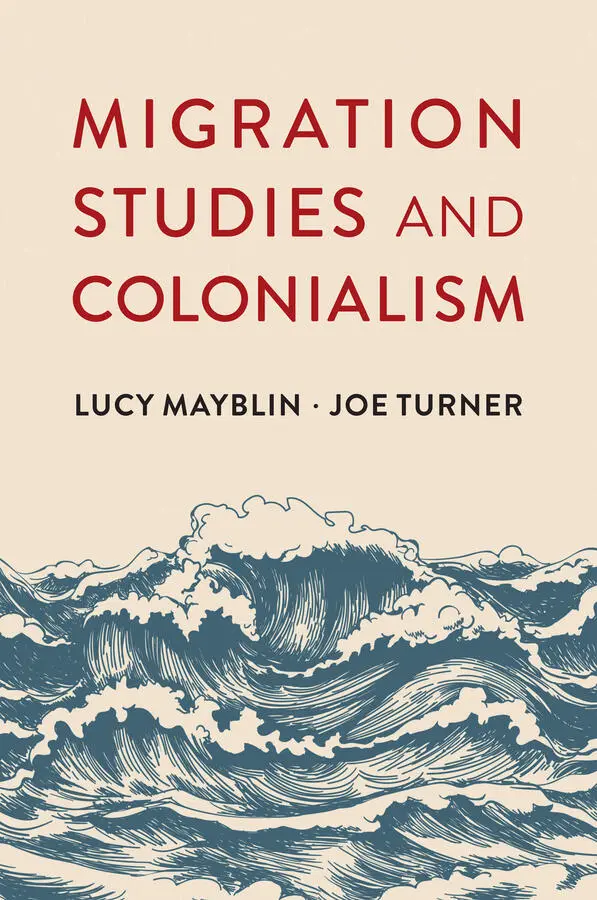
- Название:Migration Studies and Colonialism
- Автор:
- Жанр:
- Год:неизвестен
- ISBN:нет данных
- Рейтинг книги:5 / 5. Голосов: 1
-
Избранное:Добавить в избранное
- Отзывы:
-
Ваша оценка:
Migration Studies and Colonialism: краткое содержание, описание и аннотация
Предлагаем к чтению аннотацию, описание, краткое содержание или предисловие (зависит от того, что написал сам автор книги «Migration Studies and Colonialism»). Если вы не нашли необходимую информацию о книге — напишите в комментариях, мы постараемся отыскать её.
This book starts from the premise that colonial histories should be central to migration studies and explores what it would mean to really take that seriously. To engage with this task, Lucy Mayblin and Joe Turner argue that scholars need not forge new theories but must learn from and be inspired by the wealth of literature that already exists across the world. Providing a range of inspiring and challenging perspectives on migration, the authors’ aim is to demonstrate what paying attention to colonialism, through using the tools offered by postcolonial, decolonial and related scholarship, can offer those studying international migration today.
Offering a vital intervention in the field, this important book asks scholars and students of migration to explore the histories and continuities of colonialism in order to better understand the present.
Migration Studies and Colonialism — читать онлайн ознакомительный отрывок
Ниже представлен текст книги, разбитый по страницам. Система сохранения места последней прочитанной страницы, позволяет с удобством читать онлайн бесплатно книгу «Migration Studies and Colonialism», без необходимости каждый раз заново искать на чём Вы остановились. Поставьте закладку, и сможете в любой момент перейти на страницу, на которой закончили чтение.
Интервал:
Закладка:
There have been challenges to this perspective in recent years which must be acknowledged here. The most well-known intervention has been from Eve Tuck and K. Wayne Yang (2012), who are interested in decolonization in the field of education studies within the context of settler colonialism. Their point is that in settler-colonial states such as Canada, decolonization should always refer to the relinquishing of stolen land to indigenous peoples, and that ‘until stolen land is relinquished, critical consciousness does not translate into action that disrupts settler colonialism’. They argue that:
curricula, literature, and pedagogy can be crafted to aid people in learning to see settler colonialism, to articulate critiques of settler epistemology, and set aside settler histories and values in search of ethics that reject domination and exploitation; this is not unimportant work. However, the front-loading of critical consciousness building can waylay decolonization, even though the experience of teaching and learning to be critical of settler colonialism can be so powerful it can feel like it is indeed making change. (Tuck and Yang 2012: 19)
When they write about decolonization, then, they ‘are not offering it as a metaphor’ or ‘an approximation of other experiences of oppression’. Decolonization, for Tuck and Yang, ‘is not a swappable term for other things we want to do to improve our societies and schools. Decolonization doesn’t have a synonym’ (2012: 3). University-based intellectual and pedagogic activities are, for Tuck and Yang, ‘white moves to innocence’, which allow settlers to feel better about the horrors of settler colonialism without actually doing anything practical to change it since to do so would involve (at a minimum) a loss of privilege.
This is an important intervention and decolonization of intellectual thought should not be simply another ‘move to innocence’ which assuages ‘white guilt’. We need to sit with the discomforts which their intervention may give rise to and take them seriously in approaching our own work. Building critical consciousness should always, necessarily, lead to action in the contexts and varying positions of power that we occupy. Nevertheless, we concur with Bhambra, Gebrial and Nişancıoğlu (2018) in that we do not take the position that struggles against colonialism are only about settler-colonial dispossessions of land. Colonialism was/is not only a series of settler projects, it also entailed slavery and slave trading, commercial imperialism and direct rule (to name but three examples). It was furthermore accompanied by a whole host of legitimating intellectual projects, in which many universities in former metropoles played a central role, as ‘Rhodes Must Fall’ so aptly demonstrates. With Bhambra and colleagues, we take colonialism as a global project and acknowledge the role of universities, academic knowledge and disciplines as key sites through which colonialism – its moral justifications, racial theories and Orientalist imaginaries – was produced. These different projects require different, but related, responses in different contexts. We take this position, undoubtedly, as a consequence of our location in the British context and acknowledge that any blind spots on the specificity and structures of settler colonialism may be a consequence of this position.
But we also do not subscribe to the idea that all intellectual work to reveal systems of colonial knowledge should be viewed as moves towards (white) innocence (although this remains an active risk that we should be reflexive about). This is in part because intellectual work should never be the only work that we do, but also because knowledge production has long been an important part of colonizing and decolonizing work; thinking and acting are interconnected. What is of particular concern to us as scholars interested in migration is the extent to which colonial perspectives in many ways continue to dominate scholarly output and teaching in the contemporary period, as the ‘Why Is My Curriculum White’ and other projects of ‘decolonizing the university’ have so clearly shown. While this book engages with some theoretical work which challenges migration studies as it is currently articulated in the Global North, then, the perspectives discussed are not simply ‘add-ons’ to be included while the core stays the same. Instead, taking such interventions seriously upends much of what we think we know about migration.
But bearing in mind Tuck and Yang’s (2012) intervention, it is important also to state again that the intellectual sphere cannot and should not be the only sphere in which we seek to enact change. We may observe, therefore, that migration studies has tended as it has emerged to be a predominantly ‘white’ field and this may not be unrelated to the fact that the colonial past and its legacies and continuities, including a focus on race, have not been central to migration studies projects, textbooks or the agendas of research centres. Those who have provided answers to the question what would it mean to make colonialism central to how we understand migration are rarely self-declared ‘migration scholars’. We need, then, to reflect on (and act to change) structural hierarchies in higher education which are themselves connected to the legacies of colonialism, as other critics of the project have argued, at the same time as thinking about our intellectual commitments. This will include recognizing structural racisms – racial and ethnic inequalities (and silences and absences) in terms of student attainment and staff appointments and promotions. It is also to recognize that as migration studies has a historical relationship to policy making, the type of knowledge produced by scholars and taught to students does shape (if not often in a direct way) material conditions and policies. Challenging the intellectual foundations of the field is always part of broader struggles which are not always, or only, ‘academic’.
Sitting with the unease and tension around calls to decolonize which Tuck and Yang articulate, we have decided to not call this book ‘decolonizing migration studies’. However, we see this work as connecting with activities encapsulated in decolonizing agendas within ‘the university’ as an institution, a site of power relations and a place for the validation of knowledge claims. We also need to recognize our privilege within the existing systems of power and political economy which made the writing of this book possible. We are both white ‘cis’-gender scholars, with relatively secure positions in elite institutions, and this has shaped our ability to write this book, perhaps over other people systematically marginalized within, or excluded from, the academy. This is important to acknowledge. But challenging the colonial and racialized systems of academic knowledge (in this case on migration) is not simply a job for people of colour. Nor should centring colonialism be a niche research interest; it is a fundamental reorientation which is often/always contested, incomplete and imperfect, a work in progress and everyone’s responsibility. With this in mind, we hope this book will form part of broader conversations, challenges and critiques which we openly welcome and encourage.
Does migration studies need to think about colonialism?
As the discussion above indicated, ‘decolonizing’ is a highly contested agenda. But the idea that colonialism should be an important part of how we make sense of the present is, surely, less contentious, particularly in contexts where it has been elided. Recent years have seen a growing number of scholars arguing for greater acknowledgement of colonial histories and their legacies for contemporary migration issues. For example, Mains et al. (2013: 132) observe that ‘despite the material links between colonialism, postcolonialism and migration, social scientists in general have been slow to address this intersection’ (see also McIlwaine 2008, cited in Mains et al. 2013). Tudor (2018) and De Genova (2018) specifically articulate this lack of attention in terms of a neglect of postcolonial racism and racialization, and observe that there is a strong sense in the field that to speak of racism is either to be racist, or (relatedly) that such observations are (or should be) the exclusive interest of scholars of colour (see also El-Tayeb 2011; Boulila 2019; Grosfoguel, Oso and Christou 2015; Michel 2015; Walia 2014). Rivera-Salgado (1999) noted twenty years ago that race and ethnicity are ‘frequently either ignored or treated as a consequence of migration flows and considered to be a problem “here” not “there”’, but this pattern has not significantly shifted. Certainly any increased recognition of ethnicity rarely also then understands ideas of racial or ethnic difference to be rooted in long-standing practices and processes of colonialism (see Hall 1978 for more on this).
Читать дальшеИнтервал:
Закладка:
Похожие книги на «Migration Studies and Colonialism»
Представляем Вашему вниманию похожие книги на «Migration Studies and Colonialism» списком для выбора. Мы отобрали схожую по названию и смыслу литературу в надежде предоставить читателям больше вариантов отыскать новые, интересные, ещё непрочитанные произведения.








Обсуждение, отзывы о книге «Migration Studies and Colonialism» и просто собственные мнения читателей. Оставьте ваши комментарии, напишите, что Вы думаете о произведении, его смысле или главных героях. Укажите что конкретно понравилось, а что нет, и почему Вы так считаете.