Lucy Mayblin - Migration Studies and Colonialism
Здесь есть возможность читать онлайн «Lucy Mayblin - Migration Studies and Colonialism» — ознакомительный отрывок электронной книги совершенно бесплатно, а после прочтения отрывка купить полную версию. В некоторых случаях можно слушать аудио, скачать через торрент в формате fb2 и присутствует краткое содержание. Жанр: unrecognised, на английском языке. Описание произведения, (предисловие) а так же отзывы посетителей доступны на портале библиотеки ЛибКат.
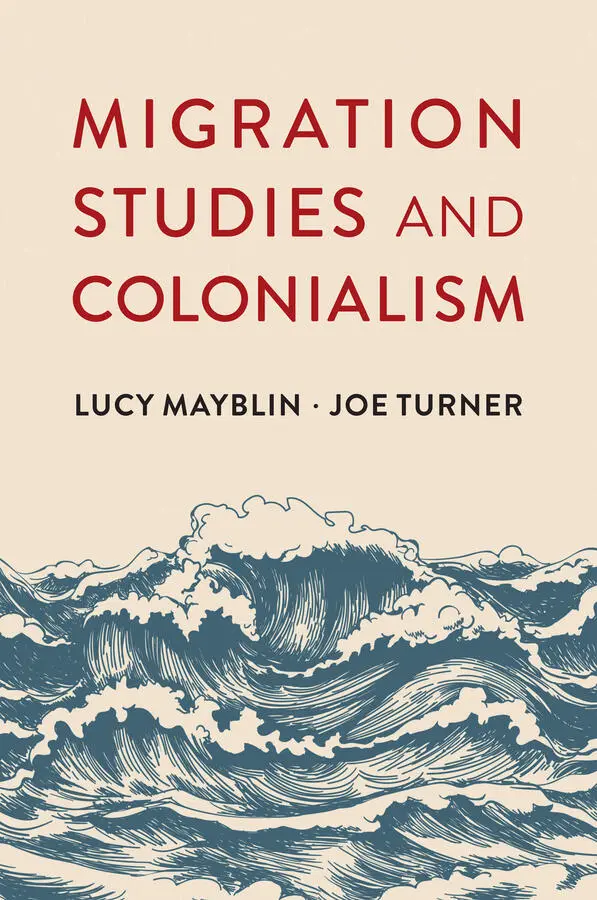
- Название:Migration Studies and Colonialism
- Автор:
- Жанр:
- Год:неизвестен
- ISBN:нет данных
- Рейтинг книги:5 / 5. Голосов: 1
-
Избранное:Добавить в избранное
- Отзывы:
-
Ваша оценка:
Migration Studies and Colonialism: краткое содержание, описание и аннотация
Предлагаем к чтению аннотацию, описание, краткое содержание или предисловие (зависит от того, что написал сам автор книги «Migration Studies and Colonialism»). Если вы не нашли необходимую информацию о книге — напишите в комментариях, мы постараемся отыскать её.
This book starts from the premise that colonial histories should be central to migration studies and explores what it would mean to really take that seriously. To engage with this task, Lucy Mayblin and Joe Turner argue that scholars need not forge new theories but must learn from and be inspired by the wealth of literature that already exists across the world. Providing a range of inspiring and challenging perspectives on migration, the authors’ aim is to demonstrate what paying attention to colonialism, through using the tools offered by postcolonial, decolonial and related scholarship, can offer those studying international migration today.
Offering a vital intervention in the field, this important book asks scholars and students of migration to explore the histories and continuities of colonialism in order to better understand the present.
Migration Studies and Colonialism — читать онлайн ознакомительный отрывок
Ниже представлен текст книги, разбитый по страницам. Система сохранения места последней прочитанной страницы, позволяет с удобством читать онлайн бесплатно книгу «Migration Studies and Colonialism», без необходимости каждый раз заново искать на чём Вы остановились. Поставьте закладку, и сможете в любой момент перейти на страницу, на которой закончили чтение.
Интервал:
Закладка:
While literatures already exist which should make ignoring colonialism seem like a bizarre and naive omission, these literatures seem still to be inaccessible, or unimportant, to many. This book seeks to showcase some of this work for people who research migration and yet never encounter such perspectives. If you are well versed in these debates, the issues that we discuss will doubtless seem obvious. Indeed, we are ‘white’ academics working in British higher education institutions and for this reason our perspectives are of course particular and limited, and undoubtedly readers will spot omissions and parochialisms throughout the book. Whilst we have sought to frame our discussion of the literature and examples in a global manner, we still broadly rely upon the legacy of intellectual projects from the Americas (North and South), with engagements from scholars from Asian and African traditions. For those not familiar with these literatures, we hope that this book will raise questions such as how broadly postcolonial and decolonial perspectives might change the kinds of research questions that we ask in migration studies, as well as the ways in which we analyse our data. Do such perspectives allow us to frame our research in terms that accord with the interests of policy makers? No. Are such perspectives policy friendly in the current terms of debate on migration? Rarely. If, and how, these perspectives can therefore be used in challenging migration policy, as most critical work hopes to do, is a topic for contemplation in the coming years. This volume, we hope, will spark discussion as part of what some have termed the ‘postcolonial turn’ in migration studies (Koh 2015; Tudor 2018). Our aim is not that you cite this book, but that in the future you cite some of the scholars discussed within it.
The growing call to ‘decolonize’ the social sciences
Recent years have seen the intensification and spread of calls to ‘decolonize the university’ and it would not be appropriate to write a book on the theme of migration studies and colonialism without discussing this agenda. While ‘decolonizing’ is a highly contested issue, the content and praxis of which is unresolved, at its heart is an agreement that we put colonialism and its legacies and continuities at the heart of our understanding of the contemporary world (Bhambra, Gebrial and Nişancıoğlu 2018; Ndlovu-Gatsheni and Zondi 2016). Academia is an important site of knowledge production and, as Dalia Gebrial argues, ‘consecration’. She goes on:
It has the power to decide which histories, knowledges and intellectual contributions are considered valuable and worthy of further critical attention and dissemination. This has knock-on effects: public discourse might seem far from the academy’s sphere of influence, but ‘common sense’ ideas worthy of knowledge do not come out of the blue, or removed from the context of power – and the university is a key shaping force in the discursive flux. (Gebrial 2018: 22)
Decolonization in this context includes, but is not limited to, renewed questioning, or uncovering, of the colonial origins of some of the core concepts of the social sciences (e.g. ‘modernity’, ‘development’, ‘capitalism’, ‘human rights’, ‘demography’); a focus on the Eurocentrism inherent to much social science research; and a critique of the ways in which contemporary research (and teaching) practices sometimes/often (depending on the field) reproduce colonial power relations.
There are disparate political and intellectual projects that all coalesce around these themes. The political projects have largely been student led and have particularly centred on ‘addressing issues of racial exclusion and racialized hierarchy within the university, including its teaching and research practices’ (Bhambra 2019: 1). ‘Rhodes Must Fall’ is widely seen as triggering a wider global movement. This campaign, based at the University of Cape Town in South Africa, centred in part around a campaign in 2015 to have a bronze statue of Cecil Rhodes removed from a prominent location on campus (Gebrial 2018; Nyamnjoh 2016). Cecil Rhodes was a wealthy British businessman and politician, who was prime minister of the Cape Colony in the late 1800s, founded the colony of Rhodesia (now Zimbabwe and parts of Zambia) and was an ardent white supremacist who laid the legal groundwork for apartheid. Challenging his reification on campus was, for the students studying there, urgent and necessary in the post-apartheid context. ‘Rhodes Must Fall’ Cape Town drew the attention of students at the University of Oxford in the United Kingdom. They too had a statue of Rhodes on campus and, as part of a much broader agenda of drawing attention to the colonial entanglements of the university, they campaigned for its removal (Gebrial 2018; Rhodes Must Fall Movement 2018). Of course, this is set within the context of a long history of anti-colonial movements in South Africa but also globally.
These explicitly de- and anti-colonial protest movements have been linked to other campus-based protests such as those against caste privilege at Hyderabad and Jawaharlal Nehru Universities in India, and Black Lives Matter on campuses in the United States, United Kingdom and elsewhere (Bhambra, Gebrial and Nişancıoğlu 2018). Related to these disparate events is the broad-based campaign ‘Why Is My Curriculum White?’. This student-led movement, often headed by students of colour, asks that teachers in higher education take a look at their reading lists and consider whether there are any scholars of colour on them at all. Where there are scholars of colour on reading lists, how many of them are present to offer core theory, as opposed to place-specific case studies? How many courses address questions of race, racism, colonialism or its ongoing legacies? These questions are most poignant when the courses under consideration cover topics such as international development or international migration. ‘Why Is My Curriculum White?’ is a challenge: it should not be possible to teach a course on international development without putting colonialism and neo-colonialism centre stage, and the First World should not be the source of every theoretical perspective relating to the topic of poverty in the Third World. For us, the same is true for migration studies: it should not be possible to teach a course on migration without mentioning colonialism or having any discussion of ‘race’ and racism, and the First World should not be the source of every theoretical perspective relating to the topic of migration globally. The point is not necessarily to stop teaching Marx, Foucault, Agamben or Carens, it is to also make sure that you are teaching Fanon, Quijano, Wynter and Spivak alongside them, while also asking how colonialism frames the work of all of these scholars.
In light of the debates sketched out above, what does it mean to ‘decolonize’ a field of scholarship? Is such a task even meaningful or is it just paying lip service to a live political issue which is having a fashionable moment and tokenistically mentioning it while carrying on as normal? For Gurminder K. Bhambra, Dalia Gebrial and Kerem Nişancıoğlu, decolonizing in the university context involves the following activities:
it is a way of thinking about the world which takes colonialism, empire and racism as its empirical and discursive objects of study; it resituates these phenomena as key shaping forces of the contemporary world, in a context where their role has been systematically effaced from view … [then] it purports to offer alternative ways of thinking about the world and alternative forms of political praxis. (Bhambra, Gebrial and Nişancıoğlu 2018: 3)
This definition places emphasis on epistemology and on the underlying Eurocentric frameworks which cut across a lot of research that is undertaken in universities around the world (see also Alatas 2006; Amin 1988; Mignolo 2011a). It focuses on academic knowledge production and particularly on the sanctioned erasure of histories of colonialism and ongoing anti-colonial struggles from many (most) fields of study. It furthermore argues that the ways that we think about the world can lead to political praxis which seeks to change it.
Читать дальшеИнтервал:
Закладка:
Похожие книги на «Migration Studies and Colonialism»
Представляем Вашему вниманию похожие книги на «Migration Studies and Colonialism» списком для выбора. Мы отобрали схожую по названию и смыслу литературу в надежде предоставить читателям больше вариантов отыскать новые, интересные, ещё непрочитанные произведения.








Обсуждение, отзывы о книге «Migration Studies and Colonialism» и просто собственные мнения читателей. Оставьте ваши комментарии, напишите, что Вы думаете о произведении, его смысле или главных героях. Укажите что конкретно понравилось, а что нет, и почему Вы так считаете.