Bioethics
Здесь есть возможность читать онлайн «Bioethics» — ознакомительный отрывок электронной книги совершенно бесплатно, а после прочтения отрывка купить полную версию. В некоторых случаях можно слушать аудио, скачать через торрент в формате fb2 и присутствует краткое содержание. Жанр: unrecognised, на английском языке. Описание произведения, (предисловие) а так же отзывы посетителей доступны на портале библиотеки ЛибКат.
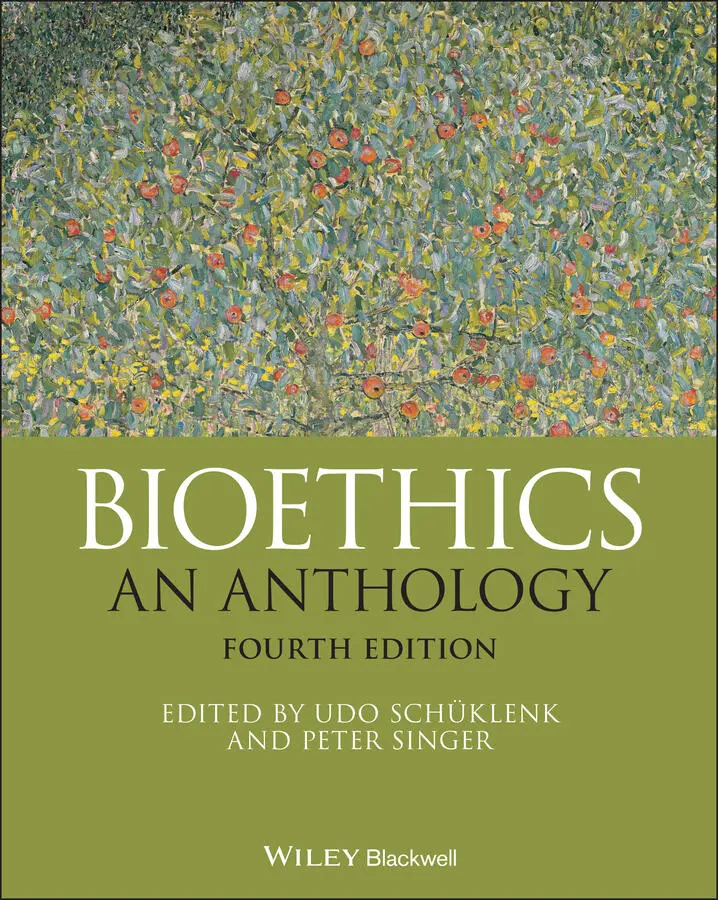
- Название:Bioethics
- Автор:
- Жанр:
- Год:неизвестен
- ISBN:нет данных
- Рейтинг книги:4 / 5. Голосов: 1
-
Избранное:Добавить в избранное
- Отзывы:
-
Ваша оценка:
Bioethics: краткое содержание, описание и аннотация
Предлагаем к чтению аннотацию, описание, краткое содержание или предисловие (зависит от того, что написал сам автор книги «Bioethics»). Если вы не нашли необходимую информацию о книге — напишите в комментариях, мы постараемся отыскать её.
For more than two decades,
has been widely regarded as the definitive single-volume compendium of seminal readings on both traditional and cutting-edge ethical issues in biology and medicine. Acclaimed for its scope and depth of coverage, this landmark work brings together compelling writings by internationally-renowned bioethicist to help readers develop a thorough understanding of the central ideas, critical issues, and current debate in the field.
Now fully revised and updated, the fourth edition contains a wealth of new content on ethical questions and controversies related to the COVID-19 pandemic, advances in CRISPR gene editing technology, physician-assisted death, public health and vaccinations, transgender children, medical aid in dying, the morality of ending the lives of newborns, and much more. Throughout the new edition, carefully selected essays explore a wide range of topics and offer diverse perspectives that underscore the interdisciplinary nature of bioethical study. Edited by two of the field’s most respected scholars, Covers an unparalleled range of thematically-organized topics in a single volume Discusses recent high-profile cases, debates, and ethical issues Features three brand-new sections: Conscientious Objection, Academic Freedom and Research, and Disability Contains new essays on topics such as brain death, life and death decisions for the critically ill, experiments on humans and animals, neuroethics, and the use of drugs to ease the pain of unrequited love Includes a detailed index that allows the reader to easily find terms and topics of interest
remains a must-have resource for all students, lecturers, and researchers studying the ethical implications of the health-related life sciences, and an invaluable reference for doctors, nurses, and other professionals working in health care and the biomedical sciences.
Bioethics — читать онлайн ознакомительный отрывок
Ниже представлен текст книги, разбитый по страницам. Система сохранения места последней прочитанной страницы, позволяет с удобством читать онлайн бесплатно книгу «Bioethics», без необходимости каждый раз заново искать на чём Вы остановились. Поставьте закладку, и сможете в любой момент перейти на страницу, на которой закончили чтение.
Интервал:
Закладка:
Nozick recognizes that there may be cases of this sort. He considers the case of avoiding a sexual imbalance and says that ‘a government could require that genetic manipulation be carried on so as to fit a certain ratio’. 8 He clearly prefers to avoid governmental intervention of this kind, and, while admitting that the desired result would be harder to obtain in a purely libertarian system, suggests possible strategies for doing so. He says: ‘Either parents would subscribe to an information service monitoring the recent births and so know which sex was in shorter supply (and hence would be more in demand in later life), thus adjusting their activities, or interested individuals would contribute to a charity that offers bonuses to maintain the ratios, or the ratio would leave 1:1, with new family and social patterns developing.’ The proposals for avoiding the sexual imbalance without central regulation are not reassuring. Information about likely prospects for marriage or sexual partnership might not be decisive for parents’ choices. And, since those most likely to be ‘interested individuals’ would be in the age group being genetically engineered, it is not clear that the charity would be given donations adequate for its job. 9
If the libertarian methods failed, we would have the choice between allowing a sexual imbalance or imposing some system of social regulation. Those who dislike central decisions favouring one sort of person over others might accept regulation here, on the grounds that neither sex is being given preference: the aim is rough equality of numbers.
But what about the other sort of case, where the working of the genetic supermarket leads to a general change unwelcome to those who contribute to it? Can we defend regulation to prevent a shift towards a more selfish and competitive population as merely being the preservation of a certain ratio between characteristics? Or have we crossed the boundary, and allowed a centralized decision favouring some characteristics over others? The location of the boundary is obscure. One view would be that the sex‐ratio case is acceptable because the desired ratio is equality of numbers. On another view, the acceptability derives from the fact that the present ratio is to be preserved. (In this second view, preserving altruism would be acceptable, so long as no attempt was made to raise the proportion of altruistic people in the population. But is this boundary an easy one to defend?)
If positive genetic engineering does become a reality, we may be unable to avoid some of the decisions being taken at a social level. Or rather, we could avoid this, but only at what seems an unacceptable cost, either to the particular people being designed, or to their generation as a whole. And, even if the social decisions are only restrictive, it is implausible to claim that they are all quite free of any taint of preference for some characteristics over others. But, although this suggests that we should not be doctrinaire in our support of the liberal view, it does not show that the view has to be abandoned altogether. We may still think that social decisions in favour of one type of person rather than another should be few, even if the consequences of excluding them altogether are unacceptable. A genetic supermarket, modified by some central regulation, may still be better than a system of purely central decisions. The liberal value is not obliterated because it may sometimes be compromised for the sake of other things we care about.
A Mixed System
The genetic supermarket provides a partial answer to the objection about the limited outlook of those who would take the decisions. The choices need not be concentrated in the hands of a small number of people. The genetic supermarket should not operate in a completely unregulated way, and so some centralized decisions would have to be taken about the restrictions that should be imposed. One system that would answer many of the anxieties about centralized decision‐making would be to limit the power of the decision‐makers to one of veto. They would then only check departures from the natural genetic lottery, and so the power to bring about changes would not be given to them, but spread through the whole population of potential parents. Let us call this combination of parental initiative and central veto a ‘mixed system’. If positive genetic engineering does come about, we can imagine the argument between supporters of a mixed system and supporters of other decision‐making systems being central to the political theory of the twenty‐first century, parallel to the place occupied in the nineteenth and twentieth centuries by the debate over control of the economy. 10
My own sympathies are with the view that, if positive genetic engineering is introduced, this mixed system is in general likely to be the best one for taking decisions. I do not want to argue for an absolutely inviolable commitment to this, as it could be that some centralized decision for genetic change was the only way of securing a huge benefit or avoiding a great catastrophe. But, subject to this reservation, the dangers of concentrating the decision‐making create a strong presumption in favour of a mixed system rather than one in which initiatives come from the centre. And, if a mixed system was introduced, there would have to be a great deal of political argument over what kinds of restrictions on the supermarket should be imposed. Twenty‐first‐century elections may be about issues rather deeper than economics.
If this mixed system eliminates the anxiety about genetic changes being introduced by a few powerful people with limited horizons, there is a more general unease which it does not remove. May not the limitations of one generation of parents also prove disastrous? And, underlying this, is the problem of what values parents should appeal to in making their choices. How can we be confident that it is better for one sort of person to be born than another?
Values
The dangers of such decisions, even spread through all prospective parents, seem to me very real. We are swayed by fashion. We do not know the limitations of our own outlook. There are human qualities whose value we may not appreciate. A generation of parents might opt heavily for their children having physical or intellectual abilities and skills. We might leave out a sense of humour. Or we might not notice how important to us is some other quality, such as emotional warmth. So we might not be disturbed in advance by the possible impact of the genetic changes on such a quality. And, without really wanting to do so, we might stumble into producing people with a deep coldness. This possibility seems one of the worst imaginable. It is just one of the many horrors that could be blundered into by our lack of foresight in operating the mixed system. Because such disasters are a real danger, there is a case against positive genetic engineering, even when the changes do not result from centralized decisions. But this case, resting as it does on the risk of disaster, supports a principle of caution rather than a total ban. We have to ask the question whether there are benefits sufficiently great and sufficiently probable to outweigh the risks.
But perhaps the deepest resistance, even to a mixed system, is not based on risks, but on a more general problem about values. Could the parents ever be justified in choosing, according to some set of values, to create one sort of person rather than another?
Is it sometimes better for us to create one sort of person rather than another? We say ‘yes’ when it is a question of eliminating genetic defects. And we say ‘yes’ if we think that encouraging some qualities rather than others should be an aim of the upbringing and education we give our children. Any inclination to say ‘no’ in the context of positive genetic engineering must lay great stress on the two relevant boundaries. The positive–negative boundary is needed to mark off the supposedly unacceptable positive policies from the acceptable elimination of defects. And the genes–environment boundary is needed to mark off positive engineering from acceptable positive aims of educational policies. But it is not clear that confidence in the importance of these boundaries is justified.
Читать дальшеИнтервал:
Закладка:
Похожие книги на «Bioethics»
Представляем Вашему вниманию похожие книги на «Bioethics» списком для выбора. Мы отобрали схожую по названию и смыслу литературу в надежде предоставить читателям больше вариантов отыскать новые, интересные, ещё непрочитанные произведения.

Обсуждение, отзывы о книге «Bioethics» и просто собственные мнения читателей. Оставьте ваши комментарии, напишите, что Вы думаете о произведении, его смысле или главных героях. Укажите что конкретно понравилось, а что нет, и почему Вы так считаете.